

Two diamonds graded Fancy Intense Yellow, same carat, same clarity, can sit ten or twenty percent apart in price with both quotes being entirely legitimate. That gap is not a pricing error and it is not one supplier overcharging. It’s the colour grade doing less work than buyers assume it does — because “Fancy Intense Yellow” describes a band, not a point, and where a stone sits inside that band is exactly the kind of detail a report doesn’t spell out in a way most buyers know to read.
If you are sourcing yellow diamonds at trade level, understanding what actually drives value inside a colour grade — not just which grade a stone carries — is the difference between pricing confidently and guessing with a certificate in hand.
Why Yellow Diamonds Are Graded Differently to White
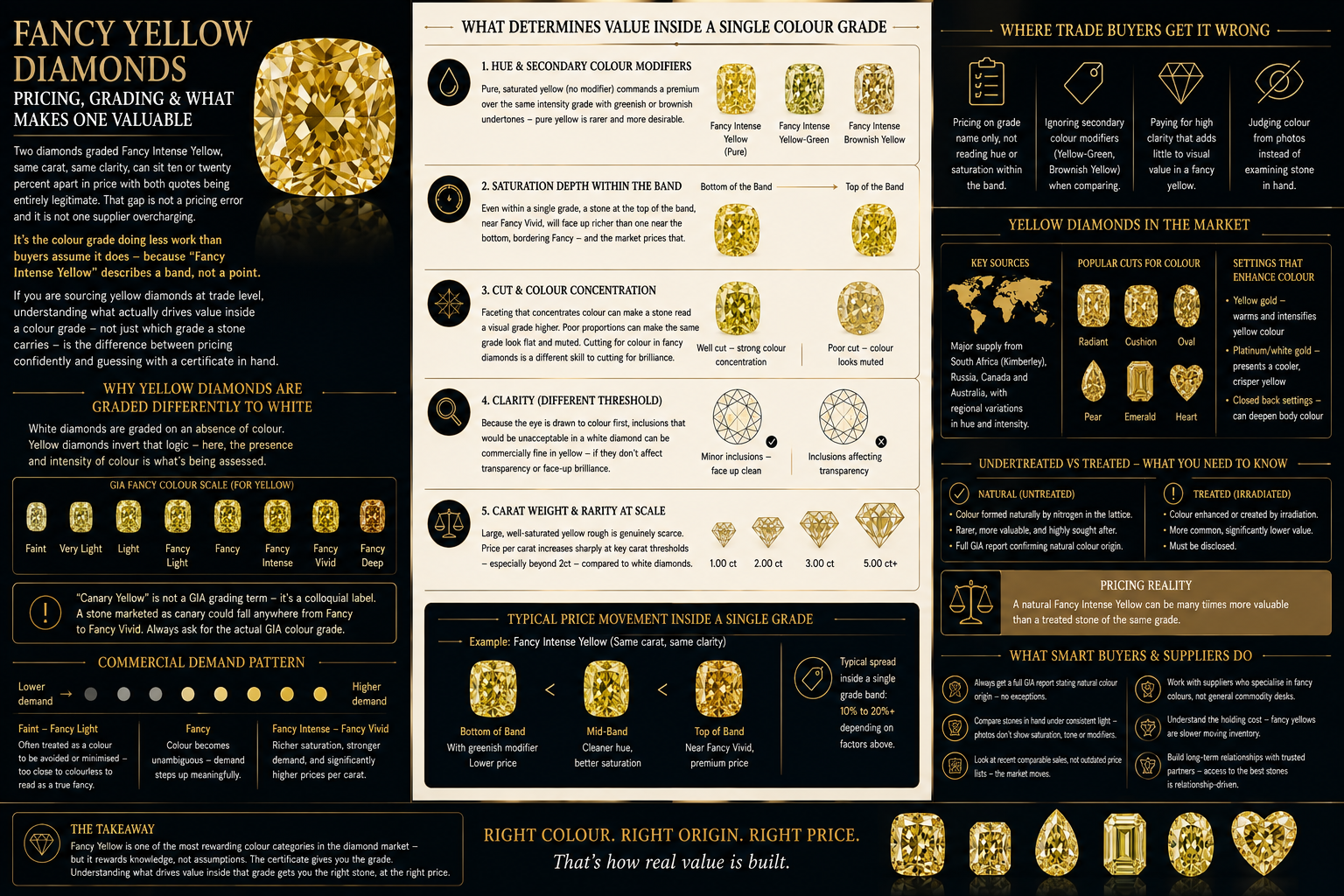
White diamonds are graded on an absence of colour — the closer to colourless, the higher the grade, the higher the price. Yellow diamonds invert that logic entirely. Here, the presence and intensity of colour is what’s being assessed, and GIA’s fancy colour scale runs from Faint, through Very Light, Light, Fancy Light, Fancy, Fancy Intense, Fancy Vivid, and Fancy Deep, with Fancy Vivid generally commanding the highest premium for its saturation.
This inversion is also why “canary yellow” — a term used loosely in retail and historically associated with vivid yellow stones — isn’t a GIA grading term at all. It’s a colloquial label, and a stone marketed as canary could fall anywhere from Fancy to Fancy Vivid depending on who’s using the term. Trade buyers should treat it as marketing language, not a grade, and ask for the actual GIA colour designation before pricing anything against it.
What buyers often miss is that yellow’s commercial desirability doesn’t increase in a straight line with grade. Fancy Light and Light yellows are frequently treated by cutters and retailers as a colour to be avoided or minimised — close enough to colourless to look like an off-white stone rather than a deliberate colour choice, but not intense enough to read as a true fancy colour diamond. Demand, and therefore price per carat, often steps up meaningfully at Fancy and again at Fancy Intense, where the colour becomes unambiguous.
What Determines Value Inside a Single Colour Grade
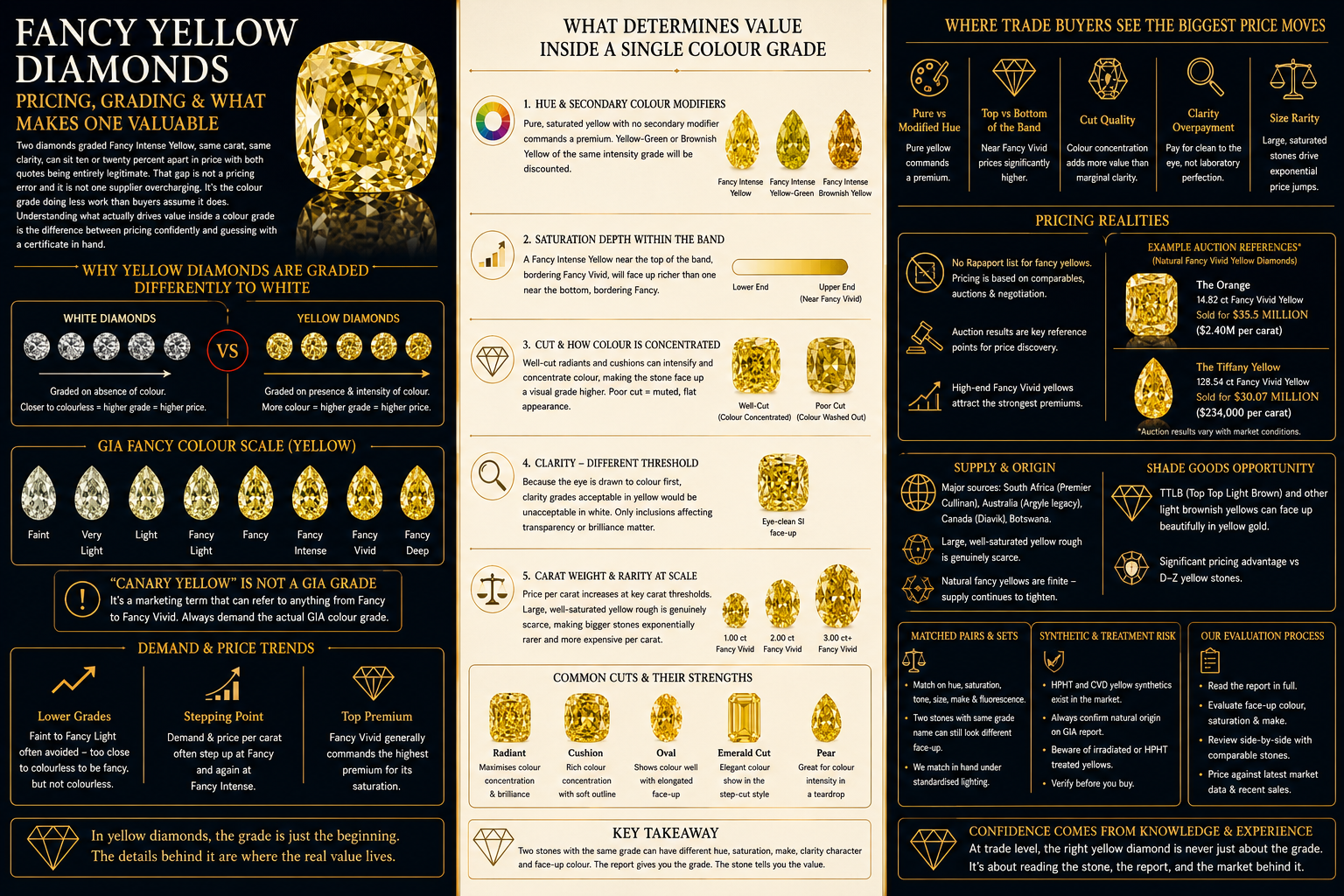
This is where most pricing confusion in yellow diamonds actually originates, because two stones can carry the identical GIA grade and still be priced apart for reasons that are entirely legitimate and entirely invisible if you’re only reading the headline grade.
Hue and secondary colour modifiers. GIA’s full colour notation for fancy diamonds includes the hue itself, plus any secondary modifying colours — a stone might be graded Fancy Intense Yellow, or Fancy Intense Yellow-Green, or Fancy Intense Brownish Yellow. A pure, saturated yellow with no secondary modifier commands a meaningful premium over the same intensity grade with a greenish or brownish undertone, because pure yellow is rarer and more commercially desirable. Buyers comparing two “Fancy Intense Yellow” stones without checking for secondary hue notation are comparing incompletely.
Saturation depth within the band. Even within a single named grade, GIA’s internal assessment allows for variation in exactly how saturated a stone reads. A Fancy Intense Yellow sitting toward the top of that band, bordering Fancy Vivid, will face up visibly richer than one sitting near the bottom, bordering Fancy — and the market prices that difference even though both carry the same grade name on the report.
Cut and how the stone concentrates colour. Yellow diamonds are frequently cut to maximise colour saturation rather than brilliance, which is a different cutting priority to colourless diamonds entirely. A radiant or cushion cut with the right facet structure can concentrate and intensify face-up colour, making a stone read a visual grade higher than its certificate states. A poorly proportioned stone in the same grade can face up muted and flat. This is a cutting skill specific to coloured diamonds, and it has a direct, sometimes substantial, effect on price that the grading report does not capture.
Clarity, with a different threshold than white diamonds. Because the eye is drawn to colour first in a fancy yellow, clarity grades that would be considered mediocre in a white diamond are frequently commercially acceptable in a yellow, provided inclusions don’t affect transparency or face-up brilliance. Buyers paying a premium for VVS clarity in a fancy yellow are often paying for a specification that adds little to the stone’s visual value — money better allocated toward a stronger hue or higher saturation.
Carat weight thresholds and rarity at scale. As with white diamonds, price per carat in fancy yellows increases at key carat thresholds, but the effect is sharper in fancy colours because large, well-saturated yellow rough is genuinely scarcer than large colourless rough. A 3-carat Fancy Vivid Yellow is disproportionately rarer, and disproportionately more expensive per carat, than a 1-carat stone of the same grade.
Color Diamonds Collections:
Natural Yellow Diamonds | Natural Pink Diamonds | Natural Blue Diamonds | Natural Green Diamonds | Natural Brown Diamonds | Natural Chameleon Diamonds | Natural Purple Diamonds | Natural Orange Diamonds | Natural Gray Diamonds
Diamond Shaped Collections:
Natural Round Brilliant Diamonds | Natural Pear Shaped Diamonds | Natural Oval Diamonds | Natural Marquise Diamonds | Natural Radiant Cut Diamonds | Natural Emerald Cut Diamonds | Natural Cushion Cut Diamonds
Where Trade Buyers Get the Pricing Wrong
The most common mistake is benchmarking a quote against a single grade name without checking hue notation, saturation position within the band, or cut quality — then assuming a lower quote on an apparently identical certificate is simply a better deal. Frequently it isn’t. It’s a stone sitting lower in the same grade band, carrying a secondary modifier, or cut to retain weight rather than colour, and the lower price reflects that accurately.
The opposite mistake is just as costly: paying a premium for clarity or symmetry specifications that don’t move the needle on a fancy yellow’s commercial value, while underweighting hue purity and saturation — the two factors that actually drive what a client sees and what the stone is worth on resale.
For matched pairs and layouts specifically, this gets harder still. Two Fancy Intense Yellow stones with identical certificates can display visibly different saturation and undertone side by side, which means colour matching for earrings or a graduated suite has to happen by physical comparison, not by certificate matching. A pair sourced on grade alone is a pair sourced on hope.
A Buyer’s Framework for Pricing Fancy Yellow Diamonds
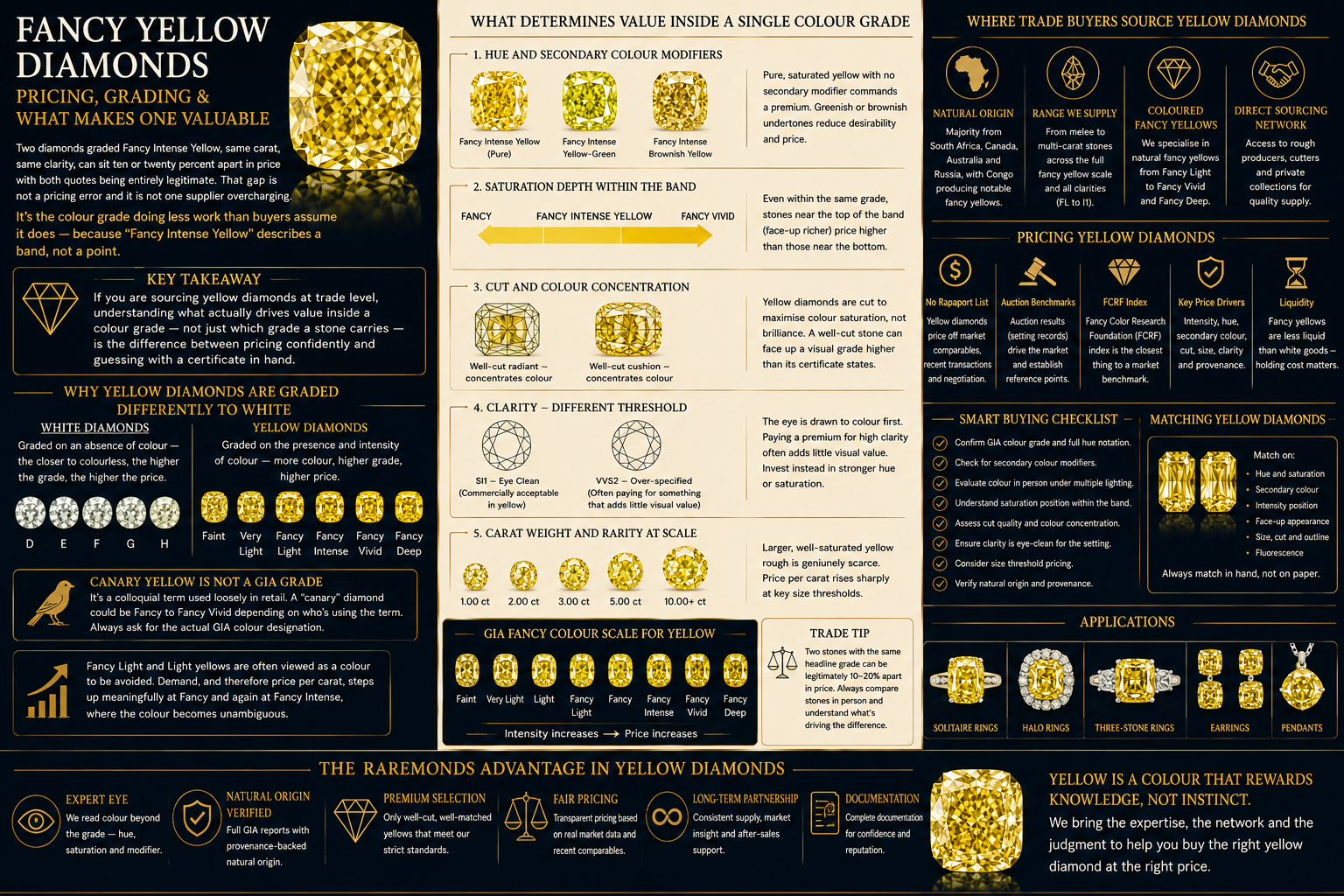
Before pricing or accepting a quote on a fancy yellow diamond, the questions worth asking are specific: What is the full colour notation, including any secondary hue modifier, not just the headline grade? Where does the saturation sit within that grade band — closer to the grade above or the grade below? How does the stone face up under daylight-equivalent lighting, not just under the directional light in a listing photo? Is the clarity grade commercially relevant to this stone’s appearance, or is it a specification being charged for that adds little visible value? And for pairs or layouts, has the colour been matched physically, stone to stone, under consistent light?
A supplier who can answer all of these specifically, with the stone in hand, is pricing on what the diamond actually is. A supplier quoting from a certificate number alone is pricing on a label.
The Raremonds Position on Fancy Yellow Diamonds
Raremonds evaluates fancy yellow diamonds beyond the grade printed on the certificate — assessing hue purity, saturation position within the colour band, cut performance, and genuine face-up appearance before a stone is priced or offered. This is where two generations of coloured diamond expertise pays off directly for trade buyers: we know when a Fancy grade is underpriced because it’s been cut to concentrate colour exceptionally well, and when a Fancy Intense quote is overpriced for a stone with a secondary brownish modifier that the certificate doesn’t headline.
For matched pairs and layouts in fancy yellow, every stone is compared physically against its partner — hue, saturation, and cut character — before being confirmed as a match, so colour consistency holds in the finished piece, not just on paper.
Frequently Asked Questions
What is the difference between Fancy Yellow and Fancy Intense Yellow in price?
The difference is substantial, not incremental. Fancy Intense Yellow displays noticeably richer, more saturated colour than Fancy Yellow, and market demand steps up meaningfully at that threshold. Price per carat for Fancy Intense Yellow typically commands a significant premium over Fancy Yellow of the same carat and clarity, reflecting both the visual difference and the relative rarity of stronger saturation.
Is “canary yellow” a real grading term?
No. Canary yellow is a colloquial, marketing term, not a GIA colour grade. Stones described as canary can fall anywhere across the fancy yellow spectrum depending on who’s using the term. Trade buyers should always request the actual GIA colour notation, including hue and any secondary modifiers, rather than pricing or comparing stones based on the word canary alone.
Why can two diamonds with the same colour grade be priced differently?
GIA’s fancy colour grades describe bands, not single points, and a stone’s saturation can sit anywhere within that band. Secondary hue modifiers — such as a greenish or brownish undertone — also affect desirability and price even within an identical headline grade. Cut quality further affects how saturated a stone appears face-up. Two stones graded identically can therefore be priced apart for entirely legitimate reasons tied to factors the certificate doesn’t headline.
Does clarity matter as much in fancy yellow diamonds as in white diamonds?
Generally, no. Because the eye is drawn primarily to colour in a fancy yellow diamond, clarity grades considered mediocre in a white diamond are frequently commercially acceptable in a yellow, as long as inclusions don’t affect transparency or brilliance. Buyers are often better served allocating budget toward stronger hue purity and saturation than toward higher clarity grades that add little visible value.
How should I price or match fancy yellow diamonds for a pair of earrings?
Matching should happen through physical, side-by-side comparison under consistent lighting, not by matching GIA certificate grades alone. Two stones with identical colour grades can display different secondary hues or saturation depth, which becomes immediately visible once they’re set side by side. Specify your colour matching requirement explicitly when sourcing a pair, and confirm the comparison has actually been done stone to stone.

.png)