

Of all the natural coloured diamonds we handle at Raremonds, pink generates the most enquiries and, by some distance, the most expensive mistakes. Every jeweller wants to work with pink. Clients ask for it by name, by mood, by a photograph of a stone on someone else’s hand. The demand is real, and it is deepening. But pink is also the most technically demanding and most expert-dependent colour in the entire trade — not in spite of how wanted it is, but partly because of it. When a colour becomes aspirational, the pressure to satisfy a brief with something “close enough” grows, and close enough is exactly where pink diamonds go wrong, and where real money is lost.
Two generations in the natural diamond trade have taught us that pink rewards discipline more than any colour we handle, and punishes shortcuts faster. This is a serious-money stone — among the most expensive things in the diamond world per carat, and increasingly bought as an asset as much as a gem. So this is a straight guide to what actually separates a confident pink purchase from a costly one, whether you’re sourcing for jewellery or for investment.
Why pink is the colour the market wants right now
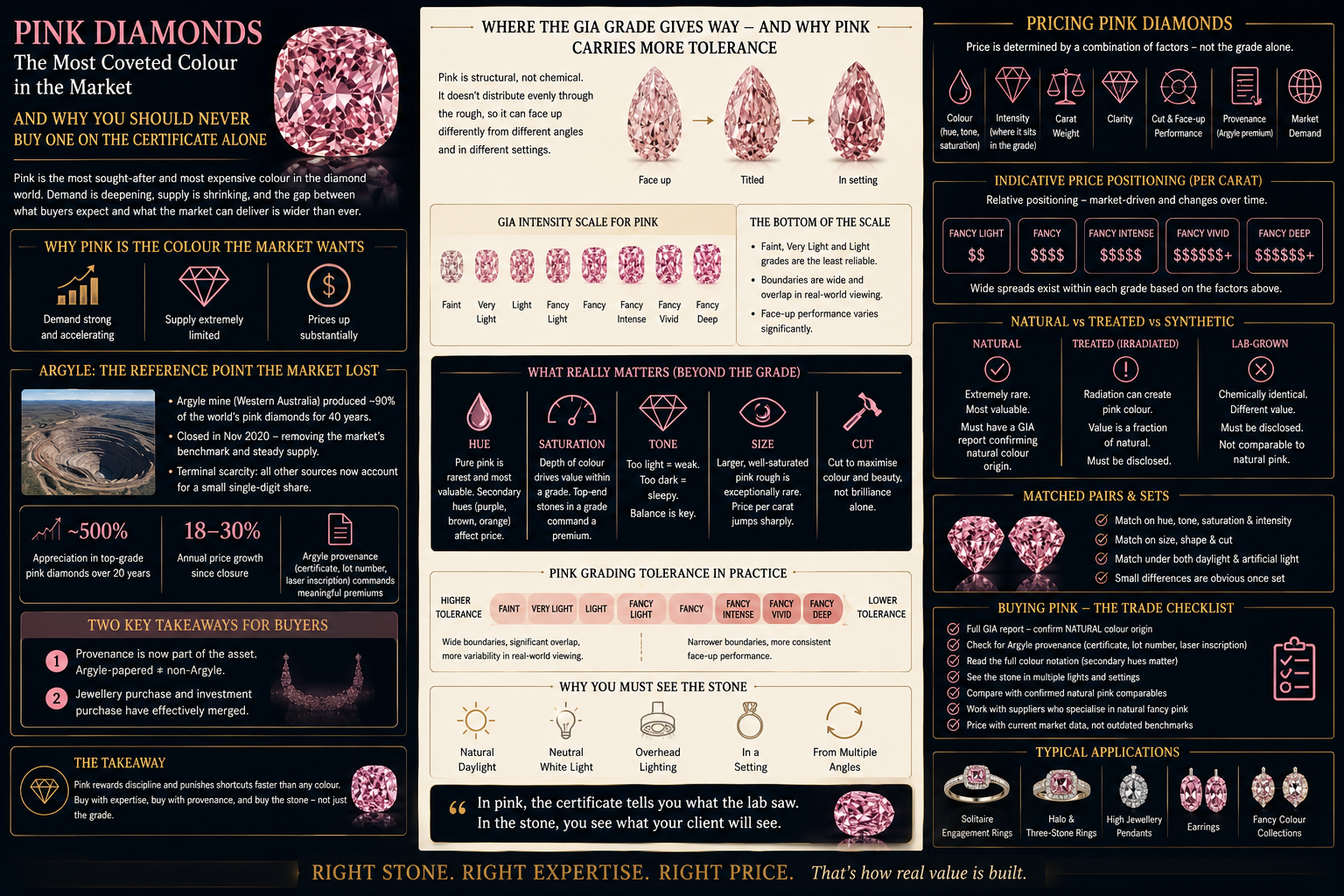
Pink demand has been climbing for years, but the supply side is what makes this moment unlike any other in the modern jewellery era — and that story runs entirely through one mine in Western Australia, which deserves its own treatment below. The short version is that genuine pink supply is tighter than it has ever been, prices for well-saturated stones have moved substantially, and the gap between what a buyer pictures when they say “pink” and what the market can actually deliver for a given budget has widened quietly but enormously. Any price comparable you remember from five years ago is almost certainly stale — in price, in availability, and in what counts as a realistic specification today.
Argyle: the reference point the market lost
For four decades, one mine produced roughly nine in every ten pink diamonds on earth — Rio Tinto’s Argyle mine, in the remote east Kimberley of Western Australia. Argyle pinks were distinctive: small, but intensely saturated, in a range of pinks, purplish pinks and salmon tones that simply weren’t coming out of the ground anywhere else. When Argyle closed in November 2020, it didn’t just reduce supply. It removed the benchmark the entire market had been pricing against, and replaced a steady trickle of new pink with a hard stop.
What’s left is what economists would call terminal scarcity — a supply that can only shrink. Every other source on earth combined now accounts for a small single-digit share of pink and red production. The market has responded accordingly. By widely cited industry and auction data, top-grade pink diamonds have appreciated on the order of 500% over twenty years, with annual gains accelerating to somewhere around 18–30% since the closure — outpacing gold, equities, fine art and classic cars over the same window. Stones carrying documented Argyle provenance — the original Argyle Pink Diamonds certificate, lot number and laser inscription — now command meaningful premiums over otherwise comparable non-Argyle stones.
For a trade buyer, two things follow. First, provenance is now part of the asset: an Argyle-papered stone and an identically graded non-Argyle stone are not the same product and shouldn’t be priced as one. Second, this is the colour where the line between a “jewellery purchase” and an “investment purchase” has effectively dissolved — and where getting the stone wrong is no longer an aesthetic disappointment but a financial one.
Where the GIA grade gives way — and why pink carries more tolerance
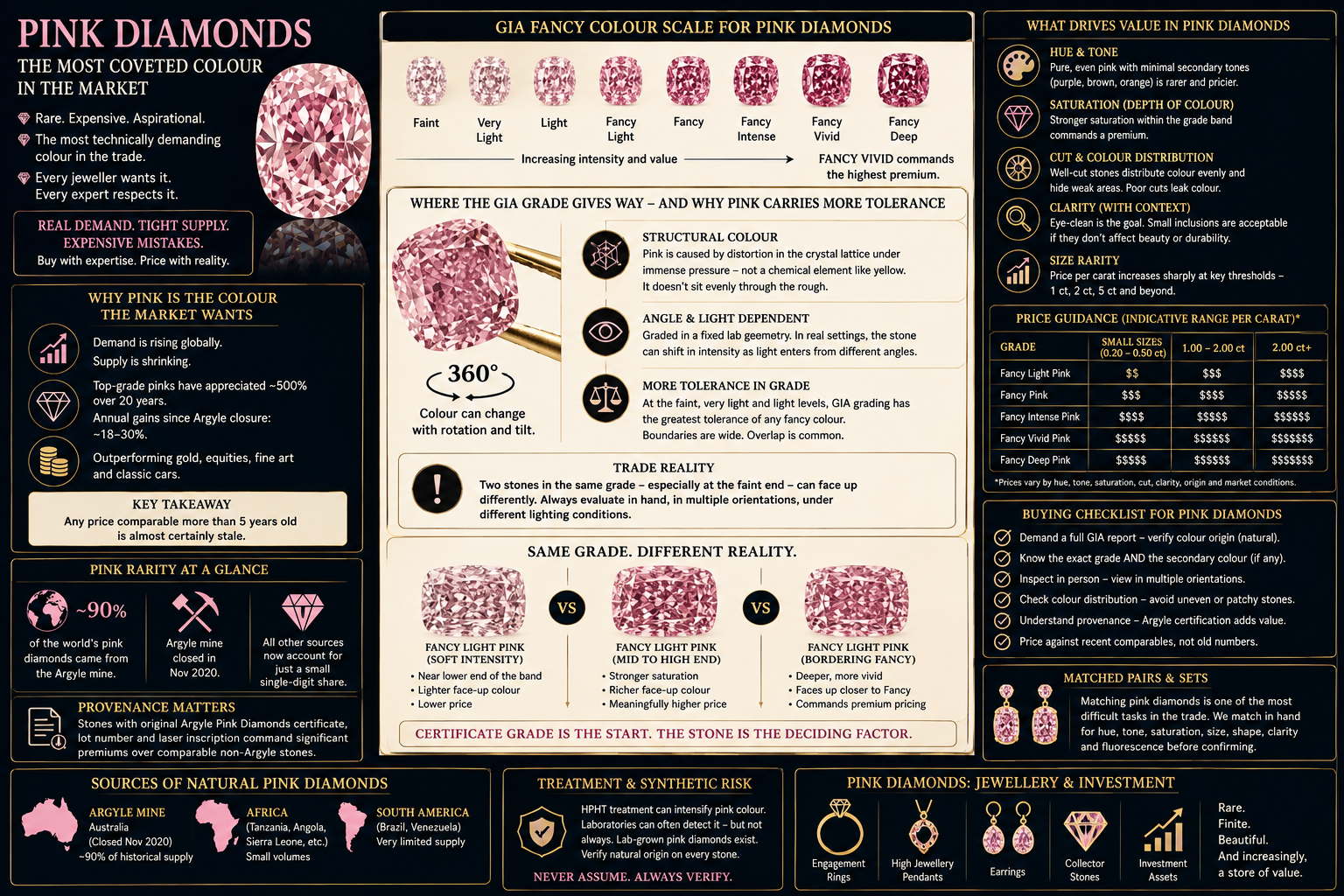
Pink is graded on the familiar GIA intensity scale — Faint, Very Light, Light, Fancy Light, Fancy, Fancy Intense, Fancy Vivid, Fancy Deep — and as far as it goes, that grading is consistent and trustworthy. But pink has a property that makes the grade less predictive of the actual stone than it is for almost any other colour, and it’s worth understanding precisely.
Pink isn’t a chemical colour the way yellow is. It’s structural — the result of distortion in the crystal lattice under immense pressure during formation — which means it doesn’t sit evenly through the rough the way nitrogen-caused yellow does. The practical consequence is that pink can face up noticeably differently from different angles: a stone read in one orientation under one light can shift when you rotate it, or move it into a setting that tilts it and changes how light enters. A grade is established against a fixed viewing geometry in a lab. How the stone behaves once it’s tilted in a real mount is a separate question the certificate was never built to answer.
This is also where I’ll say plainly something the trade tends to talk around: in pink, GIA grading carries more tolerance than buyers assume — and at the bottom of the scale it carries a great deal. The Faint, Very Light and Light pink grades are, in our experience, the least reliable in the entire fancy-colour system. The boundaries between them are fine, the colour is subtle enough that small differences in how a stone is viewed push it across a grade line, and two stones wearing the same low grade can look genuinely different in hand. Submit a borderline stone twice and you would not be surprised to see it come back differently. None of that makes GIA wrong — it makes pink hard, and it makes the lower grades close to meaningless as a buying signal on their own. At that end of the market especially, the grade tells you the stone is pink; it does not tell you which pink, or what it’s worth.
Color Diamonds Collections:
Natural Yellow Diamonds | Natural Pink Diamonds | Natural Blue Diamonds | Natural Green Diamonds | Natural Brown Diamonds | Natural Chameleon Diamonds | Natural Purple Diamonds | Natural Orange Diamonds | Natural Gray Diamonds
Diamond Shaped Collections:
Natural Round Brilliant Diamonds | Natural Pear Shaped Diamonds | Natural Oval Diamonds | Natural Marquise Diamonds | Natural Radiant Cut Diamonds | Natural Emerald Cut Diamonds | Natural Cushion Cut Diamonds
Overtones: where pink is actually won or lost
If pink buyers are caught out by one thing more than any other, it’s the secondary hue — and pink is the colour where the modifier does more commercial work than in any other fancy category.
A pure, straight pink with no secondary hue is the benchmark the market prices against, and at a given intensity it is generally the most valuable — and the rarest. The reality is that the large majority of stones graded “pink” carry a modifier, and that modifier changes the price, the market, and the setting the stone belongs in. The brown family alone spans a whole spectrum, from a faint brownish pink down to a pinkish brown that is technically a brown diamond carrying pink, and it anchors the value end of the market. Purple is the most desirable modifier: a purplish pink usually sits just below a pure pink of the same grade, though a vivid purplish pink can match or even exceed it at the very top. Orange reads as roughly neutral and flatters rose gold, while a brown or grey modifier discounts the stone. Throughout, though, intensity moves price far more than any modifier — the modifier shifts value within an intensity grade, not across the whole scale.
Here is the landscape at a glance, from entry tier to the most commercially premium:
| Pink type (modifier family) | Example GIA designations | Price vs pure pink (same intensity) | Demand notes |
| Pinkish brown / pink-brown (brown-dominant) | Pink-Brown, Pinkish Brown | Entry tier — technically brown diamonds carrying pink; the most affordable | Champagne / rosé tones; rose & yellow gold |
| Brownish pink / brown-pink (pink-dominant) | Brownish Pink, Brown-Pink | Below pure — the value tier (undervalued, in our view) | Warm; rose & yellow gold; emerging-collector demand |
| Grayish pink | Grayish Pink | Below pure; grey mutes the saturation | Value tier; limited commercial pull |
| Orangey / salmon pink | Orangey Pink, Orange-Pink | Modest discount; orange reads roughly neutral | Complements rose gold; more typical of non-Argyle origins |
| Purplish pink / purple-pink (pink-dominant) | Purplish Pink, Purple-Pink | Slight discount to pure — but the most desirable modifier; a vivid purplish pink can match or exceed pure | Highly sought by collectors; signature Argyle hue |
| Pink-purple / pinkish purple (purple-dominant) | Pink-Purple, Pinkish Purple | Rare and highly sought; generally just below an equal-intensity pure pink | High jewellery; collectors |
| Pure / straight pink | Fancy Light → Fancy → Fancy Intense → Fancy Vivid | The benchmark — generally the most valuable at a given intensity, and the rarest | Fine & high jewellery; collectors and investment — especially Fancy Pink and above |
The certificate names the modifier. It does not tell you what that modifier is worth, which market wants it, or which setting metal will make it sing rather than sulk — and in pink, that gap is where most of the value is decided.
Why we think brownish pink is the most undervalued pink in the market
I want to single out brownish pink, because the trade has, in my view, mispriced it. For years a brown modifier was treated as a straightforward demerit — a discount, a compromise. We see it very differently.
A well-cut Fancy Brownish Pink set in rose or yellow gold, where the metal lifts the warmth of the modifier, faces up as a genuinely beautiful, desirable pink — not a consolation prize. Put the same stone in platinum and the brown can read as muddiness; the difference is entirely in the pairing, which is exactly the kind of judgement a certificate can’t make for you. More to the point, the market maths is shifting. As straight and purplish pinks move further out of reach for all but the highest budgets post-Argyle, the warmth and accessibility of brownish pink — much of it Argyle-origin itself — looks less like the bottom of the pink market and more like the intelligent entry into it. We think it carries real upside, both as wearable jewellery and as a documented natural pink that is still attainable. It is one of the few corners of the pink market where you can still buy beautifully without paying the benchmark premium — provided you, or your dealer, can tell a warm, lively brownish pink from a flat, grey one.
Cut: the part that gets ignored
Pink is almost always cut to maximise face-up colour rather than brilliance, which is the correct priority for a colour stone but produces a different set of evaluation criteria than colourless cutting. A pink cut to concentrate colour through the table faces up richer and more saturated than a pink of the identical grade cut to hold weight from the rough. Both grade the same. Only one looks as valuable as the paper claims. A pink that faces up flat — colour sitting on the surface rather than radiating through the crown — has almost certainly been cut for weight retention, and its price should reflect that even when the grade doesn’t headline it. We weigh how the colour concentrates through the crown as heavily as the GIA notation, because that performance question is entirely separate from the grading one.
How pink is “enhanced” and sold in the Far East
There’s a part of the global pink market that rarely gets discussed openly, and trade buyers should understand it. Across the Far East — China, Hong Kong, Taiwan and Japan — faint, very light and light pinks are sold in enormous volume as pink jewellery, and a great deal of that apparent colour comes from the setting, not the stone. Rose gold mounts reflect warmth into a pale stone and lift its pink considerably; closed-back settings, and in some cases coloured foiling behind the stone, push the effect further still.
Used honestly and disclosed, rose-gold mounting is a perfectly legitimate way to flatter a pale pink, and it sells beautifully. The problem is the gap it creates: a faint pink that looks convincingly pink in a closed rose-gold setting can look almost colourless loose, and a buyer who only ever sees it set has no idea what they actually own. Closed backs and foiling specifically are treatments that must be disclosed, and aren’t always. This is one more reason — on top of all the others — that a pink should be evaluated loose, in a neutral environment, by someone who can tell you how much of the colour is the diamond and how much is the mount. We tell clients exactly which is which, every time.
Why you should never source pink on a certificate alone
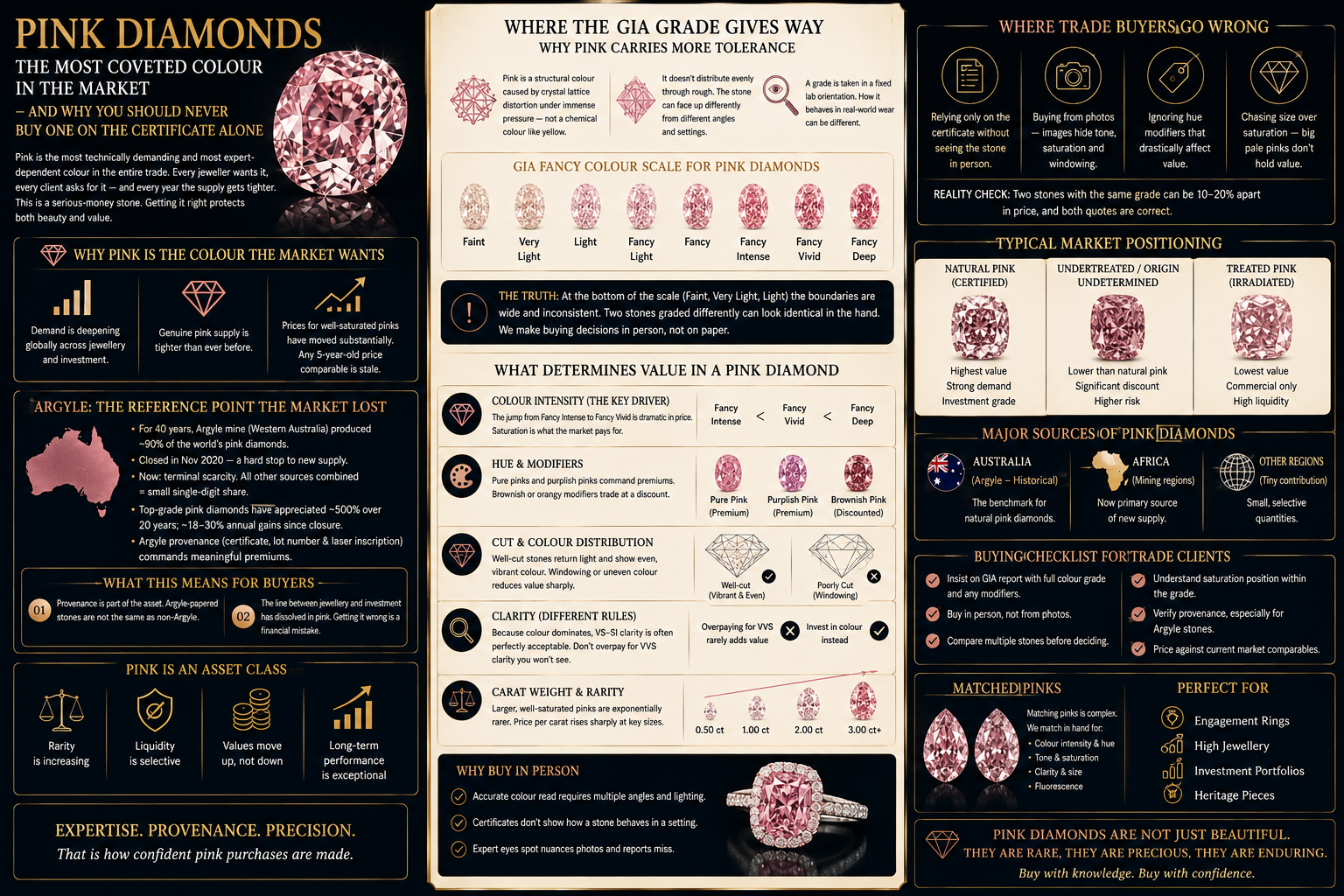
Let me be as direct as the subject deserves. A Fancy Intense Pink bought on its certificate alone, without the stone ever being evaluated in hand, exposes a brand or a buyer to real financial risk — not because the certificate is wrong, but because it was never designed to answer the questions that decide value at the point of sale.
Buying a pink diamond on the certificate alone is like choosing paint from the code on the tin instead of the colour on the wall — technically you know what you ordered, but not what you’re going to live with. How the colour performs in a specific metal, how the modifier reads under retail light versus lab conditions, whether the stone faces up as rich in person as the grade implies, how it sits beside another pink in a pair — none of that is a grading question, and all of it is a commercial one. In a colour where the grade carries this much tolerance and the prices run this high, the certificate is the beginning of the evaluation, never the end of it.
This holds whether you’re buying for jewellery or for investment — and if anything it matters more for investment, where you’re relying on the stone to hold and grow value over years. You aren’t paying a specialist to read you the certificate. You’re paying for the judgement that begins where the certificate stops — and in pink, that judgement is the difference between an asset that holds and one that quietly disappoints.
Pairs and layouts: where the discipline gets serious
Sourcing a single pink well is demanding. Sourcing a matched pair is a different discipline, and it’s where most of the real risk in pink buying is concentrated. Matching pinks means comparing colour grade, secondary hue, face-up saturation, cut profile and fluorescence simultaneously, stone to stone, under one consistent light. A Fancy Intense Pink with a faint purplish secondary will not match a Fancy Intense Pink with an orangey warmth, even when the grades read identically — and in drop earrings, where the stones sit at eye level in a client’s mirror, that mismatch is the first and only thing a discerning eye sees. No setting is subtle enough to hide it.
Scale that to a suite or a multi-stone layout, and the problem compounds across every stone in the run. It cannot be done from a spreadsheet. It takes an eye that has matched pinks specifically, across enough volume to know which modifiers agree under which light, and which pairs look fine in a photograph but diverge the instant they’re set. At Raremonds, every pink pair we supply is matched in person, side by side, with grade, secondary hue, saturation and fluorescence assessed together before either stone leaves us. If two stones grade identically but don’t agree under the light, they don’t go out as a pair.
How we work — single stones, pairs, and investment-grade pinks
Raremonds has been sourcing natural pink diamonds since 1985, across the full range — from accessible Fancy Light and brownish pinks for price-point jewellery, to Fancy Vivid centrepieces and documented Argyle-origin stones for high-value and investment commissions. That spans single stones, calibrated pairs for fine jewellery, graduated suites for high jewellery, and bespoke layouts for brands building a dedicated pink line.
Every pink we supply has been physically evaluated — rotated, viewed under multiple light sources, assessed loose before any setting flatters it — not listed off a screen. Every pair has been matched by hand. If you’re sourcing pink to a brief, send us the specification — carat range, intensity preference, modifier tolerance, setting metal, shape and stone count, and whether Argyle provenance matters to you — and we’ll come back with options evaluated against your requirement.
Send your requirement to Raremonds → WhatsApp Parth directly: +91 98193 47999
The short version
Pink is the most coveted colour in the market and the most expert-dependent to buy. Argyle’s closure turned it into a scarcity asset, which means the stakes — financial as well as aesthetic — have never been higher. The grade is a starting point that carries real tolerance, especially at the lower end, and tells you almost nothing about the modifier, the cut, or how the stone actually performs. Brownish pink is the most undervalued corner of the market and worth a serious look. And in the Far East, a great deal of “pink” is the setting as much as the stone. Every one of those judgements has to be made by eye — which is the work we do, before a stone reaches a client, not after.
FAQ
Does the GIA grade tell me how a pink diamond will look in a finished piece?
Only partly, and less than for most colours. The grade is consistent as far as it goes, but pink’s colour comes from crystal-lattice distortion rather than chemistry, so it faces up differently from different angles and shifts once tilted in a setting. The grade also carries more tolerance in pink than buyers expect — particularly in the Faint, Very Light and Light grades, where the boundaries are fine and two same-grade stones can look genuinely different. Physical evaluation under relevant conditions is what closes that gap.
Why is the secondary hue so important in pink?
Because in pink the modifier moves the price as much as the intensity grade does. Straight pink commands a premium and is the rarest; purplish pink and pink-purple carry premiums of their own in certain markets; brownish and orangey pinks sit below the benchmark — though we’d argue brownish pink is undervalued. Two stones at the same intensity grade with different modifiers can sit at very different, entirely legitimate price points.
Why does Raremonds rate brownish pink so highly?
Because the trade has treated a brown modifier as a pure discount, and we think that’s wrong. Set in rose or yellow gold, a good brownish pink faces up as a beautiful, lively pink, and as straight and purplish pinks price themselves out of most budgets after Argyle, brownish pink — often Argyle-origin itself — is increasingly the smart, attainable way into a documented natural pink. The catch is that you have to be able to tell a warm, lively brownish pink from a flat, grey one, which is an in-hand judgement.
Why did pink availability and pricing change so much after Argyle closed?
Argyle, in Western Australia, produced roughly 90% of the world’s pink diamonds for about four decades. Its closure in November 2020 removed both the dominant supply and the reference point the market priced against, leaving what amounts to terminal scarcity. Supply has tightened sharply, well-saturated stones have appreciated substantially, documented Argyle provenance now commands a premium, and any pre-2020 pricing should be treated as unreliable for today’s decisions.
Is it true that a lot of pink jewellery is colour-enhanced by the setting?
In Far East markets especially, yes — pale pinks are widely set in rose gold, and sometimes closed-back or foiled mounts, to lift the apparent colour, and sold in volume as pink jewellery. Rose-gold mounting is legitimate when disclosed; closed backs and foiling are treatments that must be disclosed. Either way, a set stone can look far pinker than the loose diamond, which is why we evaluate pinks loose and tell clients exactly how much of the colour is the stone.
How does Raremonds match pink diamond pairs?
In person, side by side, under one consistent light. We assess colour grade, secondary hue, face-up saturation, cut profile and fluorescence across both stones together. Two stones that grade identically but carry different modifiers or saturation depths are not offered as a matched pair, regardless of how closely the certificates compare.
Do you supply pink diamonds for full collection layouts and for investment?
Yes — single centrepieces, calibrated pairs, graduated suites and multi-stone layouts for jewellery brands, as well as documented stones, including Argyle-provenance pinks, for investment-led briefs. Send us carat range, intensity, modifier tolerance, shape, setting metal and stone count, and whether provenance matters, and we’ll source and evaluate to your specification

.png)