

If you buy diamonds for a jewellery business, brown deserves a hard look this year — not as a curiosity, but as a line item. For decades browns were the goods the trade sorted out and discounted, and every couple of decades somebody renamed them and repriced them upward: Argyle built the champagne and cognac vocabulary in the late 1980s, chocolate was trademarked into a retail phenomenon in the 2000s, and now, in 2025–26, the industry’s largest marketing engine has renamed them again — desert diamonds — and put real bridal-campaign money behind the name.
Our read, after two generations in the natural diamond trade: the stone never changed, the demand around it is changing fast, and the supply of its finest historical goods is finite. That combination is the classic early-buyer setup, and browns remain the lowest-capital way into natural colour that exists. Browns are one of our special categories at Raremonds — from the near-white shade parcels the trade prices in TTLB terms, through champagne and cognac goods, to certified Fancy Brown singles with premium modifiers — and this piece is written as a category memo for trade buyers: the 2026 demand picture, the three grading languages your desk needs (including the C1–C7 scale), where value and margin actually sit, how to structure an assortment, and how we supply it.
The 2026 demand picture — and who is paying for it
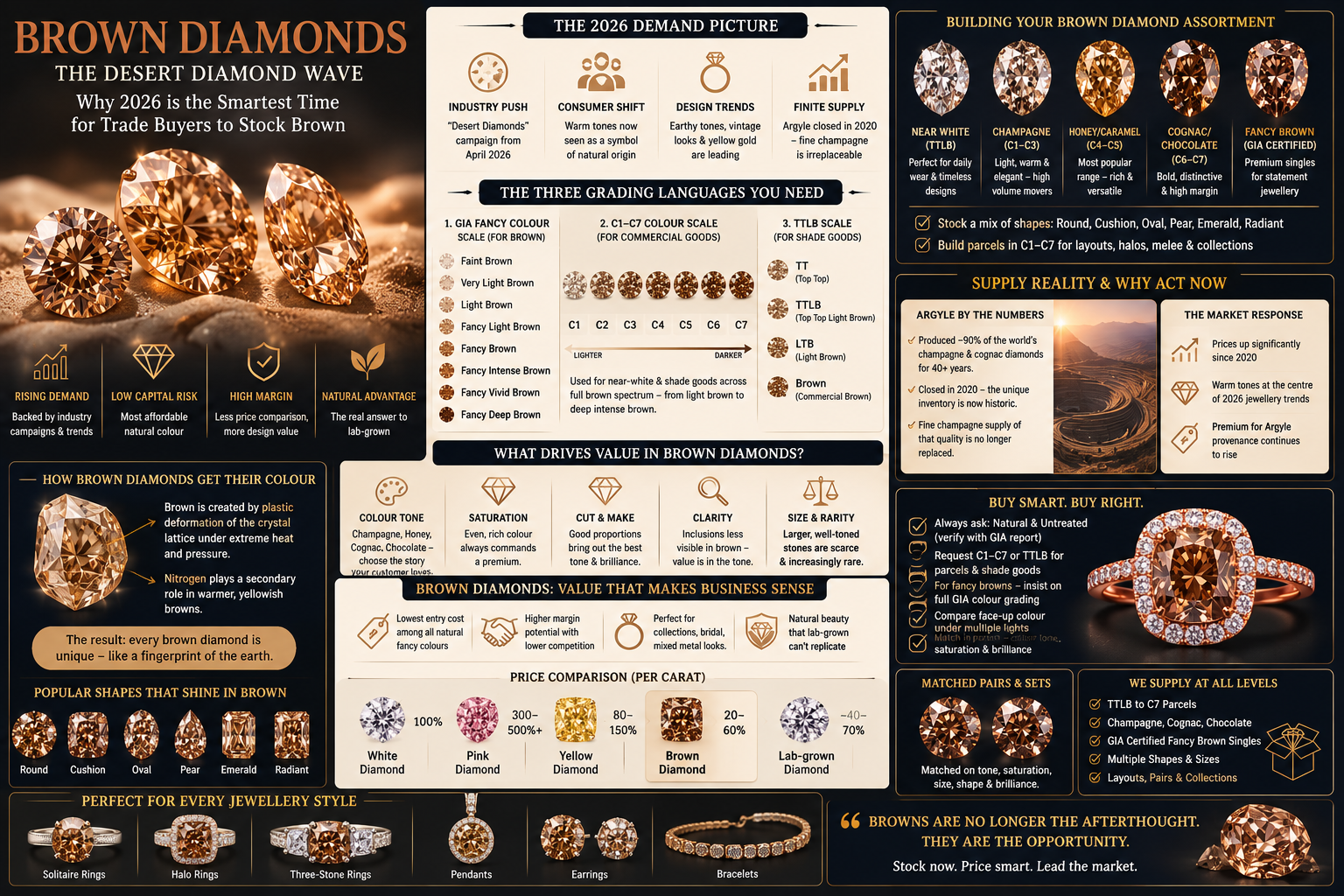
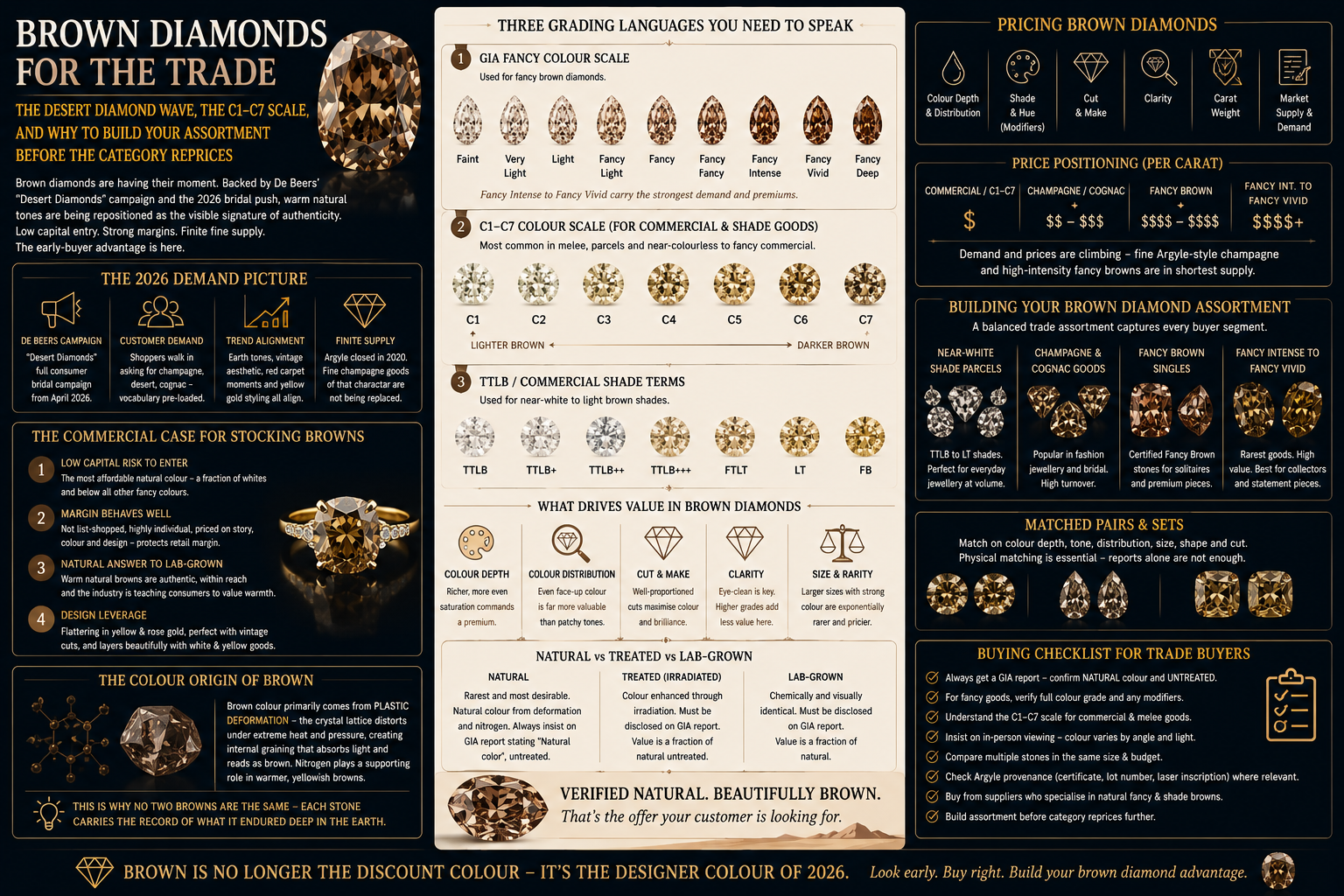
The demand story is unusual in one specific way: someone else is funding it. De Beers has made warm-toned natural diamonds — cream, champagne, honey, cognac — the centre of its “Desert Diamonds” push, first as a trade beacon and, from April 2026, as a full consumer bridal campaign built around the palette with hundreds of designer pieces. The strategic logic is aimed squarely at the lab-grown problem: with lab-grown goods overwhelmingly cut to icy high colour and clarity, natural colour is being positioned as the visible signature of a natural stone. Warmth is being converted, in consumers’ minds, from a defect into proof of origin.
For a trade buyer, that translates into three practical facts. First, customers are beginning to walk in with the vocabulary already installed — asking for champagne, desert, cognac — which is demand your marketing budget didn’t have to create. Second, the trend infrastructure is aligned: 2026 forecasts and trade bodies consistently place warm, earthy diamond tones at the centre of the year’s styling, alongside the earth-tone and vintage currents; the red carpet keeps supplying moments; and the palette pairs naturally with the yellow-gold-led design and antique-cut revival already running through the market. Third, the supply side is asymmetric: Argyle — the mine that produced the bulk of the world’s champagne goods for three decades and built the category’s language — closed in 2020, and fine champagne production of that character is not being replaced. Funded, rising demand against finite fine supply is the setup you want to be early to, not late.
The commercial case for stocking browns now
Strip the romance out and the business case stands on its own:
- Low capital risk to enter. Browns are the most affordable natural colour — a fraction of equivalent whites and below every other coloured category — so a credible test assortment costs less than a single fine white centre stone. The downside of trying the category is small; the upside of being positioned before it reprices is not.
- Margin behaves well. Browns are not list-shopped by consumers the way white solitaires are — there is no consumer-facing price sheet anchoring expectations — and each stone’s individuality resists direct comparison. Priced on story, colour and design rather than on a commodity grid, the category protects retail margin in a way commercial white goods no longer do.
- A natural answer to lab-grown. Every jeweller now needs a counter-offer for the customer drifting toward lab-grown on price. A warm natural brown is exactly that: genuinely natural, visibly individual, priced within reach — and the industry’s own campaign is teaching consumers to read warmth as authenticity. Lab-grown and treated browns exist, which is precisely why verified natural, untreated goods are the whole offer.
- Design leverage. Browns flatter yellow and rose gold, sit naturally in the vintage and antique-cut aesthetic, and layer tonally with white and yellow goods — meaning they extend collections you already sell rather than demanding a new one.
What actually makes a diamond brown
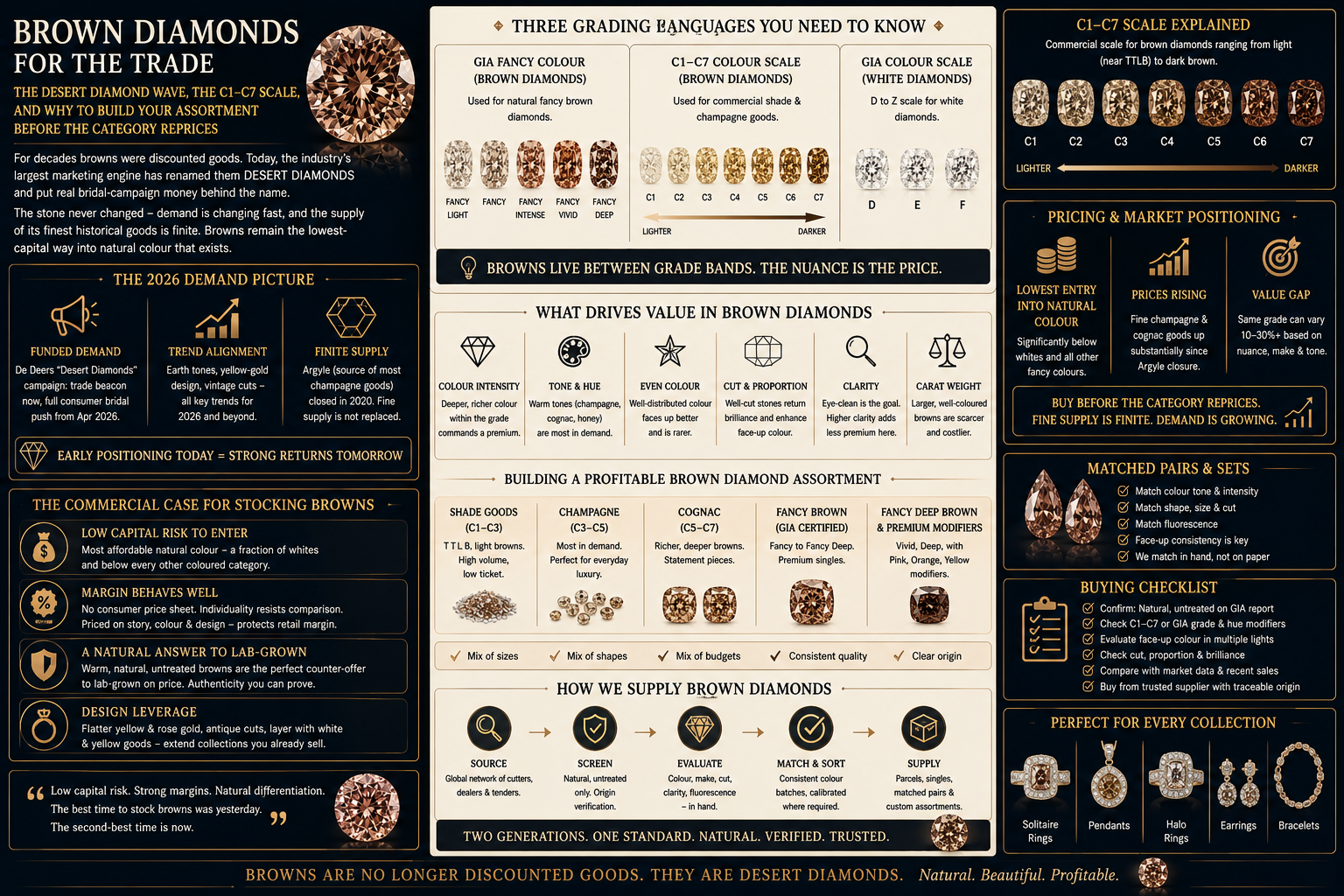
Worth having right at the counter, because most published explainers get it wrong: brown colour does not primarily come from a trace element. It comes from plastic deformation — the crystal lattice distorting under extreme heat and pressure, creating internal graining that absorbs light and reads as brown. Nitrogen plays a supporting role in warmer, yellowish browns, but deformation is the engine. That is why brown is the most individual of diamond colours — the colour is the record of what that one crystal endured — and why no two browns match. Against lab-grown uniformity, that individuality is the selling point, stone by stone.
Color Diamonds Collections:
Natural Yellow Diamonds | Natural Pink Diamonds | Natural Blue Diamonds | Natural Green Diamonds | Natural Brown Diamonds | Natural Chameleon Diamonds | Natural Purple Diamonds | Natural Orange Diamonds | Natural Gray Diamonds
Diamond Shaped Collections:
Natural Round Brilliant Diamonds | Natural Pear Shaped Diamonds | Natural Oval Diamonds | Natural Marquise Diamonds | Natural Radiant Cut Diamonds | Natural Emerald Cut Diamonds | Natural Cushion Cut Diamonds
The three grading languages of brown — and why your desk needs all three
Brown is the one colour a trade buyer will encounter graded in three different systems depending on where in the market they’re standing. Fluency in all three — and the ability to translate between them and the romance vocabulary consumers now use — is the difference between buying the category confidently and buying it blind.
1. The laboratory language (GIA). On the D-to-Z scale, brown-tinted stones carry letter grades with brown descriptors — roughly K–M Faint Brown, N–R Very Light Brown, S–Z Light Brown. Beyond Z, browns become graded coloured diamonds: Fancy Light Brown, Fancy Brown, Fancy Dark Brown, Fancy Deep Brown, with any modifier stated (yellowish, orangy, pinkish brown). Note the nuance your salespeople should know: the brown ladder is tone-led — Light → Fancy → Dark → Deep — so there is no Fancy Intense Brown or Fancy Vivid Brown on any report. “Fancy” is doing exactly one job here: stating intensity.
2. The Argyle trade scale (C1–C7). Built by Argyle to sell champagne goods and still the trade’s fastest shorthand for brown depth. It is a dealing scale, not a laboratory grade — no report prints “C4” — but parcels, price discussions and manufacturing briefs still run on it daily:
| Grade | Trade name | What it means in hand |
| C1 – C2 | Light Champagne | delicate, pale warmth; faces up bright with a golden cast |
| C3 – C4 | Medium Champagne | distinct, elegant brown; the classic champagne look |
| C5 – C6 | Dark Champagne | saturated, rich brown moving toward cognac |
| C7 | Cognac | the deepest end — full-bodied brown with warm, often orangy depth |
Two desk notes. Wording varies house to house at the top of the scale — some call C6 cognac and C7 deep cognac — because this was always a selling scale rather than a lab standard; buy the stone against the scale’s intent, not the label. And because the scale is Argyle’s, goods described in fluent C-scale terms often trace to Argyle-era sourcing — worth asking about now that the mine is closed.
3. The white-goods shade scale (TTLB and down). Below the coloured-stone threshold entirely, the trade sorts near-white parcels by brown tinge: TTLB (Top Top Light Brown), TLB, LB and onward. These stones grade high on the letter scale but carry a whisper of warmth — they face up white, especially in yellow gold, and trade at a real discount to no-shade goods. For manufacturers this has always been the quiet margin play in white lines; the 2026 twist is that the desert-diamond aesthetic is converting that discount into a feature. Warmth priced down yesterday is being marketed up today — and the parcel cost hasn’t caught up everywhere yet.
Read together, the three systems describe one continuous spectrum — a TTLB whisper, the letter grades’ faint and light browns, the C-scale champagnes, certified Fancy Brown territory. A supplier who works the whole line can serve every brief from a pavé fashion programme to a certified cognac centre; that range is what we carry.
The modifier ladder: where value and margin sit
Within browns, value moves on the modifier — the secondary hue in the stone — and the ladder is steep enough to matter to your buying:
| Face-up colour | Where it sits |
| Pinkish brown / reddish brown | the top of the category — clear premiums; Argyle-descended pinkish champagnes are collectible |
| Orangy brown (true cognac character) | strong — the liquor-toned depth the cognac name was built on |
| Pure brown, lively and clear | the benchmark — champagne through chocolate, valued on tone, clarity and life |
| Yellowish brown | attractive and commercial; typically below pure brown |
| Greenish / greyish brown | the value end — honest goods at the right number, wrong goods at the wrong one |
Two stones can both read “Fancy Brown” and sit far apart in price on that first line. The other axis is life versus murk: a fine brown is warm, transparent and glowing; a poor one is dull, greyish or muddy at the same nominal depth — and no scale, C or GIA, captures the difference. It is read by eye, face-up, which is exactly where a specialist supplier earns their place in your chain.
Building a brown assortment: how we’d structure it
For a trade buyer entering or expanding the category, we typically frame stock in four tiers:
- Volume and fashion tier. TTLB/TLB shade parcels and light-champagne melee for pavé, halos and yellow-gold fashion lines — faces up white, and the shade discount flows straight to your margin. The lowest-risk entry point in the category.
- Core commercial tier. C3–C4 medium champagne centres, roughly half-carat to two carats, in rounds, ovals, cushions and pears — the exact look the consumer campaign is selling — plus calibrated champagne accents to build around them.
- Statement tier. C5–C7 dark champagne and cognac singles, and Fancy Dark/Fancy Deep Brown certified stones, including browns in antique cuts — Old European, old mine, rose — where warmth is not a compromise but the entire vintage look.
- Premium and high-jewellery tier. Pink-, red- and orange-modified certified browns and matched pairs — the scarce end where the category’s real rarity and appreciation potential live.
Matched pairs and layouts run through all four tiers and are matched in hand, face-up, under one light — brown grades are bands and browns are individuals, so paper matching fails here more than anywhere. And where a brief calls for it, our recutting desk works browns for colour: planning a recut to deepen and even a stone’s face-up warmth, the same discipline we apply across our coloured goods.
The trade buying checklist
- Buy face-up colour, not the label. Champagne, mocha, whiskey, desert — the names sell the piece; the stone is bought on hue, tone, saturation, modifier and life, assessed face-up in the intended metal.
- Use clarity as the value lever. Deeper browns conceal inclusions, so the category rewards buying clarity intelligently — an SI that faces up clean in a C5 does the same retail job as a VS at a very different cost. Lighter champagnes show more and need more care.
- Insist on make. Browns are low-cost goods and are too often cut for weight. A dull, deep-cut brown compounds into lifelessness on your counter; a well-made one glows. The cut does half the work of the colour.
- Verify natural, untreated colour on everything. HPHT processing can lighten browns or render suitable stones near-colourless, and treated and lab-grown browns circulate. The natural-origin story is the category’s entire commercial engine — it has to be real. Everything we sell is natural and untreated, certified on graded goods.
- Match the metal in your evaluation. Yellow and rose gold amplify warmth; white metals cool and contrast it. The same stone merchandises differently in each.
Pricing
Browns price in three registers, and we quote all of them live. Shade goods (TTLB down) price off white-goods logic with shade discounts — the discount is your margin, and it is narrowing as the trend feeds through. C-scale champagne goods price on depth, make and life, parcel by parcel. Certified Fancy browns price stone by stone, with premiums concentrating in the modifiers, in fine larger goods with clean make, and increasingly in Argyle-era character. There is no single list that captures this spectrum, which is exactly why the category rewards a supplier relationship over a search bar: we tell you plainly what a number reflects — a fair buy, a modifier premium, or a murky stone dressed in a romantic name.
How we work
Raremonds has sourced and evaluated natural diamonds since 1985, and browns reward what this house was built on: reading colour by eye beyond the certificate, fluency in all three grading languages, and straight talk in a category where marketing runs ahead of grading. We supply the full brown spectrum to the trade — TTLB shade parcels and melee, calibrated champagne and cognac goods across the C1–C7 range in rounds and fancy shapes, certified Fancy Light Brown through Fancy Deep Brown singles including premium modified stones, browns in antique and special cuts, and matched pairs and layouts — every stone natural and untreated, evaluated in hand, listed on Rapnet and Nivoda, priced against live conditions. Send a brief — the programme or piece you’re building, sizes, depth of colour in any language you like (C-scale, GIA grade, or simply “desert”), quality window, quantity and timeline — and we’ll come back with goods evaluated, not just certified, at the right price for what they are.
Send your requirement to Raremonds → WhatsApp Parth directly: +91 98193 47999
The short version
Browns are being repriced in real time, and the demand is being funded for you: the Desert Diamonds campaign has put warm natural tones at the centre of 2026 consumer and bridal marketing, positioning warmth as proof of natural origin against icy lab-grown goods — while Argyle, the historic source of the finest champagne production, is closed. The commercial case is low entry capital, margin that isn’t list-shopped, a natural counter-offer to lab-grown, and design leverage into yellow gold and vintage lines.
The category runs on three grading languages — GIA’s tone-led Fancy ladder (Light → Fancy → Dark → Deep, never Intense or Vivid), the Argyle C1–C7 trade scale, and the TTLB shade spectrum — and value moves on the modifier (pinkish and reddish on top), on life versus murk, and on make. Build the assortment in tiers from shade parcels to modified certified singles, verify natural untreated colour on everything, and buy face-up. We supply the entire spectrum, evaluated in hand.
FAQ
Are desert diamonds, champagne diamonds, chocolate diamonds and brown diamonds different goods?
No — marketing names for the same natural brown family, coined in different eras: champagne and cognac by Argyle in the late 1980s, chocolate as a trademarked retail term in the 2000s, desert diamonds as the industry’s 2025–26 campaign vocabulary. None appears on a laboratory report; goods are graded on hue, tone, saturation and modifiers, and a trade desk should buy on those, using the romance names for merchandising.
What is the C1–C7 scale, and does it appear on certificates?
Argyle’s trade colour-depth scale for browns: C1–C2 light champagne, C3–C4 medium champagne, C5–C6 dark champagne, C7 the deepest cognac end (wording at the top varies house to house). It’s dealing shorthand, not a lab grade — reports use letter grades with brown descriptors up to Z, then Fancy Light Brown, Fancy Brown, Fancy Dark Brown and Fancy Deep Brown with modifiers stated.
How does GIA grade brown diamonds?
Lightly tinted browns sit on D-to-Z with descriptors (roughly K–M Faint Brown, N–R Very Light Brown, S–Z Light Brown). Beyond Z, browns take Fancy grades on a tone-led ladder — Fancy Light Brown, Fancy Brown, Fancy Dark Brown, Fancy Deep Brown — so unlike yellows there is no Intense or Vivid brown. Modifiers such as pinkish or orangy are stated on the report and move value significantly.
Where do premiums sit within browns?
On the modifier first — pinkish and reddish browns at the top, orangy (true cognac) strong, pure lively browns the benchmark, yellowish then greyish browns at the value end — then on life versus murk, make, clarity bought intelligently for the depth, and increasingly on Argyle-era champagne character now the mine is closed.
Are brown diamonds treated, and how do we protect ourselves?
Treated and lab-grown browns circulate, and HPHT processing can lighten or whiten suitable brown stones — which is why natural, untreated verification is non-negotiable in this category. Everything we supply is natural and untreated, with laboratory certification on graded goods; the authenticity story is the category’s commercial engine, so it has to be genuine.
Why should a jeweller stock browns in 2026 specifically?
Because the demand is being built at industry level — the Desert Diamonds campaign has moved into bridal, consumers are arriving with the vocabulary, taste has shifted to earth tones and natural-origin authenticity against lab-grown, and fine champagne supply became finite with Argyle’s closure. Entry capital is low, margin isn’t list-shopped, and the category extends yellow-gold and vintage lines you already run.
What brown goods does Raremonds supply to the trade?
The entire spectrum: TTLB, TLB and LB shade parcels and melee, calibrated champagne and cognac goods across the C1–C7 range in rounds and fancy shapes, certified Fancy Light Brown through Fancy Deep Brown singles including pink- and orange-modified premium stones, browns in antique and special cuts, matched pairs and layouts, and recut-for-colour support — all natural and untreated, evaluated in hand and priced live.

.png)