

Orange is the colour the trade underestimates because it so rarely sees the real thing. GIA counts orange among the four rarest diamond hues — with red, green and purple — yet the word “orange” appears on certificates constantly, almost always trailing a modifier. That contradiction is the whole category: pure, unmodified orange — the stone the trade calls a “fire diamond” or “pumpkin” — is a genuine collector rarity, while the modified orange family is broad, commercial and deeply connected to two desks we run every day. Yellowish oranges and orangy yellows shade into our cape and yellow goods; brownish oranges shade into the cognac territory our brown memo mapped. Orange, in other words, is one apex with two bridges — and a desk that understands the map can work all three.
This memo covers the category the way our purple and red memos did: where orange sits in 2026, what makes it (and why pure orange is so hard), the modifier map that decides every price, the benchmark stones, verification, and how we source and supply from melee to mandate singles.
Where oranges sit in 2026
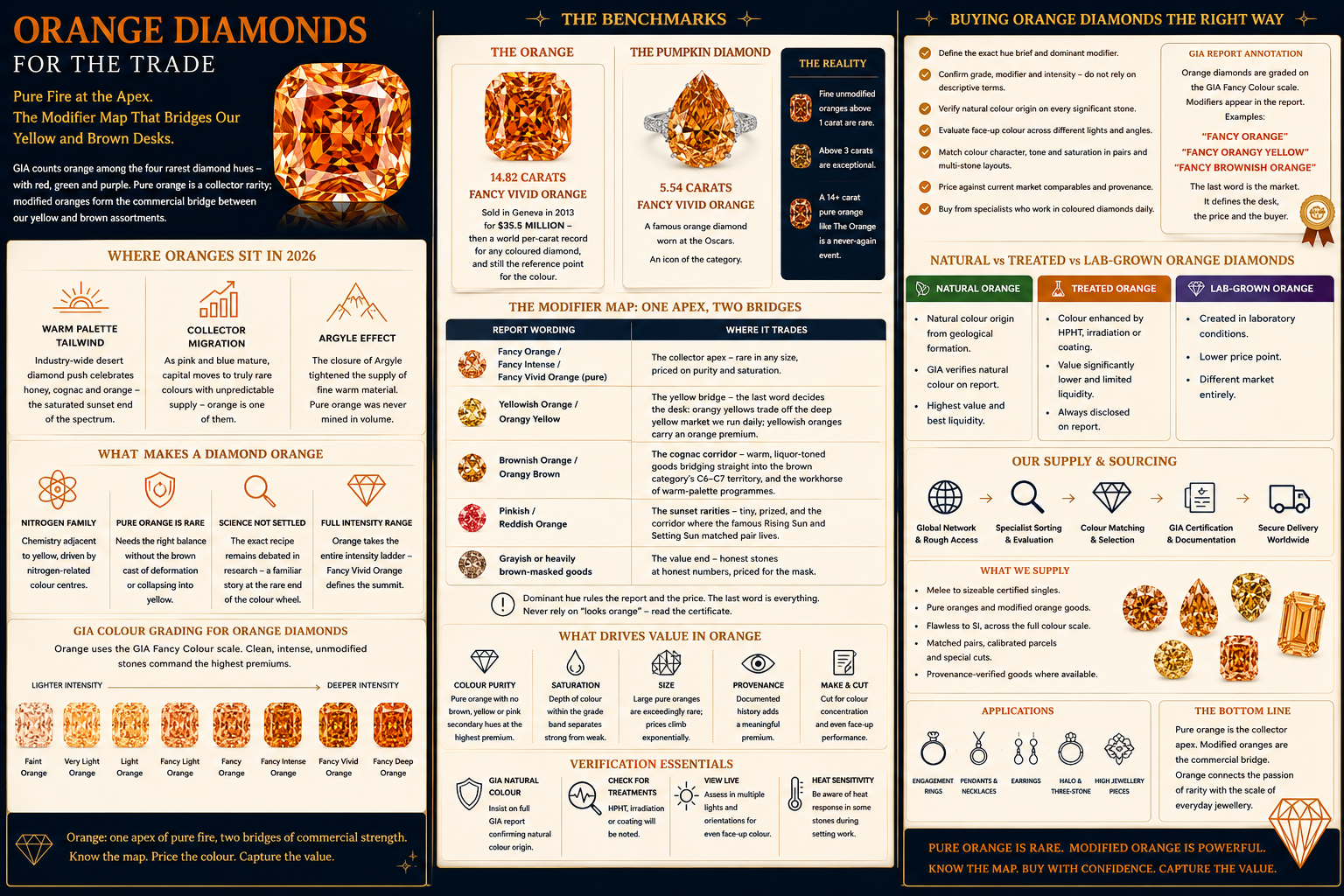
Two tailwinds, one structural fact. The first tailwind is the industry’s warm-palette moment: the desert-diamond push runs from honey through cognac, and orange is that palette’s saturated extreme — the sunset end of the spectrum the market is actively teaching consumers to love. The second is the collector migration we’ve tracked across this library: as pink and blue mature, capital hunting genuine rarity moves to the colours with unpredictable supply, and pure orange sits firmly on that list. The structural fact is Argyle again: the mine’s output seeded decades of warm goods — cognacs, orangy browns, brownish oranges — and its closure tightened the supply of fine warm material across the board. Pure orange was never mined anywhere with regularity; it simply occurs, occasionally, and the occasions are not increasing.
What makes a diamond orange — and why pure orange is so hard
Orange belongs to the nitrogen family — chemistry adjacent to yellow’s — but the pure colour demands an unusual balance: nitrogen-related centres absorbing in just the right way, without the brown cast of deformation and without collapsing into yellow. The precise recipe remains debated in the research, which is a familiar refrain by now at the rare end of the colour wheel. The practical version for a buying desk: nature finds it easy to make yellowish, brownish and orangy stones, and profoundly difficult to make a stone the laboratory will call simply Orange. That single word, unmodified, is the category’s entire apex — and unlike red, orange takes the full intensity ladder, so Fancy Vivid Orange exists and defines the summit.
The benchmarks
The ceiling of the category is The Orange: 14.82 carats, Fancy Vivid Orange, sold in Geneva in 2013 for $35.5 million — then a world per-carat record for any coloured diamond, and still the reference point for the colour. The category’s other household name is the Pumpkin Diamond, a 5.54-carat Fancy Vivid Orange famously worn at the Oscars. Below those two, the pure-orange population thins out fast: fine unmodified oranges above a carat are rare, above three carats exceptional, and The Orange’s fourteen-plus carats are treated in the trade as a never-again event. The modified family, by contrast, supplies real goods at real sizes — which is exactly why the modifier map matters.
Color Diamonds Collections:
Natural Yellow Diamonds | Natural Pink Diamonds | Natural Blue Diamonds | Natural Green Diamonds | Natural Brown Diamonds | Natural Chameleon Diamonds | Natural Purple Diamonds | Natural Orange Diamonds | Natural Gray Diamonds
Diamond Shaped Collections:
Natural Round Brilliant Diamonds | Natural Pear Shaped Diamonds | Natural Oval Diamonds | Natural Marquise Diamonds | Natural Radiant Cut Diamonds | Natural Emerald Cut Diamonds | Natural Cushion Cut Diamonds
The modifier map: one apex, two bridges
| Report wording | Where it trades |
| Fancy Orange / Fancy Intense / Fancy Vivid Orange (pure) | the collector apex — rare in any size, priced on purity and saturation |
| Yellowish Orange / Orangy Yellow | the yellow bridge — the last word decides the desk: orangy yellows trade off the deep yellow market we run daily; yellowish oranges carry an orange premium |
| Brownish Orange / Orangy Brown | the cognac corridor — warm, liquor-toned goods bridging straight into the brown category’s C6–C7 territory, and the workhorse of warm-palette programmes |
| Pinkish / Reddish Orange | the sunset rarities — tiny, prized, and the corridor where the famous Rising Sun and Setting Sun matched pair lives |
| Grayish or heavily brown-masked goods | the value end — honest stones at honest numbers, priced for the mask |
The dominant-hue rule runs the whole table, as everywhere: the last word is the market. And the two bridges are the commercial engine. A client buying deep cape and fancy yellow goods from us is one conversational step from an orangy yellow, and one more from a yellowish orange — a natural upgrade path in saturation and rarity. A client running warm-palette or cognac programmes is already trading brownish oranges whether they use the word or not. Pure orange sits above both bridges as the aspiration — the stone the other goods point toward.
Where value concentrates
Freedom from the brown mask first: the single biggest test of an orange is how much brown the eye finds face-up, because brown is what nature adds by default and its absence is what the premium buys. Then saturation (the Vivid grades carry the apex), evenness of colour, and size on the thin scale above. Clarity is secondary, as across the rare colours — colour rarity outranks it decisively. Make matters as a colour instrument: oranges are cut to concentrate and even the hue, typically in the colour-holding shapes (radiants and cushions dominate), and a weight-led cut that dilutes the colour destroys exactly what the stone is for. And certification is absolute: irradiation produces orange readily, treated and lab-grown oranges circulate widely, and a major-laboratory report confirming natural colour is the entry requirement for every stone we touch.
The commercial case
Orange runs the two-business structure this library keeps finding at the rare end, with a third leg the others lack. The anchor business: a certified pure orange, even small, is a credential stone and a collector magnet — scarcer than fine blues, cheaper than reds, and with a record book (The Orange, the Pumpkin) that sells itself. The bridge business: orangy yellows and yellowish oranges let a yellow-buying clientele step up in rarity without leaving familiar territory, and they surface through our yellow desk’s flow constantly, which means we cherry-pick rather than hunt. And the programme business: brownish oranges and the cognac corridor supply warm-palette collections at commercial volumes — calibrated goods, melee and accent stones included — riding the same desert-palette demand our brown memo documented. Liquidity follows the same split: pure oranges place through specialists on their own schedule; bridge and corridor goods trade with the yellow and brown markets’ everyday depth.
How we source and supply, and pricing
Pure oranges run on mandate through the specialist and collector networks, with face-up documentation under standardised light and natural-colour certification without exception. The bridges run through our daily desks: orangy-yellow and yellowish-orange singles and pairs surfacing via the yellow flow; brownish-orange and cognac goods — singles, calibrated parcels, melee — via the brown flow, matched by eye for hue and warmth. Pairs in pure orange are genuinely rare briefs taken with honest timelines; pairs in the bridge corridors are regular work. Pricing has no single list: pure oranges price per stone against specialist comparables, with the brown-mask question doing most of the work; bridge goods price off the deep yellow market with an orange uplift; corridor goods price with the brown category. As everywhere, we tell you plainly what a number reflects — purity, saturation, or a warm word flattering a brown stone.
Send your requirement to Raremonds → WhatsApp Parth directly: +91 98193 47999
The short version
Orange is one of the four rarest diamond hues, but it lives a double life: pure unmodified orange — the fire diamond, crowned by the 14.82-carat, $35.5 million The Orange — is a collector apex on the scale of purple, while the modified family is broad and commercial. The map is everything: orangy yellows and yellowish oranges bridge to the yellow desk, brownish oranges bridge to the cognac corridor of the brown category, pinkish and reddish oranges are sunset rarities, and the last word on the report decides the market every time. Value runs on freedom from the brown mask, saturation, evenness and size; clarity is secondary; treated oranges are common, so natural-colour certification is absolute. We source the apex on mandate and work both bridges daily — which is exactly how a client should enter the colour.
FAQ
How rare are orange diamonds really?
Pure, unmodified orange is among the four rarest diamond hues, with GIA placing it alongside red, green and purple. The word “orange” appears on certificates often — but almost always modified by yellow or brown. Straight Fancy Orange, Intense or Vivid, is a genuine collector rarity; the 14.82-carat The Orange remains the category’s never-repeated ceiling.
What causes orange colour in a diamond?
Nitrogen-family chemistry adjacent to yellow’s, in a balance unusual enough that the precise recipe is still debated. The practical point: nature defaults to adding yellow or brown, so the premium in orange is precisely the absence of those masks — the purer and more saturated the orange face-up, the rarer the stone.
What’s the difference between an orange and a yellowish orange?
The last word — the dominant hue — and it decides the market. An Orangy Yellow is a yellow diamond with warmth, priced off the deep yellow market. A Yellowish Orange is an orange diamond with a yellow lift, priced with an orange premium. One word apart on the certificate, materially apart in value — the same boundary economics that run purple-pink.
Where do brownish oranges and cognac goods fit?
In the corridor between our orange and brown categories — warm, liquor-toned stones that trade with the brown market’s C6–C7 cognac territory and supply warm-palette programmes at commercial volume. They’re honest, saleable goods when priced for the brown they carry, and the everyday engine of the orange family.
Are orange diamonds treated? Frequently — irradiation produces orange readily, and treated and lab-grown oranges circulate widely. A major-laboratory report confirming natural, untreated colour is the non-negotiable entry requirement, and everything we supply carries it.
What orange goods does Raremonds supply? Pure orange singles on mandate with face-up documentation; orangy-yellow and yellowish-orange singles and pairs through our yellow desk; brownish-orange and cognac goods — singles, calibrated parcels and melee — through our brown desk; and matched pairs in the bridge corridors as regular work, with pure-orange pairs taken as honest long-timeline briefsOrange is the colour the trade underestimates because it so rarely sees the real thing. GIA counts orange among the four rarest diamond hues — with red, green and purple — yet the word “orange” appears on certificates constantly, almost always trailing a modifier. That contradiction is the whole category: pure, unmodified orange — the stone the trade calls a “fire diamond” or “pumpkin” — is a genuine collector rarity, while the modified orange family is broad, commercial and deeply connected to two desks we run every day. Yellowish oranges and orangy yellows shade into our cape and yellow goods; brownish oranges shade into the cognac territory our brown memo mapped. Orange, in other words, is one apex with two bridges — and a desk that understands the map can work all three.
This memo covers the category the way our purple and red memos did: where orange sits in 2026, what makes it (and why pure orange is so hard), the modifier map that decides every price, the benchmark stones, verification, and how we source and supply from melee to mandate singles.
Where oranges sit in 2026
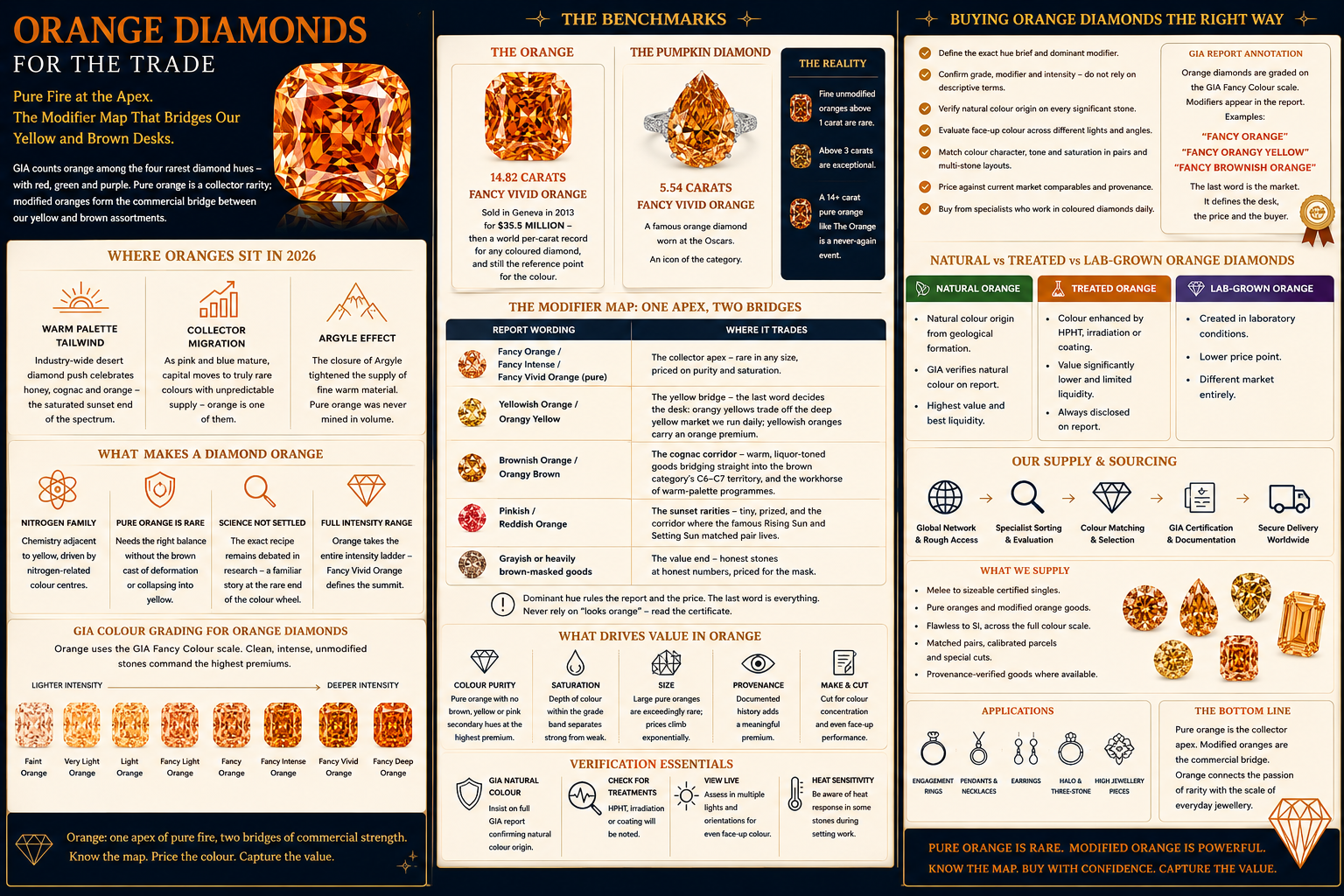
Two tailwinds, one structural fact. The first tailwind is the industry’s warm-palette moment: the desert-diamond push runs from honey through cognac, and orange is that palette’s saturated extreme — the sunset end of the spectrum the market is actively teaching consumers to love. The second is the collector migration we’ve tracked across this library: as pink and blue mature, capital hunting genuine rarity moves to the colours with unpredictable supply, and pure orange sits firmly on that list. The structural fact is Argyle again: the mine’s output seeded decades of warm goods — cognacs, orangy browns, brownish oranges — and its closure tightened the supply of fine warm material across the board. Pure orange was never mined anywhere with regularity; it simply occurs, occasionally, and the occasions are not increasing.
What makes a diamond orange — and why pure orange is so hard
Orange belongs to the nitrogen family — chemistry adjacent to yellow’s — but the pure colour demands an unusual balance: nitrogen-related centres absorbing in just the right way, without the brown cast of deformation and without collapsing into yellow. The precise recipe remains debated in the research, which is a familiar refrain by now at the rare end of the colour wheel. The practical version for a buying desk: nature finds it easy to make yellowish, brownish and orangy stones, and profoundly difficult to make a stone the laboratory will call simply Orange. That single word, unmodified, is the category’s entire apex — and unlike red, orange takes the full intensity ladder, so Fancy Vivid Orange exists and defines the summit.
The benchmarks
The ceiling of the category is The Orange: 14.82 carats, Fancy Vivid Orange, sold in Geneva in 2013 for $35.5 million — then a world per-carat record for any coloured diamond, and still the reference point for the colour. The category’s other household name is the Pumpkin Diamond, a 5.54-carat Fancy Vivid Orange famously worn at the Oscars. Below those two, the pure-orange population thins out fast: fine unmodified oranges above a carat are rare, above three carats exceptional, and The Orange’s fourteen-plus carats are treated in the trade as a never-again event. The modified family, by contrast, supplies real goods at real sizes — which is exactly why the modifier map matters.
The modifier map: one apex, two bridges
| Report wording | Where it trades |
| Fancy Orange / Fancy Intense / Fancy Vivid Orange (pure) | the collector apex — rare in any size, priced on purity and saturation |
| Yellowish Orange / Orangy Yellow | the yellow bridge — the last word decides the desk: orangy yellows trade off the deep yellow market we run daily; yellowish oranges carry an orange premium |
| Brownish Orange / Orangy Brown | the cognac corridor — warm, liquor-toned goods bridging straight into the brown category’s C6–C7 territory, and the workhorse of warm-palette programmes |
| Pinkish / Reddish Orange | the sunset rarities — tiny, prized, and the corridor where the famous Rising Sun and Setting Sun matched pair lives |
| Grayish or heavily brown-masked goods | the value end — honest stones at honest numbers, priced for the mask |
The dominant-hue rule runs the whole table, as everywhere: the last word is the market. And the two bridges are the commercial engine. A client buying deep cape and fancy yellow goods from us is one conversational step from an orangy yellow, and one more from a yellowish orange — a natural upgrade path in saturation and rarity. A client running warm-palette or cognac programmes is already trading brownish oranges whether they use the word or not. Pure orange sits above both bridges as the aspiration — the stone the other goods point toward.
Where value concentrates
Freedom from the brown mask first: the single biggest test of an orange is how much brown the eye finds face-up, because brown is what nature adds by default and its absence is what the premium buys. Then saturation (the Vivid grades carry the apex), evenness of colour, and size on the thin scale above. Clarity is secondary, as across the rare colours — colour rarity outranks it decisively. Make matters as a colour instrument: oranges are cut to concentrate and even the hue, typically in the colour-holding shapes (radiants and cushions dominate), and a weight-led cut that dilutes the colour destroys exactly what the stone is for. And certification is absolute: irradiation produces orange readily, treated and lab-grown oranges circulate widely, and a major-laboratory report confirming natural colour is the entry requirement for every stone we touch.
The commercial case
Orange runs the two-business structure this library keeps finding at the rare end, with a third leg the others lack. The anchor business: a certified pure orange, even small, is a credential stone and a collector magnet — scarcer than fine blues, cheaper than reds, and with a record book (The Orange, the Pumpkin) that sells itself. The bridge business: orangy yellows and yellowish oranges let a yellow-buying clientele step up in rarity without leaving familiar territory, and they surface through our yellow desk’s flow constantly, which means we cherry-pick rather than hunt. And the programme business: brownish oranges and the cognac corridor supply warm-palette collections at commercial volumes — calibrated goods, melee and accent stones included — riding the same desert-palette demand our brown memo documented. Liquidity follows the same split: pure oranges place through specialists on their own schedule; bridge and corridor goods trade with the yellow and brown markets’ everyday depth.
How we source and supply, and pricing
Pure oranges run on mandate through the specialist and collector networks, with face-up documentation under standardised light and natural-colour certification without exception. The bridges run through our daily desks: orangy-yellow and yellowish-orange singles and pairs surfacing via the yellow flow; brownish-orange and cognac goods — singles, calibrated parcels, melee — via the brown flow, matched by eye for hue and warmth. Pairs in pure orange are genuinely rare briefs taken with honest timelines; pairs in the bridge corridors are regular work. Pricing has no single list: pure oranges price per stone against specialist comparables, with the brown-mask question doing most of the work; bridge goods price off the deep yellow market with an orange uplift; corridor goods price with the brown category. As everywhere, we tell you plainly what a number reflects — purity, saturation, or a warm word flattering a brown stone.
Send your requirement to Raremonds → WhatsApp Parth directly: +91 98193 47999
The short version
Orange is one of the four rarest diamond hues, but it lives a double life: pure unmodified orange — the fire diamond, crowned by the 14.82-carat, $35.5 million The Orange — is a collector apex on the scale of purple, while the modified family is broad and commercial. The map is everything: orangy yellows and yellowish oranges bridge to the yellow desk, brownish oranges bridge to the cognac corridor of the brown category, pinkish and reddish oranges are sunset rarities, and the last word on the report decides the market every time. Value runs on freedom from the brown mask, saturation, evenness and size; clarity is secondary; treated oranges are common, so natural-colour certification is absolute. We source the apex on mandate and work both bridges daily — which is exactly how a client should enter the colour.
FAQ
How rare are orange diamonds really?
Pure, unmodified orange is among the four rarest diamond hues, with GIA placing it alongside red, green and purple. The word “orange” appears on certificates often — but almost always modified by yellow or brown. Straight Fancy Orange, Intense or Vivid, is a genuine collector rarity; the 14.82-carat The Orange remains the category’s never-repeated ceiling.
What causes orange colour in a diamond?
Nitrogen-family chemistry adjacent to yellow’s, in a balance unusual enough that the precise recipe is still debated. The practical point: nature defaults to adding yellow or brown, so the premium in orange is precisely the absence of those masks — the purer and more saturated the orange face-up, the rarer the stone.
What’s the difference between an orange and a yellowish orange?
The last word — the dominant hue — and it decides the market. An Orangy Yellow is a yellow diamond with warmth, priced off the deep yellow market. A Yellowish Orange is an orange diamond with a yellow lift, priced with an orange premium. One word apart on the certificate, materially apart in value — the same boundary economics that run purple-pink.
Where do brownish oranges and cognac goods fit?
In the corridor between our orange and brown categories — warm, liquor-toned stones that trade with the brown market’s C6–C7 cognac territory and supply warm-palette programmes at commercial volume. They’re honest, saleable goods when priced for the brown they carry, and the everyday engine of the orange family.
Are orange diamonds treated? Frequently — irradiation produces orange readily, and treated and lab-grown oranges circulate widely. A major-laboratory report confirming natural, untreated colour is the non-negotiable entry requirement, and everything we supply carries it.
What orange goods does Raremonds supply? Pure orange singles on mandate with face-up documentation; orangy-yellow and yellowish-orange singles and pairs through our yellow desk; brownish-orange and cognac goods — singles, calibrated parcels and melee — through our brown desk; and matched pairs in the bridge corridors as regular work, with pure-orange pairs taken as honest long-timeline briefs

.png)