

Why Natural Gray Diamonds Are the Quiet Colour With a Growing Following
Gray sits apart from every other fancy colour in this series — it is not chasing the vivid saturation that drives demand in pink, blue, or yellow. Its appeal is the opposite: a cool, understated, sophisticated neutral that has built a genuine and growing following among designers and clients who specifically want a coloured diamond that doesn’t shout. That quietness is the entire point, and sourcing it well requires understanding what makes a gray diamond read as elegant rather than simply dull.
Why Gray Diamonds Are Graded and Priced Differently to Saturated Colours
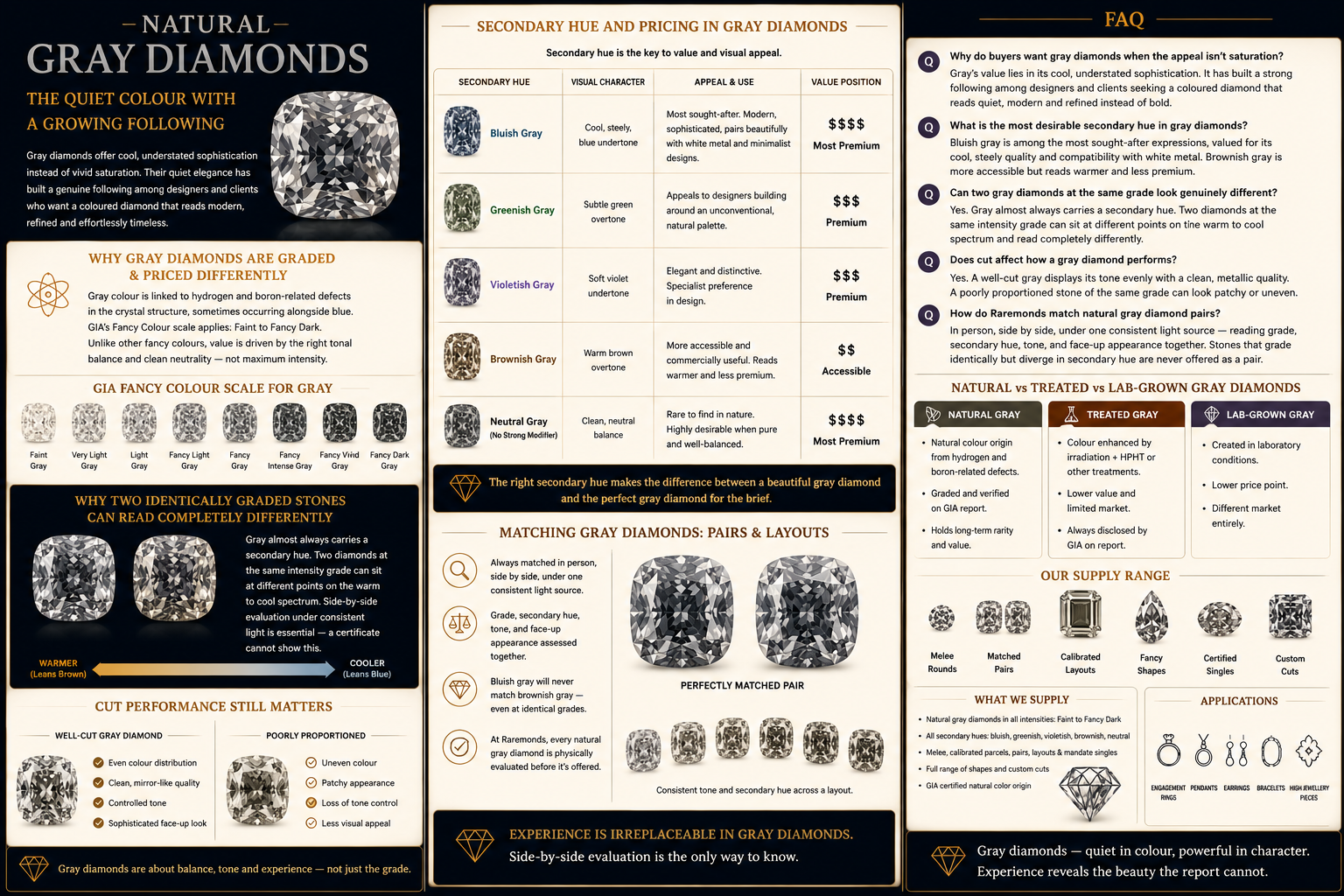
Gray’s colour origin is linked to hydrogen and to boron-related defects in the crystal structure, sometimes occurring alongside blue, and the GIA fancy colour scale applies to gray as it does to every other fancy hue — Faint through Fancy Dark. But gray’s commercial logic inverts the usual pattern. Where buyers chase the most saturated, most vivid expression of pink or blue, the most desirable gray diamonds are often valued for a specific tonal balance rather than maximum intensity — a clean, neutral gray with the right depth reads as more sophisticated than an extremely dark, heavy stone.
Why Two Identically Graded Natural Gray Diamonds Can Read Completely Differently
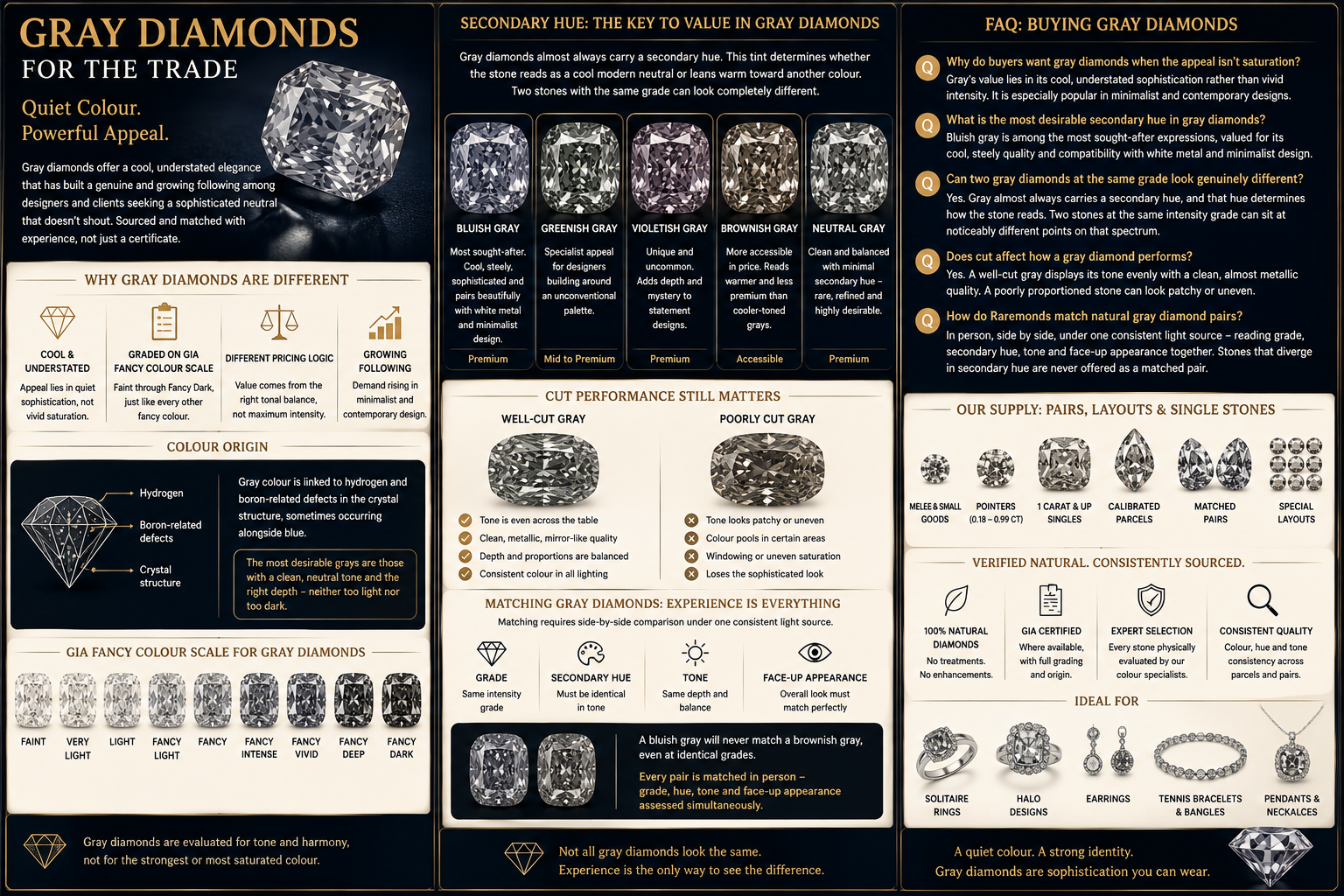
Gray is rarely a pure, neutral colour on its own — it almost always carries a secondary hue, and that secondary hue is what determines whether a stone reads as a cool, modern neutral or as something closer to a muted version of another colour entirely. Two stones graded at the same intensity can sit at noticeably different points on the warm-to-cool spectrum depending on their secondary tint, and that difference is immediately apparent once both stones are side by side under consistent light — something no certificate communicates on its own.
Color Diamonds Collections:
Natural Yellow Diamonds | Natural Pink Diamonds | Natural Blue Diamonds | Natural Green Diamonds | Natural Brown Diamonds | Natural Chameleon Diamonds | Natural Purple Diamonds | Natural Orange Diamonds | Natural Gray Diamonds
Diamond Shaped Collections:
Natural Round Brilliant Diamonds | Natural Pear Shaped Diamonds | Natural Oval Diamonds | Natural Marquise Diamonds | Natural Radiant Cut Diamonds | Natural Emerald Cut Diamonds | Natural Cushion Cut Diamonds
Secondary Hue and Pricing in Natural Gray Diamonds
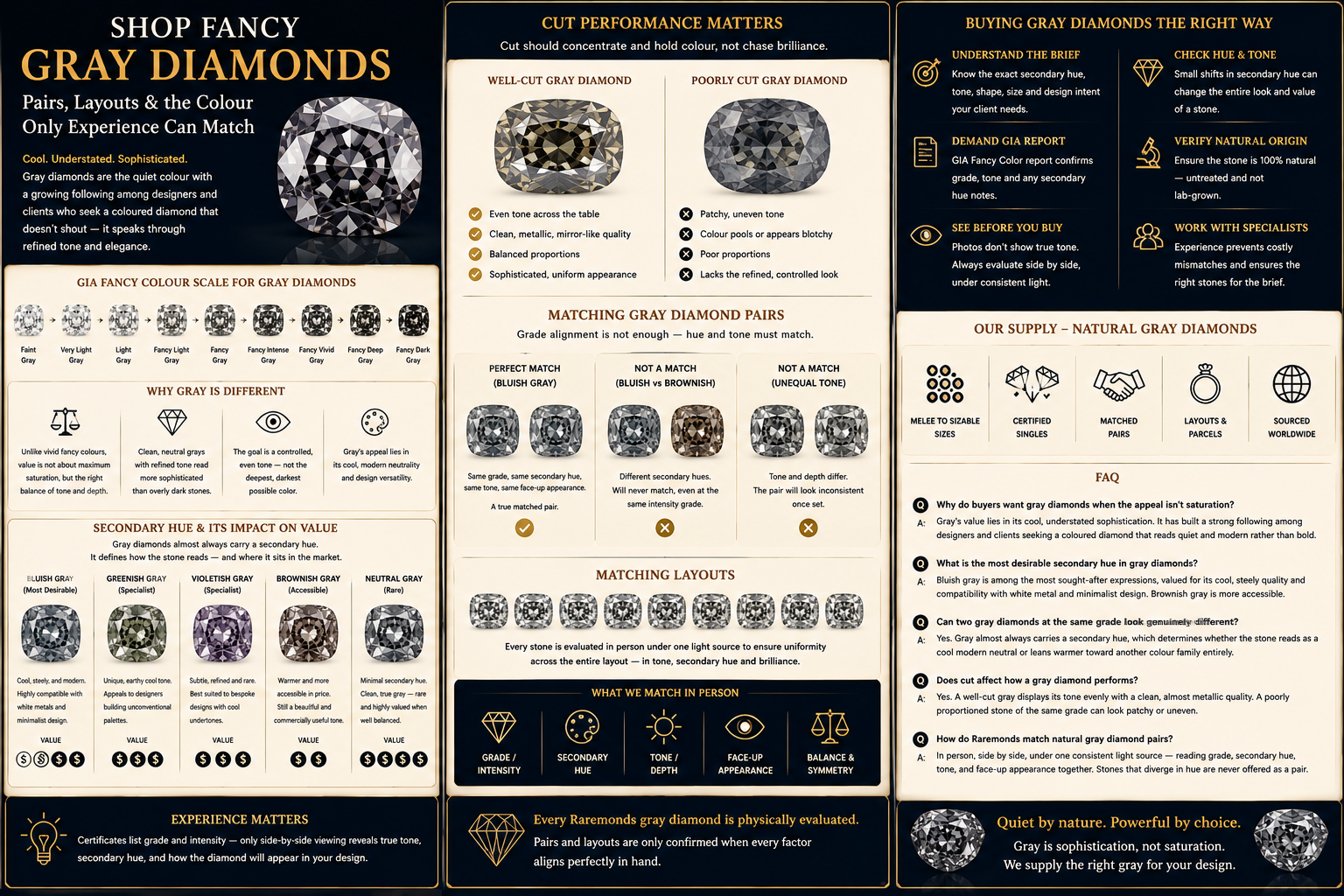
Bluish gray is among the most sought-after expressions in the category, prized for its cool, steely sophistication and its compatibility with both white metal and the minimalist design language that has driven much of gray’s recent popularity. Greenish gray and violetish gray occupy more specialist territory, appealing to designers building specifically around an unconventional palette. Brownish gray sits at the more accessible end, still commercially useful but read as warmer and less premium than the cooler-toned variations. Knowing which secondary hue a client’s design actually calls for is the difference between sourcing the right stone and sourcing a technically correct one that doesn’t suit the brief.
Why Cut Performance Still Matters in Natural Gray Diamonds
Gray diamonds are cut with the same coloured-diamond priority as every other fancy hue — concentrating and holding colour rather than maximising brilliance. A well-cut gray displays its tone evenly across the table, with a metallic, almost mirror-like quality in the best examples. A poorly proportioned stone of the same grade can look patchy or uneven, with the tone settling unevenly rather than reading as a clean, consistent neutral. For a colour whose entire appeal rests on a controlled, sophisticated appearance, this evaluation matters more than buyers typically expect.
Matching Gray Diamond Pairs and Layouts
Matching gray diamonds requires the same side-by-side, consistent-light comparison as every other fancy colour — grade, secondary hue, tone, and face-up appearance assessed together, not assumed from certificate alignment. A bluish gray will never match a brownish gray, even at identical intensity grades, and in a matched pair or layout built around gray’s quiet, cohesive aesthetic, that kind of mismatch undermines the entire design intent.
At Raremonds, every natural gray diamond is physically evaluated before it’s offered, and every pair is matched in person — grade, secondary hue, tone, and face-up appearance assessed simultaneously before either stone leaves us.
FAQ
Why do buyers want gray diamonds when the appeal isn’t saturation?
What is the most desirable secondary hue in gray diamonds?
Bluish gray is among the most sought-after expressions, valued for its cool, steely quality and compatibility with white metal and minimalist design. Brownish gray sits at a more accessible price point but reads warmer and less premium by comparison.
Can two gray diamonds at the same grade look genuinely different?
Yes. Gray almost always carries a secondary hue, and that hue determines whether the stone reads as a cool modern neutral or leans warmer toward another colour family entirely. Two stones at the same intensity grade can sit at noticeably different points on that spectrum.
Does cut affect how a gray diamond performs?
Yes. A well-cut gray displays its tone evenly with a clean, almost metallic quality. A poorly proportioned stone of the same grade can look patchy or uneven, which undermines the controlled, sophisticated appearance that makes gray desirable in the first place.
How do Raremonds match natural gray diamond pairs?
In person, side by side, under one consistent light source — reading grade, secondary hue, tone, and face-up appearance together. Stones that grade identically but diverge in secondary hue are never offered as a matched pair.

.png)