

A shipment held at customs because the paperwork didn’t anticipate this year’s requirement is not a hypothetical. It has happened repeatedly since 2024, because the rules governing non-Russian diamonds have changed on almost every deadline they’ve set — postponed, narrowed, then tightened again. For EU and US buyers, 2026 is the year the postponements run out.
If you are sourcing loose diamonds for the EU or US market, what counted as adequate documentation eighteen months ago is no longer sufficient in either jurisdiction, and the two regimes now diverge in ways that matter to how you brief a supplier. This is where both stand as of mid-2026, and what you actually need on file.
Where the EU Rules Stand Now
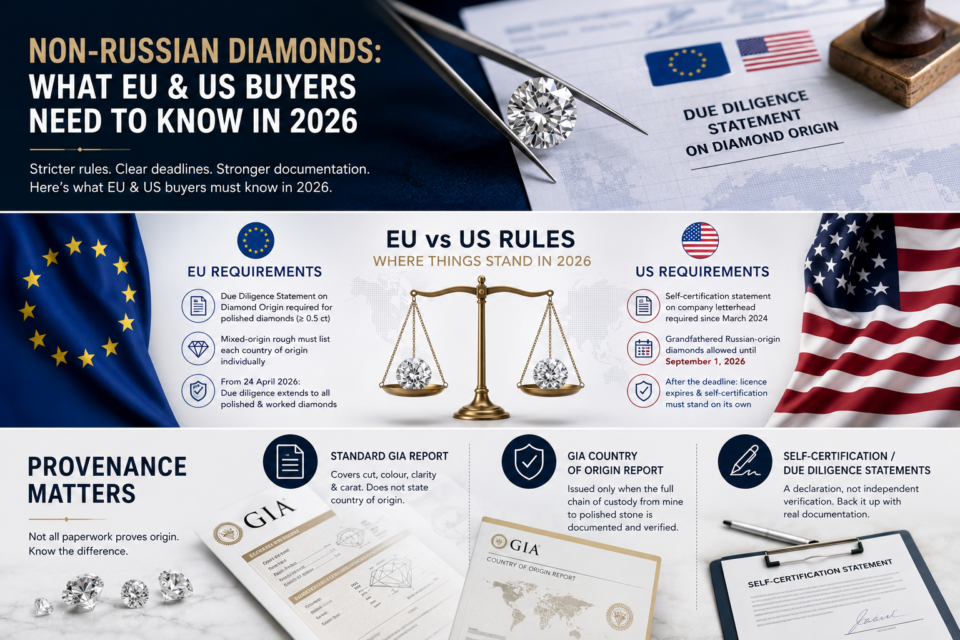
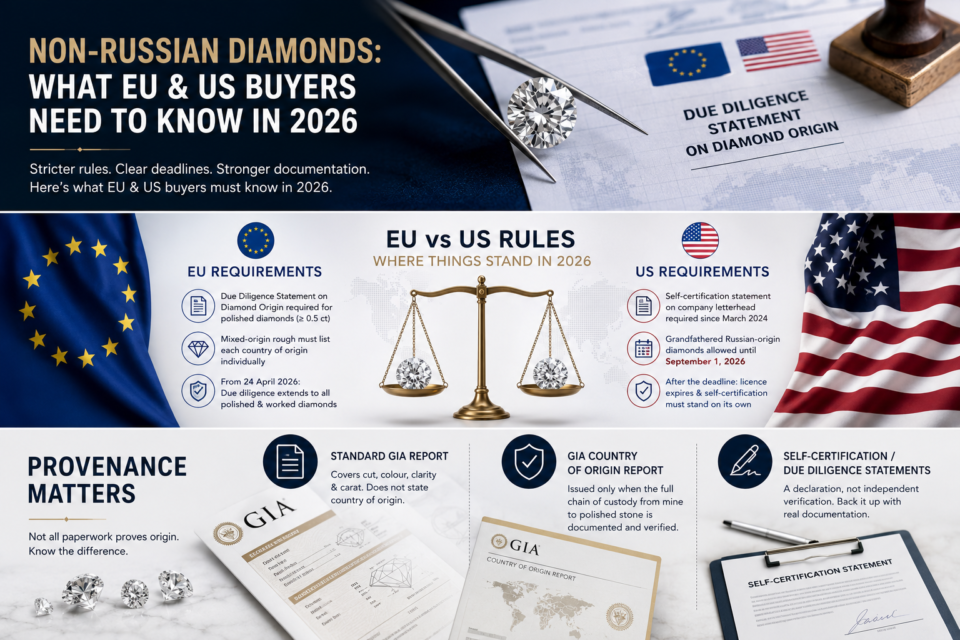
The EU has been sanctioning Russian-origin diamonds since January 2024, but the mechanism for proving non-Russian origin has been pushed back twice — first from March 2025, then again, before finally taking effect on January 1, 2026. As of that date, the mandatory traceability and certification system for polished diamonds is fully operational, and importers bringing in natural polished diamonds of 0.5 carats or larger must attach a Due Diligence Statement on Diamond Origin to their customs declaration, confirming the goods are not of Russian origin.
The EU has also closed a route that previously gave some flexibility: mixed-origin declarations on Kimberley Process certificates are no longer accepted for rough diamond imports. Where a shipment of rough contains stones from multiple countries, each country of origin now has to be stated individually, ideally on the invoice or packing list — a documentation standard that requires your upstream supplier to actually know, and disclose, where each parcel originated.
A further tightening lands later this year. Under the EU’s 20th sanctions package, from 24 April 2026 importers of polished and worked diamonds are required to provide a due diligence statement confirming the goods were not mined, processed, or produced in Russia — extending the obligation beyond the original traceability evidence requirement for rough.
Where the US Rules Stand Now
The US approach has been structurally different from the EU’s throughout — built on self-certification rather than a centralised traceability mechanism — but it has its own deadline arriving in 2026.
Since March 2024, US Customs and Border Protection has required a self-certification statement on company letterhead with each relevant entry, attesting that the shipment contains no diamonds of Russian origin or diamonds exported from Russia. That requirement hasn’t changed in substance. What has changed is the treatment of “grandfathered” stock — diamonds that left Russia before the relevant cut-off dates in 2024 and have been sitting in inventory or trade pipelines since.
The Treasury’s Office of Foreign Assets Control originally set September 2025 as the deadline after which grandfathered Russian-origin diamonds could no longer enter the US. That deadline was extended by one year, to September 1, 2026, to bring the US timeline closer in line with the G7’s January 2026 traceability milestone. After that date, the licence allowing legacy goods to clear US customs expires, and self-certification alone will need to stand behind every shipment containing stones that trace back to pre-2024 Russian origin, regardless of how long they’ve already been in the trade pipeline.
Why a GIA Report Alone Doesn’t Settle the Question
A standard GIA grading report tells you cut, colour, clarity, and carat. It does not, on its own, state country of origin. For buyers who need to document non-Russian provenance — which, under current EU and tightening US rules, increasingly means every buyer — that distinction matters.
GIA’s Country of Origin service is a separate report from standard grading, issued only where the diamond’s full chain of custody, from mine to polished stone, can be documented and verified. Not every diamond in the market has one, and not every supplier can obtain one on request, because it depends entirely on what documentation existed at the point the rough was first recorded. A stone without a prior origin claim cannot retroactively be issued one — which means provenance has to be built into the sourcing decision at the point of purchase, not requested after the fact when a customs declaration is due.
This is also where self-certification in the US and due diligence statements in the EU diverge from what a GIA Country of Origin report actually proves. Self-certification is a declaration; it is not independent verification. A GIA origin report, where available, is closer to documentary evidence — and for buyers who want their compliance position to be more than a signed statement, sourcing stones with traceable origin documentation is the more defensible position, even where the regulation itself doesn’t yet mandate it.
What This Means for How You Brief a Supplier
For EU buyers, the practical requirement now is straightforward to state and harder to fulfil: every polished diamond import of 0.5 carats or larger needs a Due Diligence Statement on Diamond Origin, and every rough shipment of mixed origin needs each constituent country named individually on the Kimberley Process documentation. A supplier who cannot tell you the country of origin for each parcel in a mixed shipment is not equipped to support an EU import under the current rules.
For US buyers, the priority is auditing your own inventory and incoming stock against the September 2026 deadline. Anything still moving on the strength of the grandfathered licence needs to clear before the licence expires, and self-certification statements need to be backed by genuine knowledge of provenance, not a templated declaration signed without underlying evidence. CBP and the Jewelers Vigilance Committee have both indicated that documentary evidence may be requested even where self-certification is the formal requirement, which means the underlying paperwork still needs to exist even if it isn’t submitted by default.
For both markets, the underlying shift is the same: provenance has moved from being a sourcing preference to being an import requirement, and the suppliers worth building a long-term relationship with are the ones who can document origin at the point of sale, not the ones who promise to look into it when a customs officer asks.
The Raremonds Position on Origin and Traceability
Raremonds sources and supplies natural diamonds with documented, traceable origin, and we work directly with clients to confirm what documentation a specific shipment requires before it ships — EU due diligence statements, US self-certification language, or GIA Country of Origin reports where provenance needs to be independently verifiable rather than declared.
With two generations in the natural diamond trade and established relationships across our sourcing network, we know the origin of what we supply, and we don’t treat that as a question to answer only when a customs form requires it. For EU and US buyers navigating the 2026 deadlines, that means the compliance conversation happens at the sourcing stage, not after a shipment is already in transit.
See our collection:
https://raremonds.com/what-makes-a-diamond-perform-beyond-the-certificate/
https://raremonds.com/the-ultimate-guide-to-buying-wholesale-diamonds-for-jewellers/
https://raremonds.com/why-most-online-diamond-listings-are-misleading/
Frequently Asked Questions
Are all Russian-origin diamonds banned from the EU and US in 2026?
Direct imports of Russian-mined diamonds have been banned across G7 countries, including the EU and US, since 2024. What’s changed for 2026 is enforcement: the EU’s traceability and certification mechanism for polished diamonds became fully mandatory on January 1, 2026, and the US licence permitting legacy “grandfathered” Russian-origin stock to clear customs expires September 1, 2026. After these dates, documentation requirements tighten considerably in both markets.
Does a standard GIA certificate prove a diamond is non-Russian?
No. A standard GIA grading report covers cut, colour, clarity, and carat weight, not country of origin. Proving non-Russian origin requires either a separate GIA Country of Origin report, where the diamond’s documented chain of custody supports one, or the due diligence and self-certification statements required under EU and US import rules respectively. Buyers should not assume standard grading paperwork satisfies origin requirements.
What’s the difference between EU and US requirements for non-Russian diamonds?
The EU operates a mandatory traceability and certification mechanism, requiring a Due Diligence Statement on Diamond Origin for polished diamond imports and individually listed countries of origin for mixed-origin rough shipments. The US relies on self-certification — a signed statement on company letterhead — without a centralised verification mechanism, though documentary evidence may still be requested by Customs and Border Protection.
What happens to existing Russian-origin inventory after the US grandfather deadline?
Diamonds that left Russia before the 2024 cut-off dates have been permitted into the US under a licence extended to September 1, 2026. After that date, the licence expires, and legacy stock can no longer rely on grandfathered status to clear US customs. Buyers holding inventory that depends on this provision should confirm its status and clear it before the deadline.
How can a buyer verify a supplier’s origin claims rather than just accepting a declaration?
The most defensible verification is a GIA Country of Origin report, which requires documented chain of custody from mine to polished stone and is independently issued rather than self-declared. Where that isn’t available, buyers should ask suppliers directly for Kimberley Process documentation, country-of-origin breakdowns for mixed shipments, and a clear account of where in the supply chain provenance was first recorded, rather than relying on a general assurance of ethical sourcing.

.png)