

Two stones with identical certificates can sit side by side in a diamond pairs of earrings and look like they came from different parcels. That is not a rare outcome. It is the default outcome when a pair is matched on grade alone — and grade alone is what most platform listings and most suppliers actually match against.
For high jewellery and fine earrings, a mismatched pair is the most visible kind of mistake a buyer can make. The client isn’t comparing one stone to a certificate. They are comparing the left ear to the right, side by side, in the mirror, under whatever light their bathroom or their dinner table happens to have. If the pair doesn’t read as identical in that moment, the certificate match means nothing.
This is what matching a pair actually requires, and where most sourcing goes wrong.
What “Matched” Actually Means at Trade Level
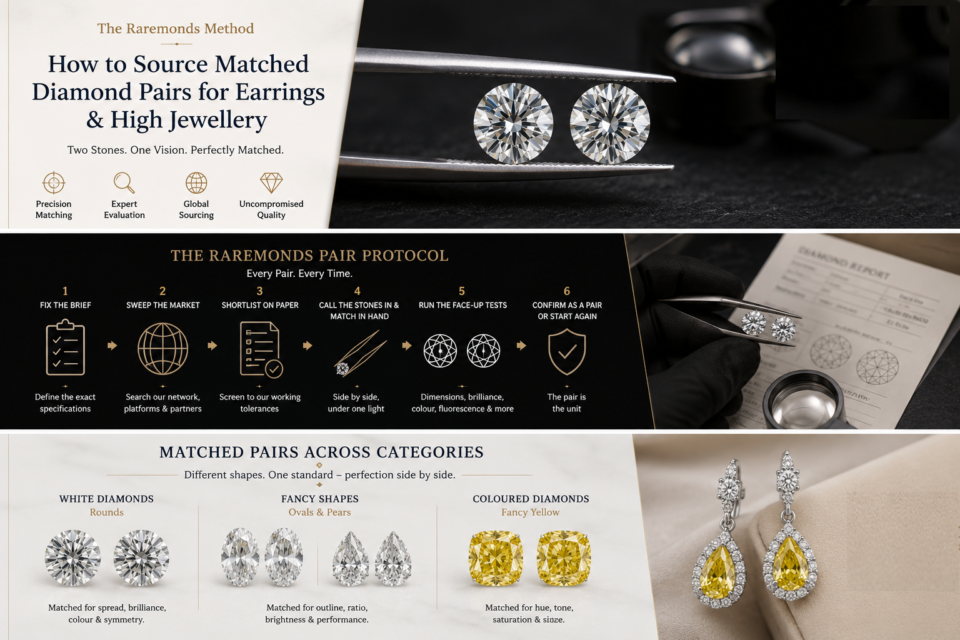
A matched pair on paper means two stones share the same shape, similar carat weight, and the same grade for colour and clarity. That is the minimum bar, and it is also where most suppliers stop. It is not where a buyer building a finished piece can afford to stop.
A genuine matched pair needs to share colour temperature — not just the GIA letter grade, but how that colour actually reads face-up, since two stones at the same grade can carry different secondary hues that become visible the moment they sit beside each other. It needs matched cut profile, because two stones with the same proportions on paper can return light differently depending on how the rough was cut. For fancy shapes, it needs matched optical character — bow-tie behaviour in ovals and pears, brilliance pattern in cushions — since two stones at an identical grade can perform completely differently under the same light. And it needs matched fluorescence, because mismatched fluorescence strength between two stones in a pair will cause one to read warmer or hazier than the other under UV-rich lighting, even when both grade identically on the report.
Calibrated size — meaning both stones cut to the same millimetre dimensions, not just the same carat weight — matters as much for setting integrity as it does for visual symmetry. Two stones at 1.00ct each can sit at noticeably different diameters depending on depth and cut style, which creates an asymmetry in the setting itself, independent of how the stones look.
Why the Certificate Cannot Confirm a Match
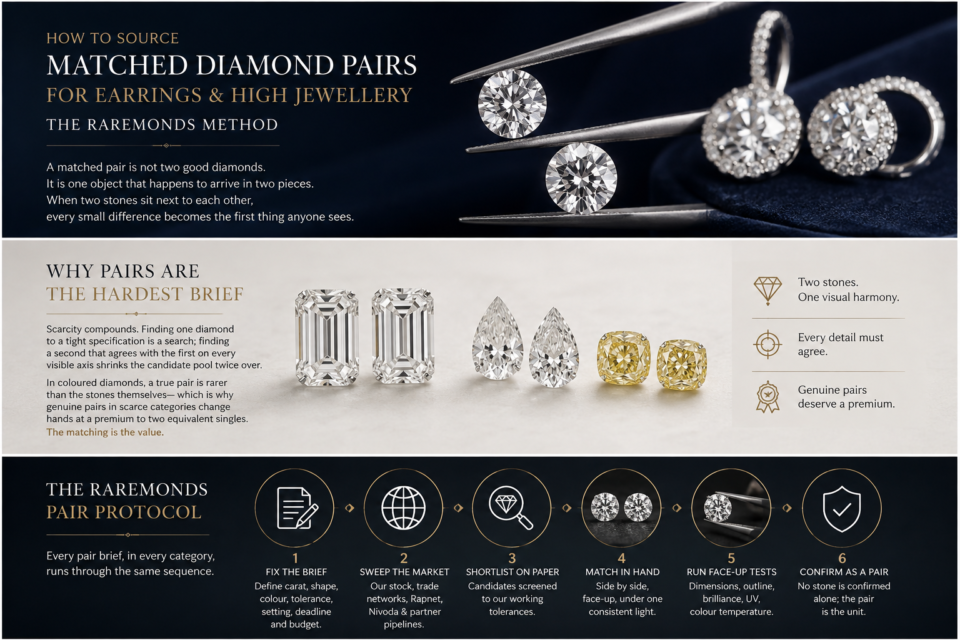
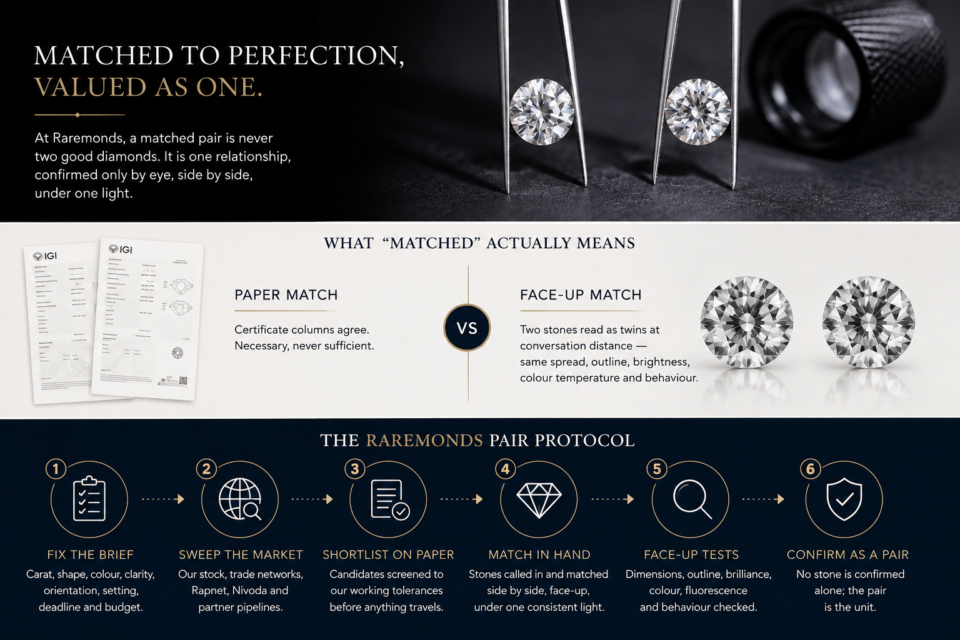
GIA grades each diamond individually, against absolute standards, not against another stone. Two reports showing identical grades tell you both stones meet the same threshold — they do not tell you the stones look the same next to each other.
This is a meaningful distinction for trade buyers. Colour grading happens in increments wide enough that two stones at the bottom and top of the same letter grade can show a visible difference once they’re set side by side. Clarity grading describes the presence and visibility of inclusions in isolation, not how two different inclusion patterns compare optically. Cut and fluorescence, as covered above, are not directly comparable across two separate reports at all.
The only way to confirm a genuine match is to evaluate both stones together, side by side, under the same light source — which means sourcing a pair on certificate alone, without that physical side-by-side evaluation, is sourcing a guess.
The Specific Risk in Fancy Shapes
Matching becomes considerably harder once you move beyond round brilliants, and this is where most pair mismatches in finished jewellery actually originate.
In oval and pear pairs, bow-tie character has to be matched, not just grade. A pair where one stone carries a dynamic bow-tie and the other a static one will look like two different stones in the same setting, regardless of identical certificates. In cushion pairs, faceting style — chunky versus crushed-ice — needs to match, since the two patterns produce visibly different brilliance and won’t read as a pair even at identical grades. In emerald and other step-cut pairs, clarity becomes more critical to match precisely, because the open table of a step cut makes any visible difference in inclusion pattern between the two stones immediately apparent.
A supplier sourcing fancy shape pairs from separate parcels, matched only on the specification sheet, is relying on coincidence to produce a genuine visual match. It happens occasionally. It is not a sourcing strategy.
Calibrated Diamonds for Multi-Stone Layouts
The matching standard becomes more demanding, not less, once you move from a pair to a graduated suite or a multi-stone layout. A three-stone ring, a tennis bracelet, or a pavé border requires every stone in the set to share consistent colour temperature, cut character, and — where relevant — bow-tie or brilliance behaviour across the entire run, not just between two stones.
For manufacturers building a SKU around a layout, this also has to be reproducible. A layout that matches perfectly the first time but cannot be matched again on reorder is a problem that surfaces months later, when a client wants a second piece or a collection needs replenishing. Sourcing depth — meaning access to enough comparable rough and cut stones to match a layout consistently across multiple orders — is what separates a supplier who can support a repeat SKU from one who got lucky once.
A Buyer’s Checklist for Sourcing Matched Pairs
Whether you buy from Raremonds or anyone else, these are the questions that separate a supplier who matches stones from one who matches certificates:
- Have the stones been physically evaluated side by side under the same light source, or matched only on paper specification?
- For colour: has secondary hue and face-up colour temperature been compared, not just the GIA letter grade?
- For fancy shapes: has optical character — bow-tie, faceting style, brilliance pattern — been matched, not just symmetry grade?
- Has fluorescence strength been compared across both stones under UV-rich light?
- Are the stones calibrated to matching millimetre dimensions, not just equivalent carat weight?
- Can the supplier reproduce this match on a reorder, or was this pair a one-time coincidence?
A supplier operating at trade standard can answer all six immediately, with specifics. A supplier matching from a spreadsheet will hedge on most of them.
The Raremonds Position on Matched Pairs and Layouts
Raremonds does not match pairs on certificate alone. Every pair and layout we supply is evaluated stone by stone, side by side, under consistent lighting — assessing colour temperature, cut profile, fluorescence behaviour, and, for fancy shapes, optical character including bow-tie consistency — before it is confirmed as a match.
With two generations in the natural diamond trade, we hold sourcing depth across white and coloured stones that allows us to match pairs precisely and reproduce layouts consistently across reorders — so a design that sells once can be replenished without a visible mismatch creeping into the second or third run. For manufacturers building a SKU around a matched layout, this reproducibility is as important as the initial match itself.
See our collection:
https://raremonds.com/non-russian-diamonds-what-eu-us-buyers-need-to-know/
https://raremonds.com/why-most-online-diamond-listings-are-misleading/
https://raremonds.com/how-diamond-dealers-actually-price-fancy-coloured-diamonds/
https://raremonds.com/what-makes-a-diamond-perform-beyond-the-certificate/
Frequently Asked Questions
Can two diamonds with identical GIA certificates still be a poor match for earrings?
Yes, and this happens more often than buyers expect. GIA grades each stone individually against absolute standards, not against each other. Two stones at the same colour and clarity grade can carry different secondary hues, different cut profiles, and different fluorescence strengths — all of which are invisible on the certificate but immediately visible once the stones sit side by side in a finished pair.
What’s the difference between a calibrated pair and a matched pair?
Calibrated refers to the stones sharing identical millimetre dimensions, which matters for setting integrity and visual symmetry. Matched refers to the stones sharing visual character — colour temperature, cut performance, and optical behaviour. A genuinely well-sourced pair needs to be both: calibrated in size and matched in appearance. A pair can be calibrated without being matched, and vice versa.
Why is matching fancy shapes like ovals and pears harder than matching rounds?
Round brilliants are cut to a standardised, symmetrical facet pattern, which makes matching more predictable. Fancy shapes carry individual optical characteristics — bow-tie behaviour in ovals and pears, faceting style in cushions — that vary stone to stone and don’t appear on the grading report. Matching fancy shapes requires comparing this optical character directly, not just the specification sheet.
How do I ensure a matched layout can be reproduced if I need to reorder?
This depends on your supplier’s sourcing depth, not just their ability to match stones once. Ask explicitly whether they can match the bow-tie character, colour temperature, and cut profile of the original layout on a future order — not just the carat and grade specification. A supplier who matched your first run by chance, from a single parcel, may not be able to repeat it.
Does Raremonds supply matched pairs in both white and coloured diamonds?
Yes. We match pairs and layouts across white diamonds and natural fancy coloured diamonds, evaluating colour temperature, cut performance, fluorescence, and — for fancy shapes — optical character including bow-tie consistency, before confirming any pair or layout as matched.

.png)