

Blue is the most demanding category in the natural coloured diamond business, and almost none of what makes it demanding has anything to do with how it looks. It is the rarest of the major fancy colours, the most capital-intensive stone most desks will ever carry, the least liquid, and the one where a single error in origin, grading or pricing can cost more than a year’s margin on white goods. For a trade buyer — a brand, a manufacturer, a high jewellery house, a serious retailer or a family office — blue is where expertise and process stop being a nicety and become the whole game.
This isn’t a buyer’s guide. It’s a working note on how blue actually moves through the trade: where the supply comes from and why it’s tightening, how you price a stone that has no price list, what a GIA report does and doesn’t settle, the grading quirk at the faint end that the trade keeps arguing about, the synthetic-and-treatment exposure that can sink a reputation, and the documentation and transparency that let a serious buyer move with confidence. Two generations in the natural diamond trade have taught us that in blue, the desk that wins is the one with origin discipline, pricing judgment and a real network — not the one with the prettiest stone.
The supply you’re working against
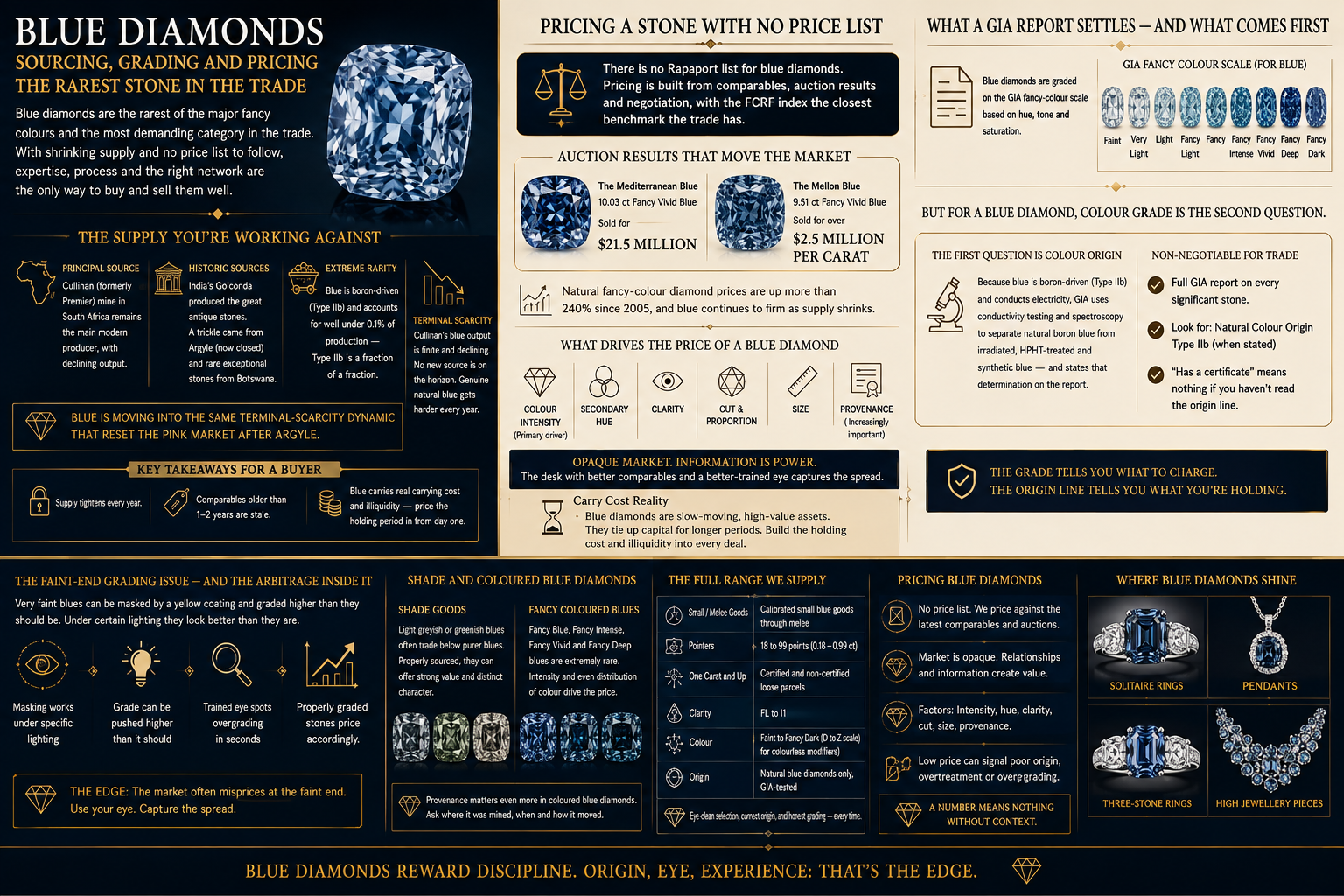
Blue owes its colour to boron, which makes it a Type IIb diamond and, incidentally, an electrical semiconductor — a fact that matters later for authentication. Boron is so scarce in the mantle that natural blue accounts for well under a tenth of one percent of production; Type IIb is a fraction of a fraction.
Historically the supply has run through a handful of sources: the Cullinan (formerly Premier) mine in South Africa as the principal modern producer, India’s Golconda for the great antique stones, a trickle of blue-violet from Argyle before it closed, and the rare exceptional stone from Botswana. The operative word is historically. Cullinan’s blue output is finite and declining, and there is no new source on the horizon. Blue is moving into the same terminal-scarcity dynamic that reset the pink market after Argyle — which means two things for a buyer: genuine natural blue gets harder to secure every year, and any internal price comparable more than a year or two old should be treated as stale.
Pricing a stone with no price list
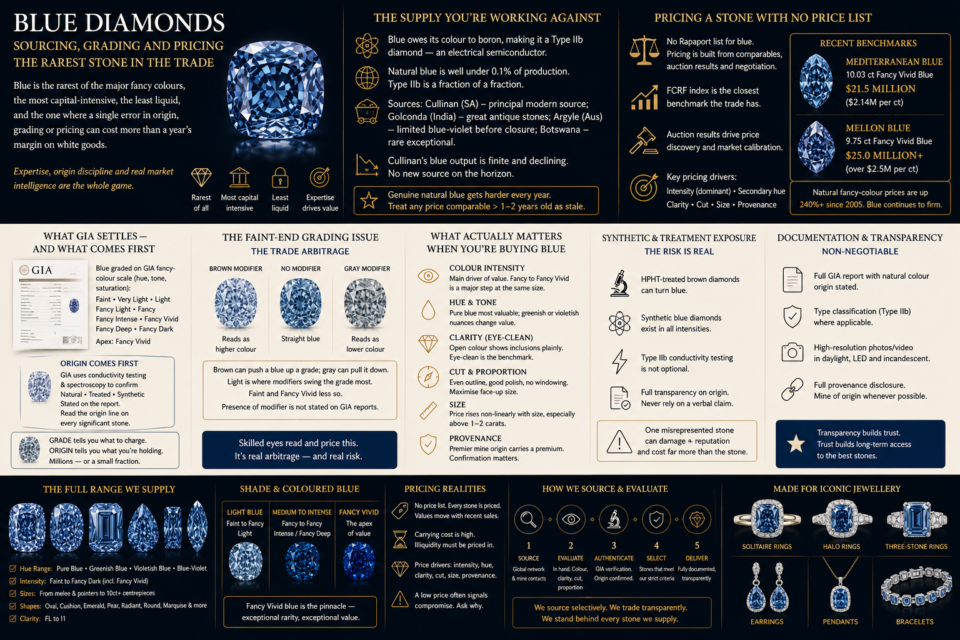
Here is the first thing that separates blue from white-goods trading: there is no Rapaport list for it. Colourless diamonds trade off a published sheet; fancy-colour blue does not. Pricing is built from comparables, auction results and negotiation, with the Fancy Color Research Foundation (FCRF) index the closest thing the trade has to a benchmark.
This is exactly why auction results matter to a working desk — not as trophies, but as the primary public price-discovery mechanism in a market with almost no transparency. When a 10-carat Fancy Vivid like the Mediterranean Blue makes $21.5 million, or the Mellon Blue clears over $2.5 million per carat, those prints become reference points the whole trade calibrates against. Natural fancy-colour prices are up more than 240% since 2005, and blue specifically continues to firm against shrinking supply.
Operationally, pricing a blue is a judgment built on intensity (the dominant driver — the multiple from Fancy to Fancy Vivid at the same size is large), secondary hue, clarity, cut, size and, increasingly, provenance, triangulated against the most recent comparable sales you can find. It is opaque, it rewards information, and the desk with better comparables and a better-trained eye captures the spread. The corollary for anyone reselling into a client: blue carries real carrying cost and real illiquidity. These are slow stones tying up large capital, and the holding period has to be priced into the deal from the start.
Color Diamonds Collections:
Natural Yellow Diamonds | Natural Pink Diamonds | Natural Blue Diamonds | Natural Green Diamonds | Natural Brown Diamonds | Natural Chameleon Diamonds | Natural Purple Diamonds | Natural Orange Diamonds | Natural Gray Diamonds
Diamond Shaped Collections:
Natural Round Brilliant Diamonds | Natural Pear Shaped Diamonds | Natural Oval Diamonds | Natural Marquise Diamonds | Natural Radiant Cut Diamonds | Natural Emerald Cut Diamonds | Natural Cushion Cut Diamonds
What a GIA report settles — and what comes first
Blue is graded on the GIA fancy-colour scale — Faint, Very Light, Light, Fancy Light, Fancy, Fancy Intense, Fancy Vivid, Fancy Deep, Fancy Dark — on hue, tone and saturation, with Fancy Vivid the apex. But for a blue stone the colour grade is the second question. The first is colour origin: natural, treated, or laboratory-grown. Because blue is boron-driven and Type IIb stones conduct electricity, GIA can separate natural boron blue from irradiated, HPHT-treated and synthetic blue using conductivity testing and spectroscopy, and it states that determination on the report.
For trade purposes the non-negotiable is a full GIA report confirming natural colour origin and, ideally, type classification. “Has a certificate” is meaningless if you haven’t read the origin line. The grade tells you what to charge; the origin line tells you whether you’re holding a stone worth millions or a treated stone worth a small fraction of it. Demand it on every significant stone, every time.
The faint-end grading issue — and the arbitrage inside it
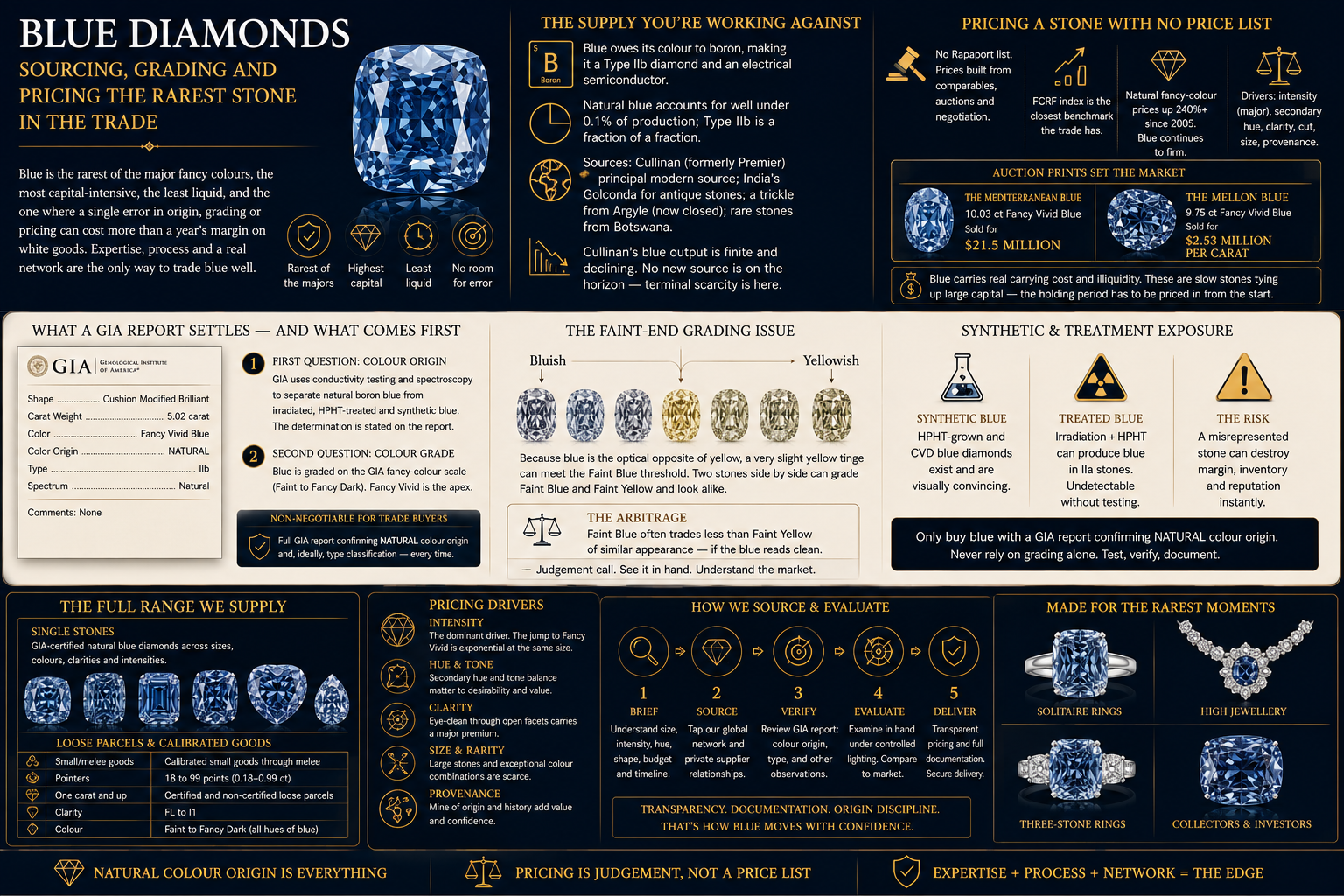
There’s a grading quirk at the faint end of blue that carries a direct commercial edge, and the trade argues about it for good reason. Because boron blue is the optical opposite of yellow, a very slight blue cancels the yellow tint the D-to-Z scale measures, so a barely-blue Type IIb stone faces up exceptionally white. In practice GIA frequently grades these on the ordinary colourless scale, where they land as a high white — often E or F — rather than as “Faint Blue” on the fancy scale.
On paper, a technicality. On a desk, real money. The same stone is either a colourless E/F white, priced off the relative transparency of the white market, or a rare Faint/Very Light Blue boron Type IIb that can carry a blue premium. That boundary is a judgment call, and it creates a genuine grade arbitrage: borderline stones get submitted with one outcome or the other in mind, because the value swing between “white” and “blue” on the same piece of carbon is large. It also creates re-grade risk — the same faint stone can read differently on resubmission, and that tolerance lands straight on your margin. The takeaway for a trader is that at the faint end you cannot deal off the letter grade alone. You need someone who can read the boron and the Type IIb character, tell you which side of the line a stone really sits, and price it accordingly.
Synthetics, treatment, and the trust behind every stone
The single biggest operational risk in blue is not overpaying for a natural stone; it’s putting a treated or synthetic stone into the chain as natural. The market is full of blue that isn’t naturally so. Irradiation produces blue and greenish-blue from near-colourless rough; HPHT pushes faint stones bluer; and lab-grown blue — boron-doped CVD and HPHT synthetic — now exists in volume at a fraction of natural prices, right down to melee. All of it can be beautiful. None of it carries natural value or appreciation.
For a supplier, this is fundamentally about trust. Putting a treated or synthetic stone into a client’s hands as natural — even unknowingly — is the kind of mistake that ends a relationship, and no amount of beauty in the stone makes up for it. Two disciplines protect everyone in the chain. On significant single stones, a GIA origin report confirming natural colour, full stop. On parcels and melee — where synthetic contamination is a live and growing problem in accent goods — batch screening, because a single undisclosed synthetic blue melee stone mixed into a parcel can compromise an entire production run and the confidence behind it. A greenish-blue stone should always prompt the origin question specifically, since irradiation so often produces that hue. This is exactly the discipline we apply to everything we supply: every blue screened and its natural origin confirmed before it reaches you.
Provenance, documentation and transparency
Where a blue comes from is part of its value, and a serious buyer should expect to see it documented. Beyond the GIA colour-origin report, a clean, traceable provenance back to a source like Cullinan gives a client real confidence in exactly what they’re buying — and well-documented stones simply stand stronger, in the market and on resale, than those with a vague or unverifiable history.
This is where the right supplier earns their place. We give you a transparent, fully documented account of every stone we offer — origin, grading and where it came from — so you always know precisely what you’re holding and can put it in front of your own client with the same confidence. In a category this opaque, that transparency is the difference between a one-off transaction and a relationship that keeps a buyer coming back.
Cut and the manufacturing trade-off
Blue cutting is a value decision, not an aesthetic one. Because the rough is so scarce and costly, cutters are forced to weigh weight retention against colour and brilliance, and a stone cut to hold carat from the rough will often face up with its colour spread thin. Cushions, ovals and pears tend to deepen and concentrate the blue; step cuts read cleaner and more restrained. For a dealer, two things follow: judging how well a stone’s cut serves its colour is part of pricing it, and there is occasionally real value in spotting a poorly cut blue whose colour could be lifted by recutting — a manufacturing call only worth making with this category’s economics firmly in mind.
Overtones — what moves and what to watch
Pure blue is the benchmark and the most prized; most blues carry a gray, green or violet modifier. Gray — the most common — generally mutes and discounts, though it can be extraordinary at the top (the Hope is a Fancy Deep Grayish-Blue). Green discounts and, again, flags a possible treatment. Violet is rarer and can carry collector appeal. But in blue the modifier is a refinement: origin and intensity move price far more than secondary hue.
| Modifier | Example GIA designation | Effect vs pure blue (same intensity) | Trade note |
| Greenish blue | Fancy Greenish Blue | Discount — and a treatment red flag | Irradiation commonly yields this hue; verify origin before pricing |
| Grayish blue | Fancy Grayish Blue, Fancy Deep Grayish-Blue | Discount; grey mutes saturation | The most common modifier in the market; the Hope’s hue |
| Violet / violetish blue | Fancy Violetish Blue, Violet-Blue | Around pure; rare | Collector interest can support price |
| Pure / straight blue | Fancy → Fancy Intense → Fancy Vivid (Deep / Dark when darker) | Benchmark — most prized; Fancy Vivid the apex | Anchors the auction comparables |
Origin and intensity dominate blue pricing; the modifier is a second-order adjustment.
The lighter blues — a commercial tier of their own
Not all of the blue business sits at the trophy end. The lighter intensities — Faint, Very Light, Light and Fancy Light Blue — are a substantial, fast-moving commercial segment, and demand for them is strongest across the Far East. In China, Hong Kong, Taiwan and Japan, pale, icy blues sell in real volume as price-point blue jewellery, at a fraction of the cost of a saturated stone and far more attainable for a broad client base. For a desk that matters in two ways. These grades actually turn over — no small thing in a category defined by illiquidity at the top. And they tie straight back to the grading point above: a stone recognised as a Light or Very Light Blue, rather than absorbed into the white scale as an E or F, can be sold into that Far East blue market at a blue price. The lighter end isn’t a consolation tier; in the right markets it’s where a great deal of the actual turnover lives — which is exactly why getting the grade designation right on these stones is a commercial decision, not a cosmetic one.
Pairs, parcels and calibrated goods
Matching is where blue punishes thin supply hardest. A matched pair — for earrings, or a layout — means two stones agreeing on tone, saturation, secondary hue and origin, pulled from a global pool that is already minuscule; it is the hardest matching in coloured diamonds and can take months. For manufacturers and brands the harder ask is calibrated blue in quantity — matched melee or small goods for a production run — which at natural-blue scarcity is genuinely difficult, and is exactly where undisclosed synthetic melee tends to creep into the supply. None of this is a listings exercise. It takes reach into the market, patience, screening discipline, and an eye that has compared blues side by side. We match blue in person, with origin confirmed on every stone, before anything is offered as a pair, suite or parcel.
How we work — terms, goods, and clients
Raremonds have sourced and evaluated natural diamonds since 1985, and blue is where our process is tightest. We supply natural blue across the spectrum a trade client actually needs: investment-grade single stones with full GIA origin and documented provenance; statement centre stones for high jewellery and bespoke commissions; and, where it can be done honestly, matched pairs and calibrated goods for production — every stone evaluated in hand and origin-confirmed, never listed off a screen. We supply full origin and provenance documentation for complete transparency, and price openly against the best comparables available — so you can see exactly how a number was reached. If you’re sourcing blue to a brief — intensity, secondary-hue tolerance, clarity, shape, carat range, provenance and commercial terms — send it over, and we’ll come back with options that are real, evaluated, and honestly priced, with the reasoning behind every number.
Send your requirement to Raremonds → WhatsApp Parth directly: +91 98193 47999
The short version
Blue is the trade’s highest-stakes, lowest-liquidity colour, and the hard parts are operational, not visual. It has no price list, so pricing is comparables-and-auction-driven with the FCRF index as the benchmark. The colour grade is secondary to confirming natural origin, because treated and synthetic blue — down to melee — is everywhere. At the faint end, genuine boron blues get graded as plain E–F whites, and there’s real arbitrage and opportunity in that boundary. Clear, documented provenance sets a stone apart and supports its value. And matching blue at any volume is the hardest job in the category. Win the work — pricing, origin, guidance and transparency — and blue is the best business in coloured diamonds. That work is what we do.
FAQ
How do you price a blue diamond when there’s no Rapaport list?
From comparables, recent auction results and negotiation, with the Fancy Color Research Foundation (FCRF) index as the nearest benchmark. Intensity is the dominant driver, adjusted for secondary hue, clarity, cut, size and provenance, and triangulated against the most recent comparable sales. The market is opaque by nature, which means information and a trained eye are where the margin sits.
What documentation should come with a blue diamond?
A full GIA report confirming natural colour origin is the single most important document — it tells you the colour is natural rather than treated or lab-grown, which is what the price rests on. Alongside it, expect clear documentation of the stone’s provenance, so you know where it came from. We provide both as standard on every blue we offer: the colour grade tells you what to pay, and the origin and provenance tell you exactly what you’re paying for.
How do I protect a parcel from synthetic blue contamination?
Screen melee and small goods in batches, and insist on GIA origin reports for significant stones. Lab-grown blue now reaches down to melee, and a single undisclosed synthetic in a parcel can compromise an entire production run. We screen the goods we supply and stand behind their natural origin, so what you receive from us is exactly what it’s represented to be.
How does Raremonds help me procure a blue diamond?
On the three things that decide a blue purchase: pricing, guidance and transparency. Because blue has no published price list, we price every stone against the best current comparables and walk you through the reasoning, so you know the number is fair. We guide you on what’s realistic for your brief and budget — intensity, hue, cut and size — and where the genuine value sits. And we give you a fully documented, transparent account of every stone, including its origin and grading, so you can buy, and resell, with complete confidence.
Why do faint blues come back graded E or F instead of Faint Blue, and why does it matter commercially?
Because boron blue offsets yellow, a faint blue makes the stone face up whiter, so GIA often grades it on the D-to-Z scale as a high white rather than as Faint Blue. The same stone can therefore be priced as a colourless E/F white or as a rare boron blue — a large value swing that creates both arbitrage and re-grade risk. At that boundary you need an expert read of the boron and Type IIb character to know, and price, which side of the line a stone falls on.
Can you source calibrated blue or matched pairs for production?
Yes, where it can be done honestly — matched pairs, suites and calibrated goods with origin confirmed on every stone. Natural-blue scarcity makes volume matching genuinely hard and is precisely where synthetic melee enters the market, so everything is screened and evaluated in hand before it’s offered.

.png)