

Green is the rarest of the primary fancy colours and, by some distance, the hardest to buy well. The colour often can’t be proven natural, the price swings by an order of magnitude on a single line of a report, and more green diamonds come back from the laboratories marked “undetermined” than any other colour. None of that should put a serious buyer off — handled with the right expertise, green is one of the most rewarding stones in the trade. It simply means green is a colour you do not buy without someone who genuinely knows it.
That is the work we do. Across two generations in the natural diamond trade, green is a colour we’ve spent years learning to read — the reports, the stones, and the market that sits behind them — so our clients can buy the right green at the right price, with no ambiguity about what they’re getting. This is a working note on how green actually behaves: where the colour comes from, why the origin question is so fraught, how the labs are closing the gap, the real market for undetermined stones, and — throughout — how we help you navigate all of it to the right stone.
What you’re actually dealing with
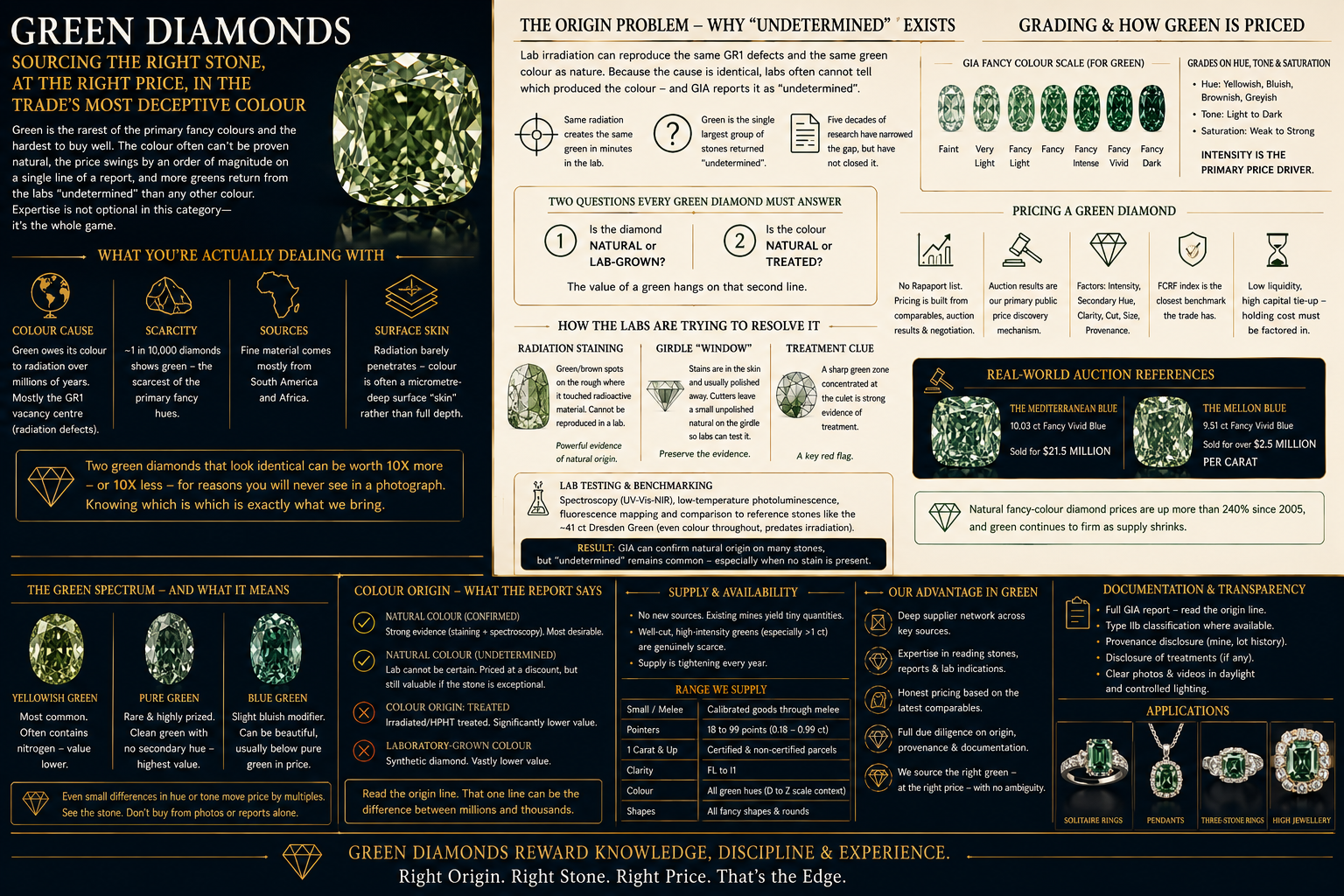
Green owes its colour to radiation. Over millions of years, a diamond sitting near uranium, thorium or radioactive fluids is bombarded by alpha particles that knock carbon atoms out of the lattice and create the vacancy defects — the GR1 centre above all — that absorb red light and turn the stone green. A few take their green from H3, hydrogen- or nickel-related defects instead. It’s a late, lucky accident of geology, and it’s rare: roughly one diamond in ten thousand shows green, the scarcest of the primary fancy hues, with the fine material coming mostly from South America and Africa. One quirk matters downstream more than any other: alpha radiation barely penetrates, so the green is often a surface “skin” only micrometres deep rather than a colour running through the stone — which shapes both how a green is cut and how its origin is judged.
This is the backdrop to every green decision, and it’s why the colour rewards knowledge over instinct. Two green diamonds that look identical to the eye can be worth ten times more — or ten times less — for reasons that never show up in a photograph. Knowing which is which, before you commit, is exactly what we bring.
The origin problem — why “undetermined” exists
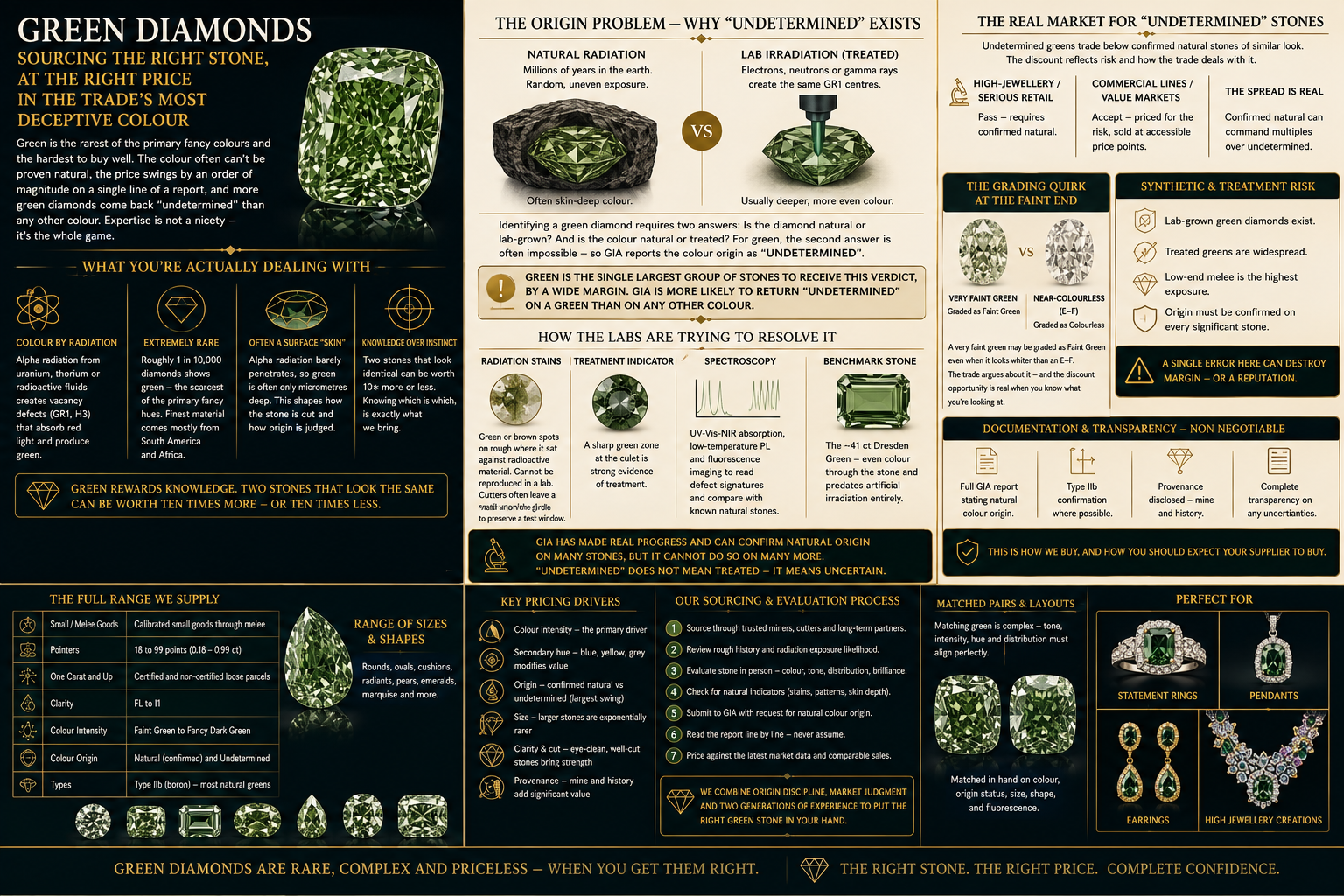
Here is the defining problem of the category. The same radiation that colours a green diamond in the ground can be reproduced in a laboratory — and has been, commercially, since the 1940s. Fire electrons, neutrons or gamma rays at a pale diamond and you create the very same GR1 vacancies, the very same green, often deeper and more even than nature manages. The physical cause of colour is identical whether it happened over a hundred million years in the earth or in minutes under an electron beam.
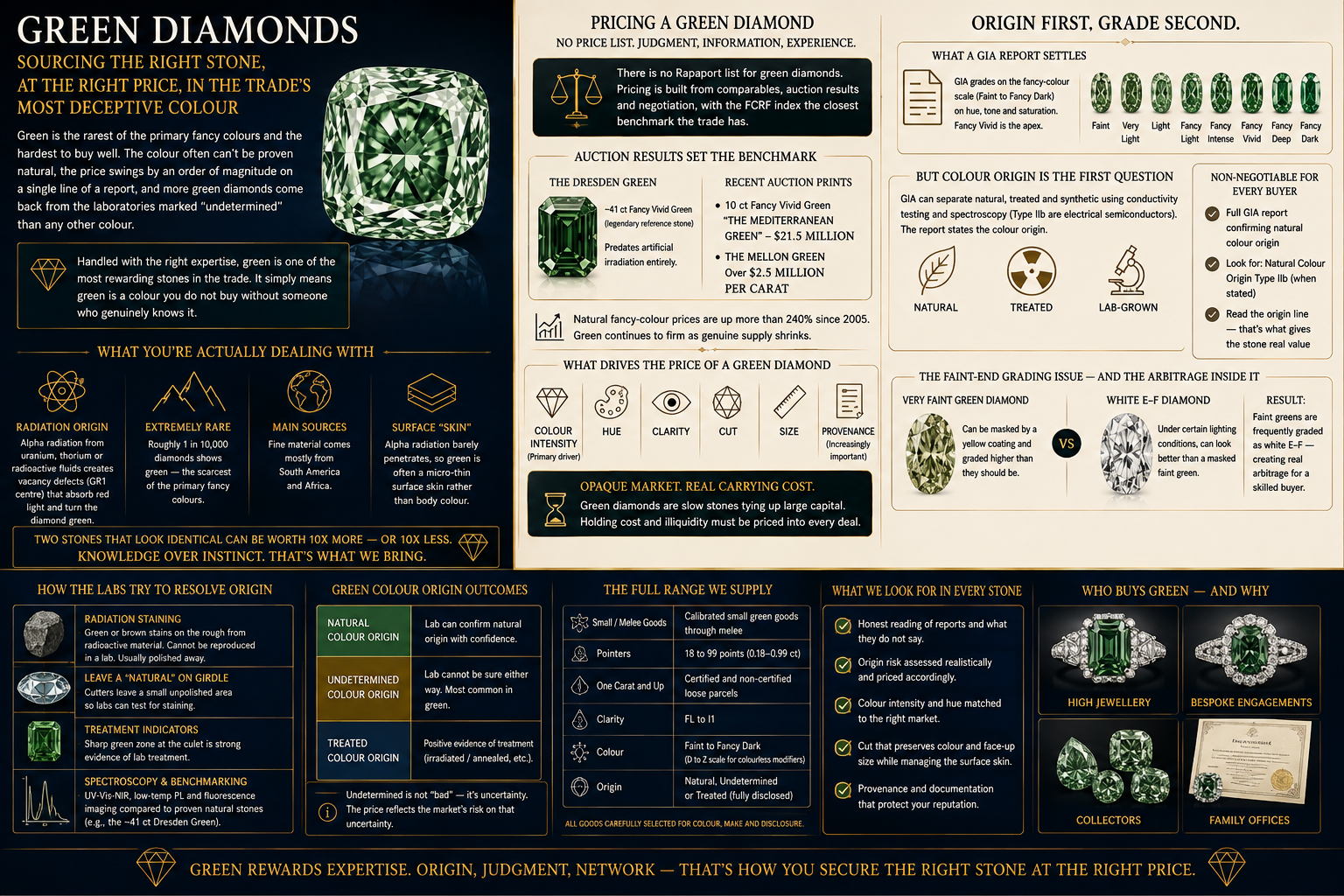
Identifying a coloured diamond is really two questions: is the diamond natural or lab-grown, and is the colour natural or treated. For green, the first is straightforward; the second is often impossible. Because lab irradiation so closely mimics natural exposure, the laboratories frequently cannot tell which produced a stone’s colour — and when they can’t, GIA reports the colour origin as “undetermined.” Green is the single largest group of stones to receive that verdict, by a wide margin, and GIA is more likely to return it on a green than on any other colour. Five decades of research have narrowed the gap but not closed it.
For a buyer, that uncertainty is the whole challenge of green — and the single best reason to work with someone who reads these stones and these reports every day. The value of a green hangs on a line that often says, in effect, “we cannot be sure,” and knowing how to act on that line is where real expertise starts.
Color Diamonds Collections:
Natural Yellow Diamonds | Natural Pink Diamonds | Natural Blue Diamonds | Natural Green Diamonds | Natural Brown Diamonds | Natural Chameleon Diamonds | Natural Purple Diamonds | Natural Orange Diamonds | Natural Gray Diamonds
Diamond Shaped Collections:
Natural Round Brilliant Diamonds | Natural Pear Shaped Diamonds | Natural Oval Diamonds | Natural Marquise Diamonds | Natural Radiant Cut Diamonds | Natural Emerald Cut Diamonds | Natural Cushion Cut Diamonds
How the labs are trying to resolve it
The labs are not helpless, and it pays to know what they look for — it’s exactly the knowledge that lets us tell you what a given report really means for you.
The strongest evidence of natural origin is radiation staining — green or brown spots left on the rough where it sat against radioactive material. These stains cannot be reproduced in a lab, so their presence is a powerful natural-origin signal. The catch is that they’re superficial, sitting in the skin of the stone, so they’re usually polished away in cutting — which is why you’ll see cutters deliberately leave a small unpolished “natural” on the girdle of a green to preserve a window of evidence the lab can test. Other features point the other way: a sharp green zone concentrated at the culet is strong evidence of treatment.
Beyond stains, the labs read defect signatures with spectroscopy — UV-Vis-NIR absorption, low-temperature photoluminescence and fluorescence imaging — and benchmark against known natural stones, most famously the roughly 41-carat Dresden Green, whose colour runs evenly through the whole stone and predates artificial irradiation entirely. The honest summary is that GIA has made real progress and can confirm natural origin on many stones, but there is still no single definitive test, and a large share of greens keep coming back undetermined. Tracking exactly where that line sits — what today’s testing can and can’t conclude — is part of how we keep clients from paying for certainty they don’t actually have.
The market for undetermined stones — and how we help you use it
This is where good guidance earns its keep, because “undetermined” isn’t the end of a stone’s life — it’s a market of its own, and a useful one once you understand it.
Origin drives green pricing more than anything else. A confirmed natural green is one of the most expensive things in the diamond world — fine stones run well past $100,000 a carat, and the Aurora Green set a per-carat record around $3.3 million. A confirmed treated stone is a cheap commercial good. An undetermined stone sits in between: priced far below a confirmed natural — the discount is often put at around 90% — because you cannot prove what it is, and yet it may genuinely be a natural stone that simply lost its radiation stains to the polishing wheel. That gap is both the opportunity and the risk.
So there’s a real market for undetermined greens, and it’s entirely legitimate to trade — provided everyone is honest about what’s changing hands. Some buyers treat these stones as a calculated bet that the colour is natural; others simply want a beautiful, sizeable, genuinely natural diamond in a green hue for a fraction of a confirmed natural’s price, and are happy to own the question. Our job is to put you on the right side of that decision. We’ll source a confirmed natural when that’s what your piece needs, or a documented undetermined stone at the honest price for what it is when that’s the smarter buy for your brief and budget — and we’ll always show you the report and tell you plainly which you’re holding, and exactly what you’re paying for the doubt. The one rule we never bend: an undetermined stone is sold as undetermined, never dressed up as confirmed natural. That line is the difference between a fair discount and fraud.
Getting the right price
With most colours, intensity leads to pricing. Green is the exception — the colour-origin line leads, and pricing it well is where expertise turns straight into money. Like all fancy colours, green has no Rapaport list to fall back on; value is built from comparables, auction results and the Fancy Color Research Foundation index, with the origin question layered on top, capable of moving a stone’s worth by an order of magnitude on its own. A confirmed natural, an undetermined stone and a treated stone of identical colour, clarity and size are three different products at three different prices.
This is precisely where a buyer needs a partner rather than a price list. We settle the origin tier first, then price the stone within it against the best comparables we can find, and we show you the working — what the tier is, what comparable stones have done, and why the number lands where it does. The result is that you pay the right price for the actual stone in front of you: not a confirmed-natural price for an undetermined stone, and not a treated price for a genuine rarity. In a colour this opaque, that clarity is worth more than any discount.
Cut — and why it’s part of the value
Remember that thin green skin. Because the colour often lives only micrometres below the surface, the cutter faces a real dilemma on every green: cut for weight and risk the colour washing out, or orient the rough to drive the green face-up and lose a large share of the weight doing it. A well-cut green that presents its colour properly carries a substantial premium over a poorly cut one of the same grade — and judging that, stone by stone, is part of what we evaluate for you before you ever commit. Those same naturals are left on the girdle to hold the colour double as the lab’s evidence of natural origin, one of the rare cases where the cutting, colour and authentication decisions are all the same decision.
Overtones
Pure green is the rarest expression of the colour and the classic benchmark, and most greens carry a modifier — frequently two, which is part of what makes green grading so intricate. Yellowish green is the most common single modifier and trades below pure; grayish green, often combined with yellow as grayish yellowish green, is the everyday muted green you actually see on reports. Blue, though, is the exception that runs the other way: because blue is itself a rarer, more coveted colour than green, a blue modifier lifts a stone’s value rather than softening it — a bluish green or blue-green is in most cases valued at or above a pure green of the same intensity. (It’s the same logic by which a green-modified yellow outprices a pure yellow.) Each of these hues runs across the full intensity range, from Fancy Light up to Fancy Vivid. As with every colour, origin and then intensity dominate green’s value far more than any secondary hue. One sub-type earns its own mention: the chameleon, a green-to-yellowish stone that temporarily shifts colour with heat or darkness, a curiosity with a small but devoted following. Matching the right hue to a client’s piece and price point is part of the guidance we bring to every green.
| Hue / modifier | Example GIA designations (across intensities) | Value vs pure green (same intensity) | Trade note |
| Grayish green / grayish yellowish green | Fancy Light → Fancy Vivid Grayish Green; Grayish Yellowish Green; Gray Yellowish Green | Below pure — grey mutes the colour | The common muted greens; gray, often paired with yellow, is the everyday combination you see on certs |
| Yellowish green / yellow-green | Fancy Light → Fancy Vivid Yellowish Green; Yellow-Green | Below pure — the most common single modifier | The everyday green hue; yellow is the cheaper colour, so it softens the value |
| Pure / straight green | Fancy Light → Fancy → Fancy Intense → Fancy Vivid (Deep / Dark for darker tones) | The rarest single hue — the classic benchmark | Confirmed-natural pure greens are the trophy stones |
| Bluish green / blue-green | Fancy Light → Fancy Vivid Bluish Green; Blue-Green | At or above pure — the one modifier that lifts value | Blue is the rarer, more coveted colour, so it raises a green’s value rather than discounting it; blue-modified greens often match or exceed pure |
Two things the table can’t show on its own: green very commonly carries two modifiers at once — grayish yellowish green is the classic example — and every hue here spans the whole intensity scale. And as always in green, the colour-origin line moves price far more than any modifier or even intensity; the secondary hue is the last adjustment, not the first.
Pairs and layouts
Matching is brutal in green, and not only because supply is thin. You’re matching colour, tone and secondary hue across stones that are already extremely scarce — and origin status too, because a confirmed natural and an undetermined stone can’t honestly sit together in one piece at the same price, however close their colour. Assembling a matched pair or a layout of confirmed-natural greens is one of the hardest sourcing jobs in coloured diamonds, and it’s exactly the kind of search our network and patience are built for. We match green in person, with each stone’s report and origin status confirmed, and we never blend origin tiers within a single piece.
How we help — and what working with us looks like
Raremonds has sourced and evaluated natural diamonds since 1985, and green is the colour where our value to a client is clearest, because the report alone so often leaves the most important question open. What we bring comes down to three things. Knowledge: we read green stones and green reports for a living, so we can tell you what a stone actually is and what it’s actually worth. Price: we settle origin first and price openly against live comparables and the FCRF index, so you pay the right number for the right tier. Transparency: on every stone we show you the GIA report and tell you exactly what it says — natural, treated or undetermined — with nothing dressed up as something it isn’t.
In practice that means you can come to us for a confirmed-natural green for a high jewellery or investment piece, or a documented undetermined stone at an honest price when that’s the smarter buy — and either way leave knowing precisely what you own and why it cost what it did. Tell us what you’re after — colour, intensity, secondary-hue tolerance, clarity, shape, carat range, and your position on origin — and we’ll find you the right green at the right price, evaluated in hand and documented to the letter.
Send your requirement to Raremonds → WhatsApp Parth directly: +91 98193 47999
The short version
Green is the rarest primary fancy colour and the hardest to buy well — natural and lab irradiation produce identical colour, so green draws more “undetermined” origin reports than any other stone, and a single line of the report can move its value tenfold. But that difficulty is exactly why expertise pays. We read these stones and reports daily, settle the origin tier before we price, and tell you plainly what every stone is — confirmed natural, treated, or a documented undetermined stone bought honestly at the right price for what it is. Whether you want a trophy natural or smart value, our job is the same: find you the right green at the right price, with no ambiguity about what you’re holding. That’s the work.
FAQ
What does “undetermined” colour origin mean on a green diamond?
It means the laboratory could not confirm whether the green is natural or the result of treatment. Because artificial irradiation produces the identical colour-causing defects to natural radiation, GIA frequently cannot tell the two apart — and when it can’t, it reports the colour origin as undetermined. Green draws this verdict more than any other diamond colour. We help you understand exactly what that means for a given stone, and what it’s worth.
Why is green so much harder to authenticate than other colours?
Because the cause of the colour is the same whether it happened in nature or in a lab. Natural green comes from radiation displacing carbon atoms and creating GR1 vacancy defects; laboratory irradiation, used commercially since the 1940s, creates the very same defects and the very same green. There’s no clean chemical fingerprint separating them, which is why so many greens end up undetermined — and why an experienced eye matters so much here.
How does GIA decide whether a green is natural or treated?
The strongest natural-origin evidence is radiation staining — green or brown surface spots that cannot be reproduced in a lab — which is why cutters often leave a small unpolished “natural” on the girdle to preserve it. The lab also reads colour zoning (a sharp green zone at the culet points to treatment) and uses spectroscopy and fluorescence imaging, benchmarked against historic natural stones like the Dresden Green. It can confirm natural origin on many stones, but there is still no single definitive test.
Is there a market for undetermined green diamonds — can I buy or sell them?
Yes. There’s a genuine market for undetermined greens, and they’re entirely legitimate to trade. They price far below a confirmed natural — the discount is often put at around 90% — because the origin can’t be proven, yet the stone may well be natural. Some buyers treat them as a calculated bet; others simply want a beautiful, sizable natural diamond in green at a fraction of a confirmed natural’s price. We’ll source one for you and price it honestly for what it is — sold as undetermined, with its report shown, never represented as confirmed natural.
How big is the price difference between natural, undetermined and treated green?
Enormous — origin is the single biggest factor in a green’s value. Fine confirmed-natural greens run well past $100,000 a carat, and the record-setting Aurora Green reached around $3.3 million per carat. Undetermined and treated stones of the same colour trade dramatically lower, frequently cited at around a 90% discount to confirmed natural. This is why, with green, we settle origin before we even start on intensity, clarity and cut — so you pay for the stone you’re actually buying.
Which green is most valuable, and how do secondary hues affect it?
A pure, straight green is the rarest single hue. The twist is blue: because blue is itself a rarer, more coveted colour than green, a blue modifier lifts value rather than softening it, so a bluish green or blue-green is in most cases valued at or above a pure green of the same intensity. Every other modifier discounts — yellowish green is the most common and trades below pure, and grayish green (frequently as grayish yellowish green, since green often carries two modifiers at once) sits lower still. These stay second-order to origin and intensity, which move the price far more — and we’ll guide you to the hue that fits both your piece and your budget.
How does Raremonds help me find the right green at the right price?
Three ways. Knowledge — we read green stones and reports daily, so we can tell you what a stone truly is and what it’s worth. Price — we settle the origin tier first and price openly against live comparables and the FCRF index, with the reasoning shown, so you never overpay for an undetermined stone or underpay for a rarity by mistake. And transparency — we show you the GIA report on every stone and tell you exactly what it says, so you know precisely what you’re buying and can sell it on with the same clarity.

.png)