

Let us start with a disclosure, because this memo would be dishonest without it: Raremonds is listed on Rapnet and Nivoda, and we do business through both every week. The platforms are not the problem. They are the greatest discovery tools the trade has ever built — a searchable window into hundreds of thousands of stones that, a generation ago, would have taken a month of phone calls to survey. The problem is what a listing is: a certificate summary, a price, and media chosen by the seller. Every one of those three elements can be technically accurate and still leave a buyer holding a stone that looks nothing like the decision they thought they made.
After two generations in the natural diamond trade — on both sides of the screen — we can tell you exactly where listings mislead, why the mechanism is structural rather than criminal, and how a professional desk reads through it. This is that memo: the certificate-equivalence illusion, the media games, the price signals most buyers misread, the comments field where value quietly dies, and the working protocol we’d give any jeweller sourcing online.
The core illusion: identical certificates, different diamonds

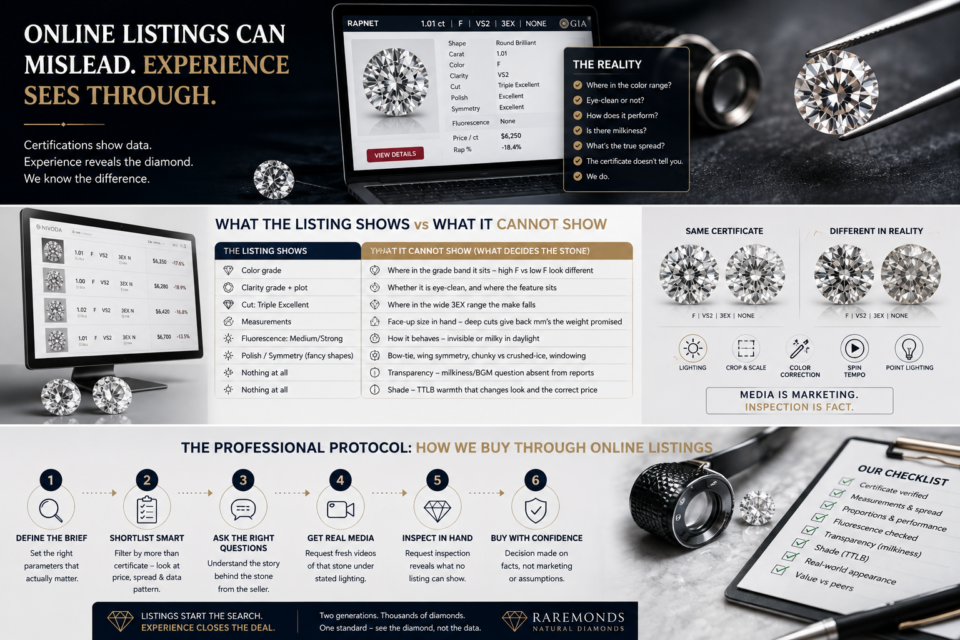
Everything else in this memo descends from one fact our whole library keeps proving: a grade is a band, not a point. Two GIA reports can read identically — same carat, colour, clarity, same Triple Excellent — while the stones differ visibly in hand. One F sits at the top of its grade, one at the bottom. One VS2 is eye-clean with a feature tucked under a prong position; the other carries it dead under the table. One 3EX is a Hearts & Arrows precision cut at ideal angles; the other scraped into Excellent at the range’s edge and faces up flat. One is crisp and transparent; the other carries the faint milkiness no grade line reports. A listing renders both stones as the same row in a search result — and prices them differently, which brings us to the first professional skill: reading the discount as information.
The price is a message, not just a number
On the platforms, white goods are quoted against the Rapaport list, and the discount is the market speaking. A stone listed dramatically below its peers in the same certificate bracket is not a bargain waiting for a fast click — it is a stone the market has already inspected and judged. The discount is the disclosure: it prices the bow-tie, the milk, the low colour feel, the fluorescence haze, the deep make, the something that made every previous viewer pass. Sorted-by-price-ascending is not a value strategy; it is adverse selection with a search filter. The professional read is the opposite: within a bracket, the interesting stones are usually the ones priced with the pack whose sellers can explain exactly why — and the outliers, high or low, are questions to ask, not answers to buy.
What the listing cannot show you
| The listing shows | What it cannot show — and what decides the stone |
| Colour grade | where in the grade band the stone sits — a high F and a low F are visibly different side by side |
| Clarity grade + plot | whether it is actually eye-clean, and where the feature sits relative to the table and future prongs |
| Cut: Triple Excellent | where in the wide 3EX range the make falls — angle combination, painting or digging, spread versus depth |
| Measurements | face-up size in hand — deep-cut goods give back millimetres the weight promised |
| Fluorescence: Medium/Strong | how it behaves — invisible, or milky in daylight; the difference between an arbitrage and a mistake |
| Polish/Symmetry (fancy shapes) | the bow-tie (dynamic or dead), wing symmetry, chunky versus crushed-ice character, windowing |
| Nothing at all | transparency — the milkiness/BGM question that flattens performance at any grade, absent from every report |
| Nothing at all | shade — the TTLB-scale warmth that changes both the look and the correct price |
That right-hand column is, not coincidentally, the table of contents of our performance memo — because performance is precisely the thing a listing format cannot transmit.
The media games
Photos and videos close the gap in theory and widen it in practice, because the seller chooses the light. Dark-field photography makes every stone a constellation; tight crops remove the scale that would reveal a small spread; colour-corrected images cool a warm stone by two grades; spin videos are shot at the exact tempo that keeps a static bow-tie moving; sparkle reels use point-lighting that flatters crushed-ice faceting the showroom will expose. And at the commodity end, stock media stands in for the actual stone entirely. None of this is fraud — it is marketing physics — but the professional response is fixed: for any stone that matters, demand fresh video of that stone, under stated lighting, face-up and tilting, ideally beside a reference stone. A seller who cannot produce it in a day is telling you something about whether they have the stone at all.
The availability fiction
Which raises the quiet one: a meaningful share of online inventory is virtual. The same stone listed by four brokers at four prices, none of whom hold it; stones on memo across the world, listed as available; chains where your “supplier” is three dealers from the goods, and every link adds price, days and failure risk. The tells are old-fashioned — can they get it on video today, can they state its physical location, does the price move when you ask firm — and the discipline is older: buy from desks that hold or directly control what they list.
The comments field: where value dies quietly
The single highest-yield habit in online buying costs ten seconds: read the comments and treatments fields before anything else. Clarity enhanced. Laser drill lines. HPHT annotations. “Internal graining not shown.” Colour-origin qualifiers. Old report dates on stones that may have been chipped or recut since. And in mixed marketplaces, the lab-grown line sitting one filter-slip away from natural results at a tenth of the price. Every one of these is disclosed — technically — in the field nobody reads, formatted identically to the stone you meant to buy. A desk that reads certificates bottom-up, comments first, avoids ninety percent of what this memo describes.
The fraud that defeats every ordinary check: lab-grown stones on genuine natural certificates
Everything above is structural misleading — legal, grey, survivable. This section is the outright fraud, and every buyer sourcing online needs it in writing. The mechanism is brutally simple: the certificate is real; the diamond is not. A genuine natural report is obtained — from a sold stone, a recut stone, paper circulating loose — and a CVD lab-grown diamond is cut to match it: the same weight to the point, the same measurements to the hundredth, the same proportions, and in the worst cases the report number forged onto the girdle. Every ordinary verification now passes. The loupe finds the inscription. The scale agrees. The measurements agree. The listing, the paper and the stone form a perfect closed loop — around a synthetic worth a fraction of the invoice.
What makes this fraud so dangerous is that nothing in the standard buying ritual catches it. Modern CVD material can be colourless, high-clarity and Type IIa — visually indistinguishable from fine natural goods at the desk — and cross-checking stone-to-certificate is precisely the ritual the fraud is engineered to survive. The only thing that defeats it is instrument screening: the spectroscopy-based synthetic detectors that read growth signatures no cutting wheel can disguise.
So here is our standing rule, stated as plainly as we run it: every stone that enters the Raremonds desk is machine-screened for laboratory growth — CVD and HPHT alike — regardless of the natural certificate it carries. No exceptions, and no seniority for famous paper. We adopted the rule from experience, not theory: we have intercepted certificate-matched lab-grown stones more than once, and those screenings have saved our clients from losses no discount would ever have repaid. Treat a natural certificate as a claim, not a conclusion — and buy from desks that verify the stone, not just the story around it.
The structural truth: the best stones often never list
One more honesty, because it explains the rest: the open platforms skew, inevitably, toward what remains. Fine goods with obvious demand are frequently placed before they ever list — through standing relationships, forward-sourcing sight of production, and dealers’ first calls. That is not a conspiracy; it is how any market with private information works, and it is why our matched-pairs memo describes completing pairs from goods still on the wheel or awaiting certification. The listing universe is real and useful. It is simply not the whole market — and the part it omits is disproportionately the part you wanted.
The professional protocol
Use listings for discovery, dealers for confirmation. Read comments and treatments first, price-as-signal second, media last. Demand same-day video of the actual stone under stated light for anything above commodity value. Treat within-bracket price outliers as questions. Verify report dates, re-check inscriptions on arrival — and screen every stone through a synthetic-detection instrument regardless of the paper it carries, because the certificate-matched fraud above defeats every other check. Buy fancy shapes and coloured stones only from desks that can talk about the right-hand column of the table above — bow-tie character, band position, transparency — unprompted. And route anything that matters through a desk that evaluates in hand: which is, transparently, the sentence this memo was built to earn. We list on Rapnet and Nivoda because the window is valuable; we exist because the window is not the sorting desk. Every stone we confirm has been read by eye — face-up, under one light, against the questions no listing answers — and documented on video before it travels.
Send your requirement to Raremonds → WhatsApp Parth directly: +91 98193 47999
The short version
Online listings mislead structurally, not criminally: a listing is a certificate summary plus seller-chosen media, and certificates are bands, not points — so identical rows hide visibly different stones. The discount is the market’s disclosure (cheap-in-bracket means inspected and passed), the media is chosen light, part of the inventory is virtual, the comments field holds the treatments and qualifiers that decide value, and the finest goods often place before they list. Gravest of all, genuine natural certificates are used to sell lab-grown stones cut to match the paper — a fraud we have intercepted more than once, and the reason every stone at our desk is machine-screened for CVD and HPHT growth regardless of its certificate. The protocol: discovery online, confirmation in hand; comments first; price as signal; fresh video of the actual stone; instrument screening on arrival; and a supplier who evaluates beyond the certificate — which is the desk we run, on both sides of the screen, since 1985.
See our collection:
https://raremonds.com/non-russian-diamonds-what-eu-us-buyers-need-to-know/
https://raremonds.com/why-most-online-diamond-listings-are-misleading/
https://raremonds.com/how-diamond-dealers-actually-price-fancy-coloured-diamonds/
https://raremonds.com/what-makes-a-diamond-perform-beyond-the-certificate/
FAQ
Are Rapnet and Nivoda unreliable? No — they are the trade’s best discovery tools, and we list on both. The limitation is the listing format itself: a certificate summary plus seller-chosen media cannot transmit band position, transparency, bow-tie character or fluorescence behaviour, which is where stones actually differ. Use the platforms to find candidates; use a desk that evaluates in hand to confirm them.
Why is the cheapest stone in a certificate bracket usually a mistake? Because the discount is information. On list-quoted white goods, a stone priced far below its identical-certificate peers has typically been viewed and passed by professional buyers who saw what the listing can’t show — a dead bow-tie, milkiness, a low colour feel, a deep make. Sorted-by-price-ascending is adverse selection, not value hunting.
What should I check first on any online listing? The comments and treatments fields — before the price, before the pictures. Clarity enhancement, laser drilling, HPHT annotations, colour-origin qualifiers and old report dates all live there, disclosed but unread. Then the report date, then the price against its bracket, then fresh video of the actual stone under stated lighting.
How do I know a listed stone actually exists with that seller?
Ask for same-day video of that specific stone and its physical location, and watch whether the price holds when you go firm. Brokered chains and double-listed virtual inventory fail those tests quickly. Buying from desks that hold or directly control their goods removes the problem at the root.
Can a lab-grown diamond be sold with a genuine natural certificate?
Yes — and it is the most dangerous fraud in online buying. A real natural report is paired with a CVD stone cut to its exact weight and measurements, sometimes with the report number forged onto the girdle, so inscription, scale and dimensions all “verify” perfectly. Modern CVD material is visually indistinguishable from natural at the desk, so only instrument screening catches it. Every stone that enters our desk is machine-screened for CVD and HPHT growth regardless of its paper — a rule born of intercepting exactly this fraud more than once before it reached a client.
Can good video replace seeing a stone in hand?
Honest video under stated, consistent lighting — face-up, tilting, ideally with a reference stone — closes most of the gap, which is why we document every confirmed stone that way before it travels. Seller-styled marketing video does the opposite. The difference is whether the light was chosen to inform or to flatter.

.png)