

One housekeeping note first, because precision is the entire point here. In laboratory language, “Fancy” is not a category — it is an intensity grade, one rung on the ladder that runs Faint through Fancy Light, Fancy, Fancy Intense and Fancy Vivid. The category is coloured diamonds. We’ve kept the familiar phrase in this title because it is how the world types the question; everywhere else, this memo uses the trade’s discipline, because sloppy words produce sloppy prices — and in coloured goods, the gap between a sloppy price and a correct one is rarely small. Our founder ran pricing and data analysis at a De Beers DTC sightholder before two decades in colour; what follows is that discipline, written down.
The first structural fact: there is no list
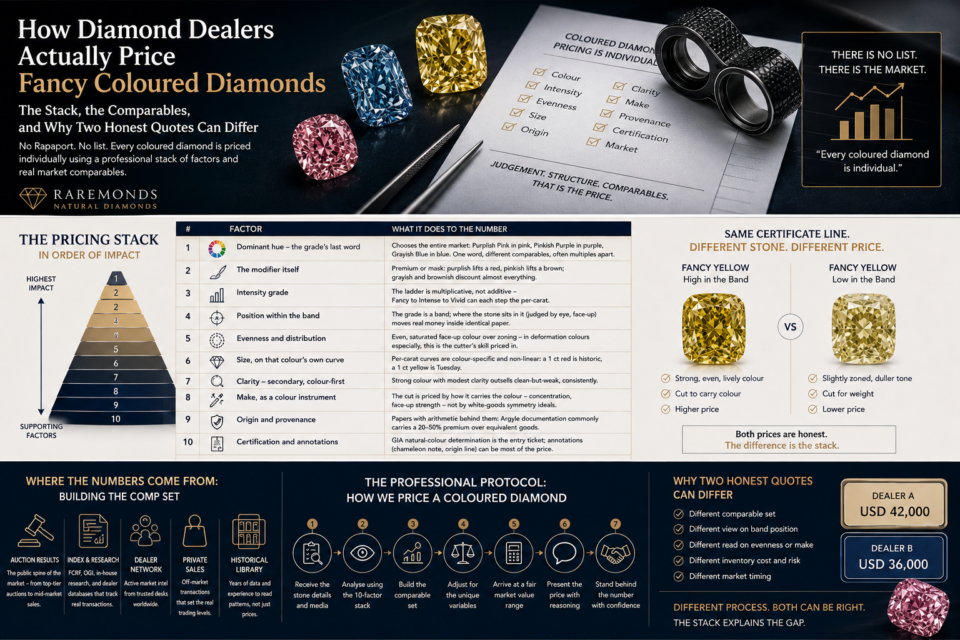
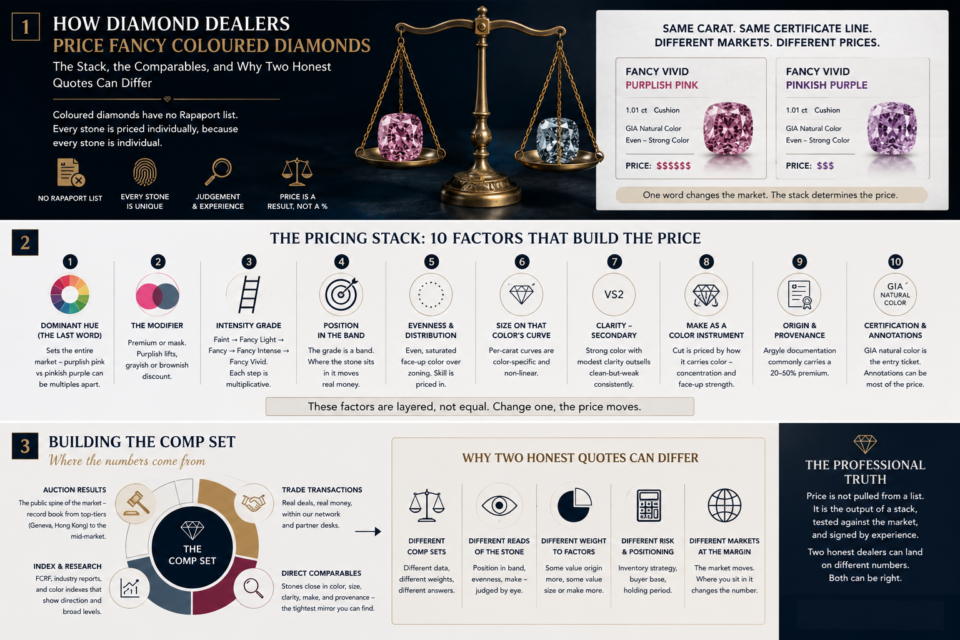
Coloured diamonds have no Rapaport. No grid, no sheet, no percentage-off convention. Every coloured stone is priced individually, because every coloured stone is individual — the grades are wide bands, the populations are tiny, and two stones sharing a certificate line can sit a multiple apart. This is not a market failure; it is the market working, and it is why coloured goods reward a specialist desk the way white goods reward a spreadsheet. Everything below is how the desk substitutes judgement, structure and comparables for the list that doesn’t exist.
The pricing stack, in the order a dealer actually works it
| # | Factor | What it does to the number |
| 1 | Dominant hue — the grade’s last word | chooses the entire market: Purplish Pink prices in pink, Pinkish Purple in purple, Grayish Blue in blue. One word, different comparables, often multiples apart |
| 2 | The modifier itself | premium or mask: purplish lifts a red, pinkish lifts a brown; grayish and brownish discount almost everything they touch |
| 3 | Intensity grade | the ladder is multiplicative, not additive — Fancy to Intense to Vivid can each step the per-carat, not nudge it |
| 4 | Position within the band | the grade is a band; where the stone sits in it (judged by eye, face-up) moves real money inside identical paper |
| 5 | Evenness and distribution | even, saturated face-up colour over zoning — in deformation colours especially, this is the cutter’s skill priced in |
| 6 | Size, on that colour’s own curve | per-carat curves are colour-specific and non-linear: a one-carat red is historic, a one-carat yellow is Tuesday |
| 7 | Clarity — secondary, colour-first | strong colour with modest clarity outsells clean-but-weak, consistently; the auction record proves it in public |
| 8 | Make, as a colour instrument | the cut is priced by how it carries the colour — concentration, face-up strength — not by white-goods symmetry ideals |
| 9 | Origin and provenance | papers with arithmetic behind them: Argyle documentation commonly carries a 20–50% premium over equivalent goods |
| 10 | Certification and annotations | GIA natural-colour determination as the entry ticket; annotations (a chameleon note, an origin line) can be most of the price |
Two illustrations make the stack concrete. Take two stones both graded Fancy Yellow: one sits high in the band, even and lively, cut to carry colour — the other low, slightly zoned, cut for weight. Same certificate line; the desk prices them a genuine distance apart, and both prices are honest. Or take the one-word boundary: a Fancy Vivid Purplish Pink and a Fancy Vivid Pinkish Purple of similar weight are neighbours on the colour wheel and strangers on the invoice, because factor #1 assigned them different markets before factors #2–10 ever ran.
Where the numbers come from: building the comp set
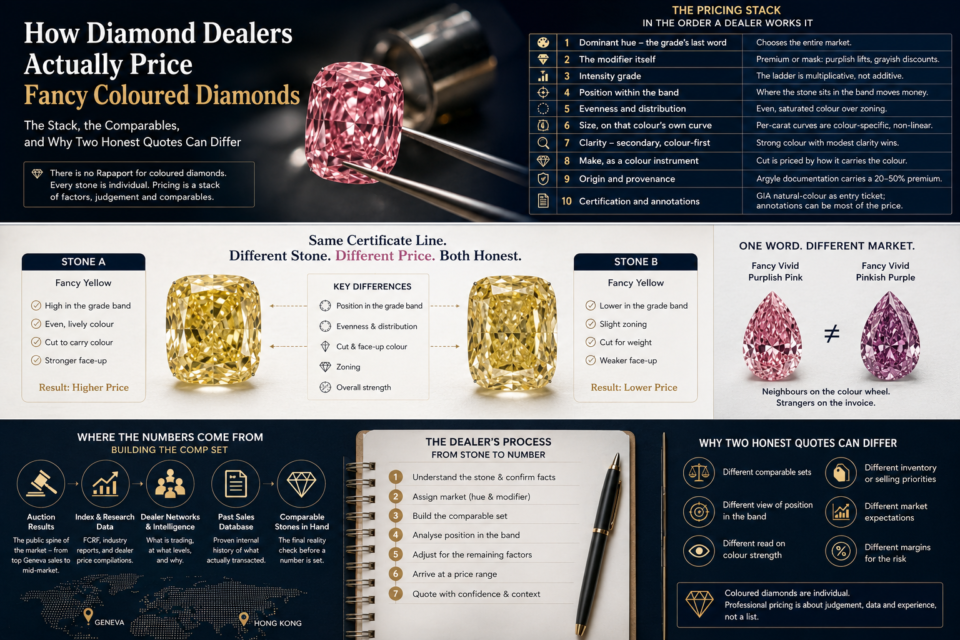
A stack needs inputs, and this is the half of the craft outsiders never see. A dealer prices a coloured stone against a comparable set assembled from: auction results (the public spine of the market — the record book from Geneva and Hong Kong down to the mid-market sales); index and research data (FCRF and similar trackers, strongest in pinks, blues and yellows); tender and tender-resale results where provenance categories like Argyle are concerned; the dealer networks — the private layer of recent trades, offers made and refused, stones that didn’t sell and why; and the desk’s own book, the accumulated record of what actually cleared. The comp set is then adjusted through the stack: this stone is higher in band than the auction lot, smaller than the index bracket, better papered than the network offer. That adjusted triangulation isthe price.
Which explains something buyers find suspicious and shouldn’t: two honest dealers can quote the same stone differently, because their comp sets differ — different recent trades seen, different weightings, different reads on band position. The dishonest quote isn’t the different one; it’s the one whose owner cannot walk you through the stack. Ask any desk to show its logic, factor by factor. We show ours as standard.
The premiums the stack doesn’t capture — and the honest discounts
Three adjustments sit on top. The pair premium: a true matched pair in colour prices above two equivalent singles, because the matching is the value — grades are bands, and two stones agreeing by eye is rarer than the stones themselves. The liquidity adjustment: deep categories (pinks, yellows) price confidently against rich comp sets; thin ones (violet, pure purple, chameleon, Fancy White) carry honest uncertainty, and a correct quote says so out loud. And the story discount, running the other way: champagne, cognac, desert, sunset — the romance vocabulary sells the finished piece beautifully, but none of it appears on a certificate, and a desk that lets a marketing word into the pricing stack has stopped pricing and started hoping. We price the stone; the client is welcome to sell the poem.
What this means for a trade buyer
Practically: never buy coloured goods on the certificate line alone — the line is factor #1, #3 and #10 of a ten-factor stack. Insist on face-up assessment (or standardised face-up video) for factors #4, #5 and #8, because that is where identical paper diverges. Learn the one-word boundaries in the categories you buy; they are the highest-leverage literacy in this trade. Treat clarity as a lever, not a hurdle. Ask every quote to show its comparables. And when a coloured price looks impossibly good, run the stack backwards — the discount is almost always sitting in a factor you haven’t checked yet, usually #4, #5 or a treatments line in the comments field.
How we price, and why we show the working
Raremonds prices coloured diamonds the way this memo describes because it is how our house was built: two generations in natural colour since 1985, a founder who came up through sightholder pricing and data, a desk fluent in every grading language the category uses — GIA’s ladders, the Argyle families, the champagne C-scale, the TTLB spectrum — and a standing habit of showing clients the comp logic behind every number. Every stone natural and untreated, certified, read by eye for band position and evenness, documented face-up under standardised light, and priced against a comparable set we will walk you through factor by factor. When a stone is a fair buy, we say so; when a number reflects a mask, a zone or a romantic word doing the work, we say that too.
Send your requirement to Raremonds → WhatsApp Parth directly: +91 98193 47999
The short version
Coloured diamonds have no price list, so dealers price every stone through a stack: dominant hue chooses the market (the grade’s last word — often the single most expensive word in the trade), the modifier lifts or masks, intensity multiplies, position-in-band and evenness move real money inside identical paper, size runs on colour-specific curves, clarity is secondary, make is priced as a colour instrument, provenance papers carry arithmetic premiums, and certification is the entry ticket. The number comes from a comparable set — auctions, indices, tenders, dealer networks, the desk’s own book — adjusted through that stack, which is why two honest quotes can differ and why the test of any quote is whether the desk can show its working. Ours always can: pricing discipline is where this house started.
See our collection:
https://raremonds.com/what-makes-a-diamond-perform-beyond-the-certificate/
https://raremonds.com/the-ultimate-guide-to-buying-wholesale-diamonds-for-jewellers/
https://raremonds.com/why-most-online-diamond-listings-are-misleading/
FAQ
Why isn’t there a Rapaport list for coloured diamonds?
Because a list requires interchangeable goods, and coloured stones aren’t. The grades are wide bands, the populations are tiny, and two stones on the same certificate line can honestly sit a multiple apart on band position, evenness and make. Every coloured stone is priced individually against comparables — which is the market working, not failing.
What single factor moves a coloured diamond’s price most?
The dominant hue — the last word of the grade — because it chooses which market prices the stone before anything else runs. Purplish Pink versus Pinkish Purple, Grayish Blue versus Bluish Gray: one word apart on the certificate, whole markets apart on the invoice. Intensity steps are the next biggest mover, and they multiply rather than add.
How can two dealers quote the same stone differently and both be honest?
Because prices come from comparable sets, and comp sets differ — different auctions weighted, different private trades seen, different reads on where the stone sits in its band. Honest quotes converge once the working is shown. The red flag is never the different number; it’s the desk that can’t walk you through the stack behind it.
Does clarity matter in coloured diamonds?
Less than almost anyone expects. The market prices colour first — hue, intensity, band position, evenness — and treats clarity as a lever: strong colour with modest clarity consistently outsells clean stones with weak colour, a pattern the public auction record has demonstrated repeatedly. In some categories (black, Fancy White) clarity isn’t graded at all.
What premium do matched coloured pairs carry?
A real one, because grades are bands: two stones agreeing by eye — hue, modifier, tone, evenness, fluorescence — are rarer than the stones themselves, so a true pair prices above two equivalent singles. The matching is the value, which is why we match every pair face-up under one light before confirming either stone.
How does Raremonds justify its coloured-diamond prices?
By showing the working: the comparable set (auction, index, tender and network data plus our own book), the stack adjustments — band position, evenness, size curve, make, papers — and a plain statement of what the number reflects. Our founder’s background is sightholder pricing and data analysis; transparency about method is the house habit, not a marketing line.


.png)