

Here is the sentence this entire house was built on: the certificate describes a diamond; it does not describe how the diamond behaves. Performance — the brightness, fire and life a stone actually throws at a customer across a counter — is decided by variables the report either measures too coarsely or does not measure at all. Two stones with identical paper can differ so visibly in hand that a lay customer picks the better one in three seconds without knowing why. The trade calls that gap “make,” “life,” “performance”; we call it the reason a sorting desk still exists in the age of the searchable certificate.
This memo is the anatomy of that gap, written for trade buyers: what performance actually consists of, the certificate’s real coverage (narrower than most desks admit), the invisible variables that decide stones at every grade, how performance changes shape by shape — including the antique cuts, where the standard itself changes — and the evaluation protocol we run on every stone before it travels. It is also, candidly, the memo that explains where margin hides: mispriced performance is the most reliable arbitrage left in white goods.
What “performance” actually is
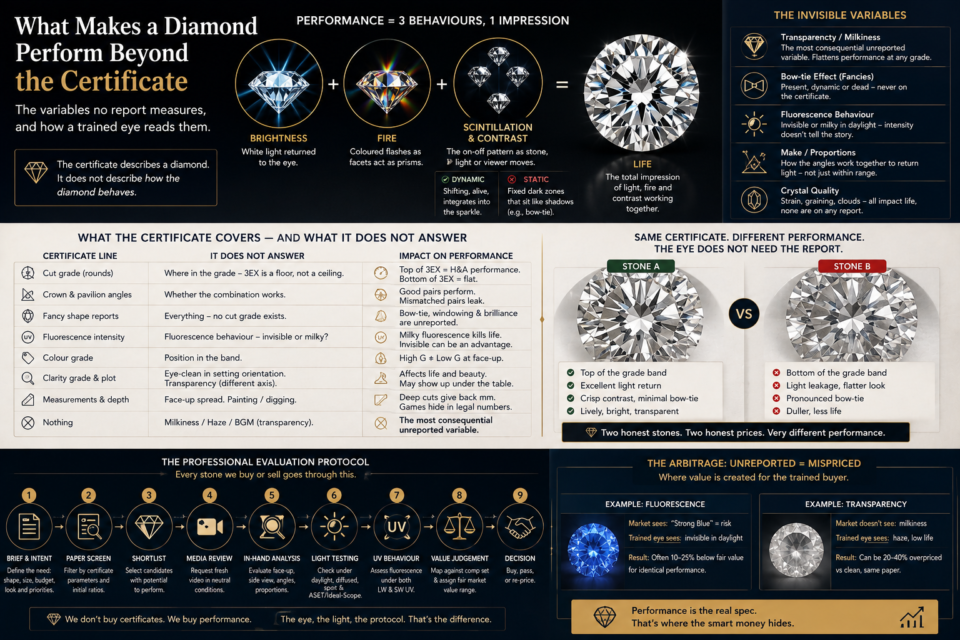
Three behaviours, one impression. Brightness: the white light returned to the eye — the stone’s baseline illumination, killed by leakage through a windowed pavilion or a too-deep make. Fire: the coloured flashes as facets act as prisms — fed by crown height and angles, flattened by shallow cutting. Scintillation and contrast: the on-off pattern as stone, light or viewer moves — and here the crucial distinction the report never draws: contrast can be dynamic (shifting, alive, integrating into the sparkle) or static (fixed dark zones that sit like shadows and photograph like stains). A dead bow-tie is static contrast. A crisp Hearts & Arrows pattern is contrast engineered to stay dynamic. Same word on paper — polish Excellent, symmetry Excellent — opposite stones in hand.
What the certificate actually covers — honestly mapped
The report’s coverage is real but narrow, and knowing its edges is the professional skill:
| Certificate line | The performance question it does not answer |
| Cut grade (rounds only, until the 2027 rollout adds oval, pear and marquise) | where in the grade — Triple Excellent spans a wide range of angle combinations; the top of it is Hearts & Arrows territory, the bottom faces up flat. 3EX is a floor, not a ceiling |
| Crown and pavilion angles | whether the combination works — the sweet spots (crown around 34–35°, pavilion around 40.6–41°) perform; legal-but-mismatched pairs leak |
| Every fancy shape’s report | everything — polish, symmetry and measurements only; no cut grade exists, so bow-tie, windowing and brilliance style are entirely unreported |
| Fluorescence intensity | fluorescence behaviour — most blue fluorescence is invisible or flattering; a minority goes milky in daylight. The word “Strong” prices the fear; the eye prices the stone |
| Colour grade | position in the band — a high G beside a low G reads at conversation distance |
| Clarity grade and plot | eye-cleanliness in the actual setting orientation, and transparency, which is a different axis entirely |
| Measurements and depth | face-up spread — deep-cut goods hand back the millimetres the carat promised, and painting/digging games hide inside legal proportions |
| Nothing | milkiness, haze, the BGM question — the transparency variable that flattens performance at any grade and appears on no line of any report |
That last row deserves its own sentence: transparency is the most consequential unreported variable in diamonds. A milky stone with perfect paper is a dull stone with perfect paper.
The arbitrage paragraph
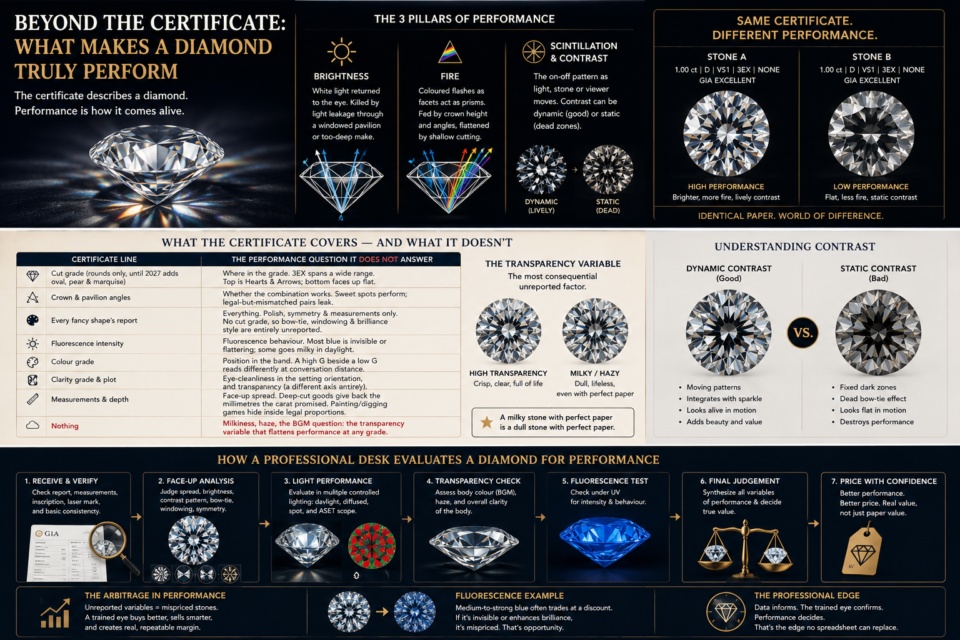
Because these variables are unreported, they are systematically mispriced — in both directions — and a desk that reads them buys better than the market. The classic: fluorescence. Medium-to-strong blue routinely trades at a 10–20 percent discount on the word alone; the majority of such stones show no milkiness whatsoever, and a checked, clean, strong-blue stone is the same diamond at a genuine discount — bought correctly, it is the most reliable margin in white goods. The mirror image: high-in-band stones — the F that borders E, the VS2 that lives eye-clean, the 3EX cut at true ideal angles — carry performance the bracket price never charged for. The desk’s whole job is telling those apart from their identically-papered opposites, which is why every arbitrage in this paragraph requires the protocol at the end of this memo.
Performance, shape by shape
Performance is not one standard — it changes with the architecture. In the elongated brilliants (oval, pear, marquise), the bow-tie decides the stone: dynamic and integrated, or a fixed dark band no setting hides — a visual call, never a report line. In cushions and radiants, the question the certificate cannot ask is brilliance style: chunky broad-flash or crushed-ice shimmer — neither wrong, both real, and a buyer who doesn’t specify has ordered blind. The step cuts (emerald, Asscher) invert the game entirely: open facets are windows, so performance is clarity and colour made visible — the hall-of-mirrors effect lives or dies on eye-cleanliness and even step rhythm, and no brilliance metric applies. Princess punishes depth with face-up size; heart lives on lobe symmetry that no symmetry grade captures.
And then the antique cuts change the standard itself. An Old European or old mine cut assessed under a modern brilliance scope will always “fail,” because it is answering a different question: these stones were cut for candlelight, and their performance — the warm, chunky, flickering glow — reads under warm, soft light or not at all. Judging an antique cut under showroom LEDs is measuring a cello with a stopwatch. Performance, in other words, is always performance for a context — which is why our evaluation protocol tests stones in the light they’ll actually live in.
The protocol: how we actually evaluate
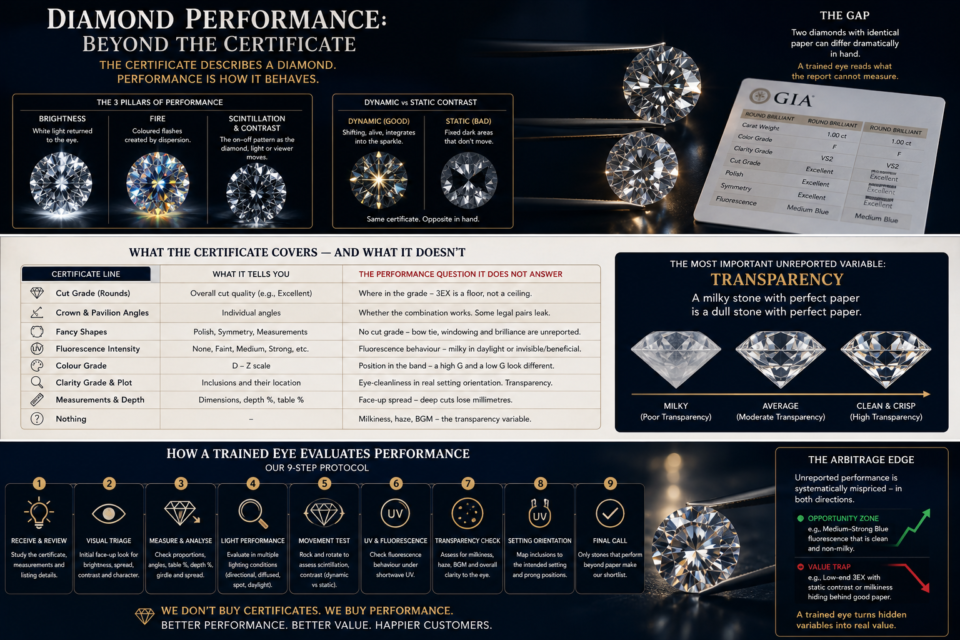
Every stone we confirm runs the same sequence, and none of it requires anything a report supplies. Side by side, under one known light — comparison is the only honest scale, which is why singles are read against references and pairs against each other. Face-up first — the stone is worn face-up; pavilion-view romance is for tweezers, not customers. The tilt and rock — brightness held through movement, bow-ties tested for life, windowing exposed at angle. Multi-light pass — spotlit, diffuse, and daylight-adjacent, because a stone that performs in one environment and dies in another is a complaint waiting to happen; fluorescent stones get the UV-rich check specifically. Transparency read — the milk question, asked deliberately, on every stone regardless of grade. And documentation — video under stated, standardised light, so the client sees the behaviour, not our adjectives, before anything travels. It takes minutes per stone. It is the entire difference between selling paper and selling diamonds.
Why this is a sales memo, not just a technical one
For a trade buyer, performance is not connoisseurship — it is sell-through. The end customer at your counter cannot read a plot diagram, but they can see which stone is alive; performance is the one quality that sells itself unassisted, and a performing stone at a fair price outsells a certificate at a discount every week of the year. Stock bought on performance turns faster, returns less, and builds the reputation that no grading column ever built for anyone. That is the commercial case for buying through a desk that evaluates — and it is the entire case for this one. Raremonds has read stones by eye for two generations: every diamond evaluated through the protocol above, priced with its performance named honestly — including when the honest name is a discount — and documented so you see what we saw.
Send your requirement to Raremonds → WhatsApp Parth directly: +91 98193 47999
The short version
Performance — brightness, fire, and contrast that stays dynamic — is decided by variables the certificate measures coarsely or not at all: position within grade bands, angle combinations inside 3EX, fluorescence behaviour rather than the word, face-up spread against depth, bow-tie life, brilliance style, step-cut clarity visibility, and above all transparency, the milkiness axis absent from every report. Fancy shapes carry no cut grade at all (oval, pear and marquise join in 2027; everything else stays evaluation-only), and antique cuts must be judged under the warm light they were cut for.
Because these variables are unreported they are mispriced — fluorescence discounts on clean stones and high-in-band goods are the trade’s most reliable arbitrage — and reading them takes a protocol: side by side, one light, face-up, tilted, multi-light, transparency checked, documented on video. That protocol is our desk, and performance is what your counter actually sells.
See our collection:
https://raremonds.com/non-russian-diamonds-what-eu-us-buyers-need-to-know/
https://raremonds.com/why-most-online-diamond-listings-are-misleading/
https://raremonds.com/how-diamond-dealers-actually-price-fancy-coloured-diamonds/
https://raremonds.com/what-makes-a-diamond-perform-beyond-the-certificate/
FAQ
Two diamonds have identical GIA certificates — why do they look different?
Because grades are bands and key variables go unreported: one stone sits high in its colour band, cut at true ideal angles, crisp and transparent; the other sits low, scraped into the same grades, slightly milky. The report renders both identically. The difference is performance, and it is read by eye, side by side, under one light.
Is Triple Excellent enough to guarantee a beautiful round?
It is a floor, not a ceiling. 3EX spans a wide range of angle combinations; the top of the range — ideal crown-and-pavilion pairings, Hearts & Arrows precision — faces up visibly brighter than the bottom. We treat 3EX as the starting filter and evaluate where in the range a stone actually sits.
Should I avoid fluorescent diamonds?
No — you should check them. Most medium-to-strong blue fluorescence is invisible or mildly flattering; a minority of stones go milky in daylight. The market discounts the word 10–20 percent regardless, which makes checked, clean fluorescent stones the most reliable value in white goods — and unchecked ones a genuine risk. The eye decides, not the line on the report.
What is the most important thing no certificate reports?
Transparency. Milkiness and haze flatten a stone’s performance at any grade and appear on no report line. It is the first deliberate check in our protocol on every stone, because perfect paper on a milky stone is still a dull diamond.
Do fancy shapes have cut grades?
Not today — reports carry polish, symmetry and measurements only, so bow-tie, windowing and brilliance style are entirely unreported. GIA’s first fancy-shape cut grades arrive in 2027 for oval, pear and marquise only; every other shape remains evaluation-only indefinitely, which is exactly why fancy shapes should never be bought on paper alone.
How do you evaluate antique cuts like Old Europeans?
Under the light they were cut for. Antique cuts were made for candlelight, and their warm, chunky glow reads under soft, warm illumination — a modern brilliance scope will always score them “wrong” because it is asking the wrong question. Performance is always performance for a context, and we test stones in the context they’ll live in.

.png)