

Most “wholesale diamond guides” online are written to rank, not to inform — a 4Cs recap, a stock photo, a contact form. This one is written from the other side of the desk: what a wholesaler who has supplied jewellers, designers and manufacturers across ten-plus markets since 1985 would actually tell a buyer building or rebuilding their diamond supply in 2026.
It covers the market as it genuinely stands, how to structure an assortment so capital works, how wholesale pricing mechanics actually function (list-and-discount for whites, the stack for colour, parcel logic for smalls), the certified-versus-non-certified decision, the supplier checklist that separates a desk from a middleman, the red flags, and the brief template that gets you better goods faster.
The 2026 market, in the paragraphs that matter
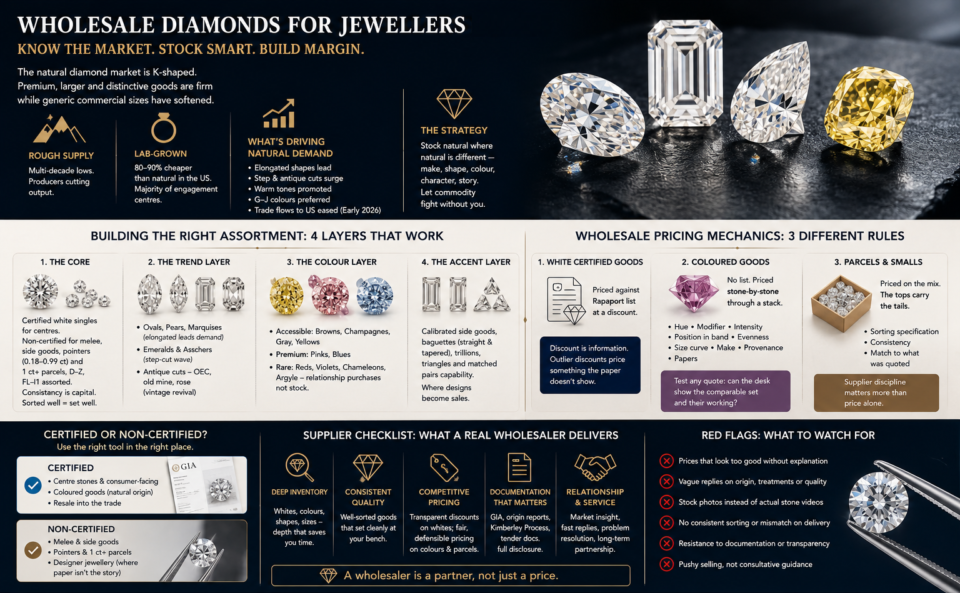
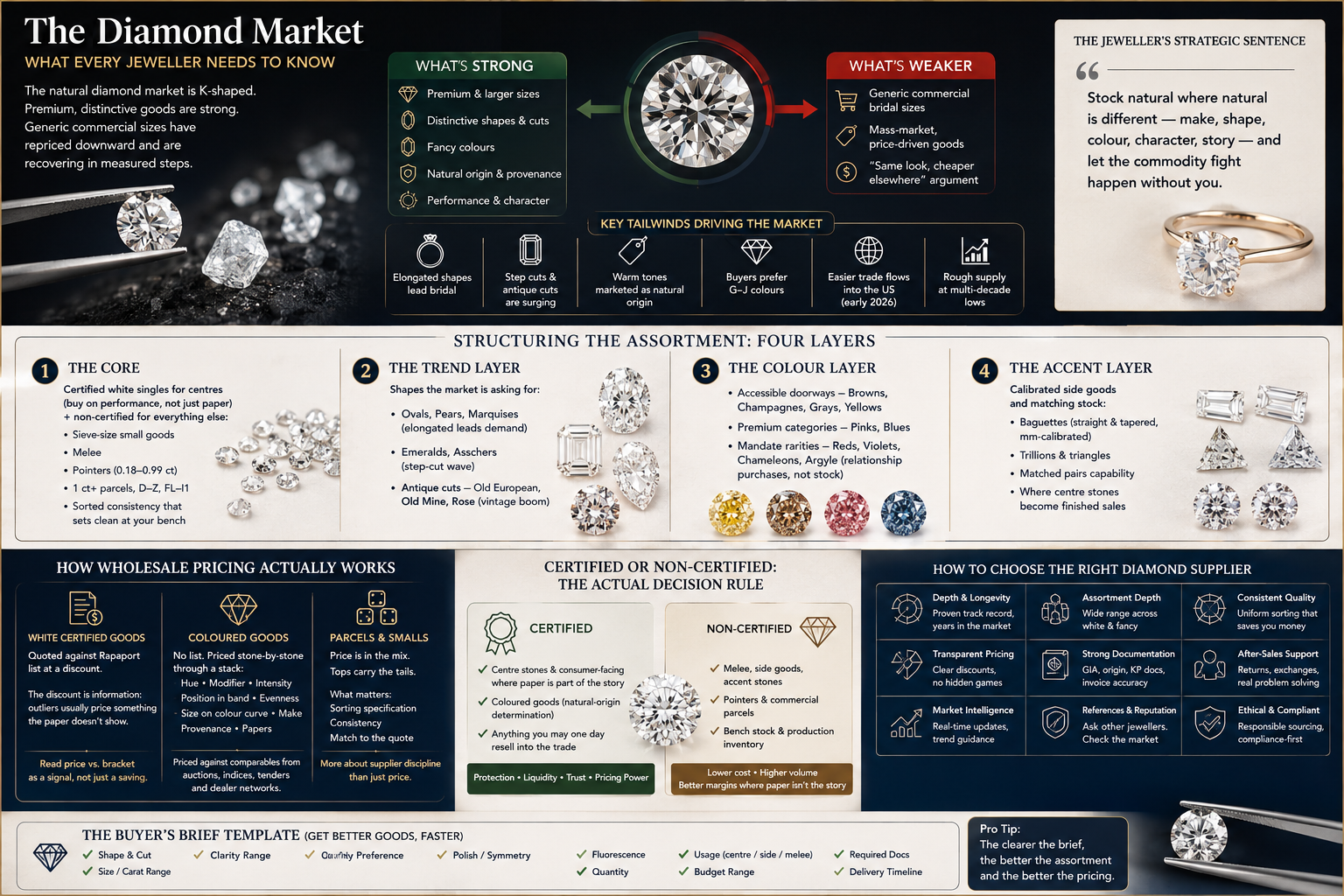
Buy against reality, not nostalgia. The natural market is K-shaped: premium, larger and distinctive goods are firm — rough supply sits at multi-decade lows with producers cutting output — while generic commercial bridal sizes have repriced downward and are recovering only in measured steps.
The force behind the split is structural: lab-grown now accounts for the majority of engagement-ring centre stones in the US at an 80–90 percent discount to natural, which means the natural stone that competes on “same look, colourless, certified, cheaper somewhere else” has lost its argument — and the natural stone that competes on distinctiveness, character, colour, story and performance has never had a better one.
Every current tailwind runs that way: elongated shapes lead bridal, step cuts and antique cuts are surging on the vintage revival, warm tones are being marketed industry-wide as proof of natural origin, buyers increasingly prefer the G–J colours that face up beautifully for less, and trade flows into the US eased with the early-2026 trade arrangements. The strategic sentence for any jeweller: stock natural where natural is different — make, shape, colour, character, story — and let the commodity fight happen without you.
Structuring the assortment: four layers
- The core. Certified white singles for centres (bought on performance, not just paper — see below) plus non-certified goods for everything else: sieve-size small goods, melee, pointers (0.18–0.99 ct) and one-carat-plus parcels, D–Z, FL–I1, assorted to your exact specification. This layer is where consistency matters most: goods sorted properly at the wholesaler set cleanly at your bench without re-sorting — a cost most buyers never price until they’ve paid it.
- The trend layer. The shapes the market is actually asking for: ovals, pears and marquises (elongated leads demand, with GIA cut grades arriving for exactly these three in 2027), emeralds and Asschers on the step-cut wave, and the antique cuts — Old European, old mine, rose — riding the vintage boom. Weight this layer to your clientele, but do not skip it; it is where natural currently wins.
- The colour layer. The accessible doorways first — browns and champagnes (with an industry marketing campaign running behind them), grays, yellows — then the premium categories (pinks, blues) to depth your market supports, then the mandate rarities (reds, violets, chameleons, Argyle) as relationship purchases rather than stock. Colour is the least list-shoppable inventory a jeweller can hold, which makes it the most margin-protective.
- The accent layer. Calibrated side goods and matching stock: baguettes (straight and tapered, millimetre-calibrated), trillions and triangles, matched pairs capability through your supplier — because three-stone and accent-led design is where centre stones become finished sales.
How wholesale pricing actually works
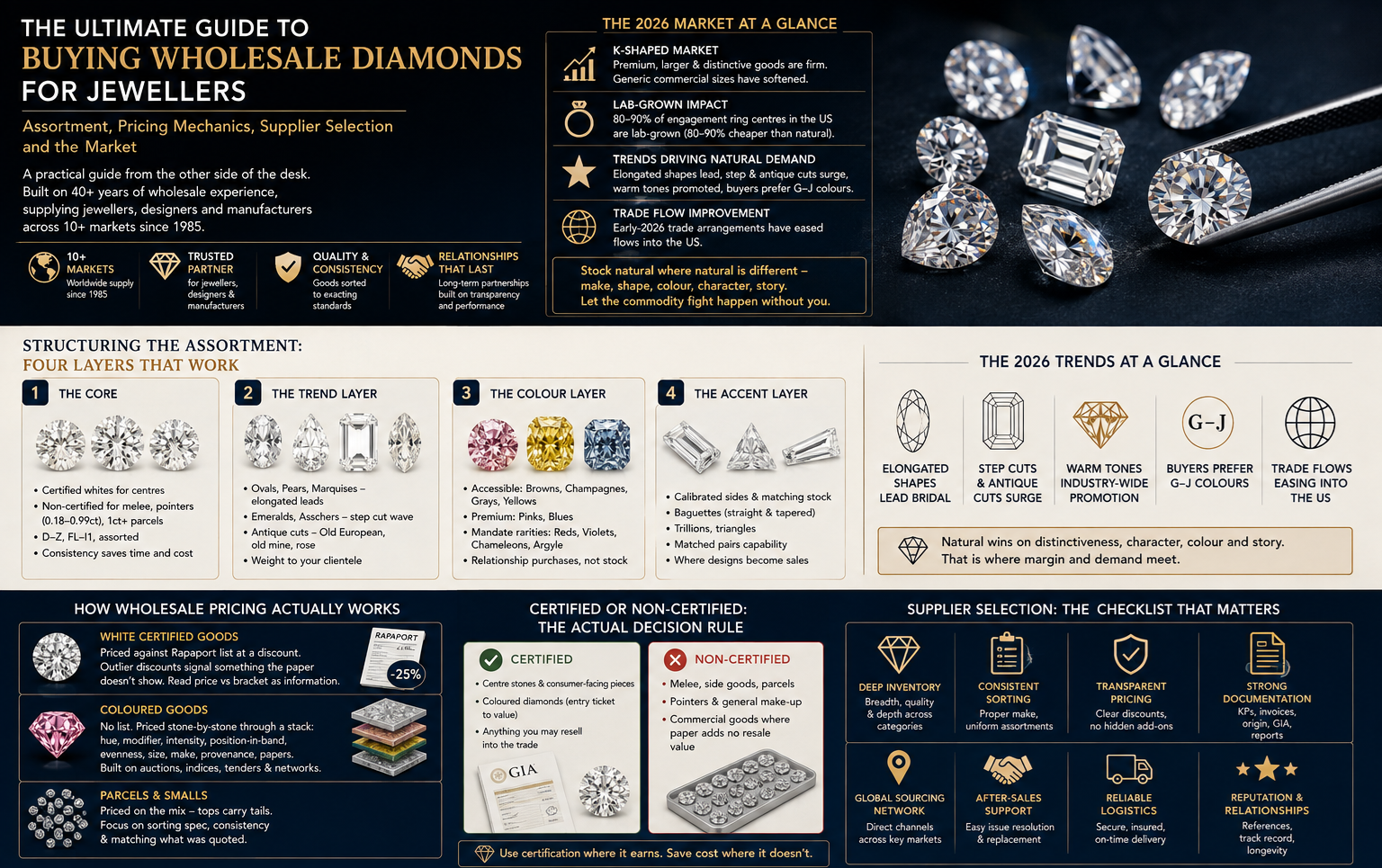
Three different mechanics, one market. White certified goods quote against the Rapaport list at a discount — and the discount is information, not just a number: within a certificate bracket, an outlier discount prices something the paper doesn’t show, so the professional habit is reading price-versus-bracket as a signal before reading it as a saving.
Coloured goods have no list at all: they price stone-by-stone through a stack — dominant hue, modifier, intensity, position-in-band, evenness, size on that colour’s own curve, make, provenance, papers — against comparable sets built from auctions, indices, tenders and dealer networks; our companion memo walks the full mechanics, and the test of any coloured quote is whether the desk can show that working. Parcels and smalls price on the mix: a parcel is an assortment whose tops carry its tails, so the questions that matter are the sorting specification, the consistency stone-to-stone, and whether what arrives matches what was quoted — which is a supplier-discipline question more than a price question.
Certified or non-certified: the actual decision rule
Certification is a tool with a cost, so deploy it where it earns: certified for centre stones and anything consumer-facing where the paper is part of the retail story, for coloured goods (where the natural-origin determination is the entry ticket to value), and for anything you may one day resell into the trade. Non-certified for melee, side goods, calibrated accents and manufacturing stock, where certification costs would erase the margin and the wholesaler’s sorting integrity is the real quality system — which is precisely why the supplier matters more on non-cert goods, not less. On lab hierarchy: GIA is the standard we hold for natural goods, and the one we arrange when the choice is ours; other reports have currency where stones already carry them, priced accordingly. And on every certificate, read the comments and treatments fields before the grades — clarity enhancement, laser drilling and HPHT annotations live there, formatted exactly like the stone you meant to buy.
Choosing the supplier: the checklist that actually predicts outcomes
| Test | What it tells you |
| Do they evaluate beyond the certificate — and can they talk bow-ties, band position, fluorescence behaviour and transparency unprompted? | whether you’re buying diamonds or paper |
| Is their sorting consistent enough to set without re-sorting? | the hidden cost line in every parcel relationship |
| Is disclosure automatic — treatments, lab-grown separation, shade goods named as what they are? | whether their invoice and their inventory tell the same story |
| Do they hold or directly control their goods, with same-day video of the actual stone? | whether you’re three brokers from the diamond |
| Can they match — pairs, layouts, calibrated runs — and recut when the market can’t supply? | whether hard briefs get filled or apologised for |
| Do they show pricing logic — Rap-and-discount reasoning on whites, the comp stack on colour? | whether a negotiation is possible or just theatre |
| Platform presence and a physical desk with a track record? | discovery is online; accountability is an address |
A note on trade terms, stated plainly because clarity beats salesmanship: memo and consignment exist across this industry and suit some relationships. Our own model is outright sale — sharply priced, fully documented, insured to your door — because we’d rather earn the order with the stone and the number than with float. Whichever model you buy on, insist that the terms, the returns window and the documentation are in writing before goods travel.
Red flags, briefly
Prices materially below bracket with no explanation offered. Media that doesn’t match the report, or reports older than the stone’s story. “GIA-certifiable” as a phrase (everything is certifiable; certified is a different word). Treatments living quietly in comments fields. Pressure pacing — “three other buyers on it” is a sentence, not a fact. And any desk that gets vague when you ask where, physically, the stone is right now.
The brief template that gets better goods
The fastest way to better supply is a better brief. Send: the use (centre, side, parcel, programme), shape and size range, quality window (colour, clarity, and your tolerance edges), make priorities (spread? performance? budget?), certified or non-cert, quantity and repeatability (one-off or programme), timeline, and target pricing if you have one. What a proper desk returns: candidates evaluated — not just listed — with face-up video under stated light, honest notes on where each stone sits in its bands, and a price whose logic is shown. That loop, run a few times, is how a supplier becomes an extension of your buying desk rather than a search result.
How we work
Raremonds supplies the trade the way this guide describes because the guide is simply our desk written down: two generations in natural diamonds since 1985, BKC Mumbai, listed on Rapnet and Nivoda and supplying jewellers, designers and manufacturers across ten-plus markets.
Full white-goods range from sieve sizes and melee through pointers to certified singles; every trending shape including the antique cuts; the complete colour spectrum from champagne parcels to mandate rarities; matched pairs, layouts and recut-to-match; every stone evaluated by eye, documented on video, disclosed completely and priced with the working shown. Send the brief — we’ll return stones evaluated, not just certified, at the right price for what they are.
Send your requirement to Raremonds → WhatsApp Parth directly: +91 98193 47999
The short version
Buy against the 2026 market as it is: K-shaped, with lab-grown owning the commodity fight and natural winning on distinctiveness — so structure four layers (core whites certified and non-cert, the trend shapes, the colour ladder, calibrated accents) and put capital where natural is different. Know the three pricing mechanics: Rap-and-discount for whites (the discount is information), the comparable-driven stack for colour (no list exists), and mix-logic for parcels (sorting consistency is the real price).
Certify where paper earns — centres, colour, resale — and lean on supplier sorting integrity everywhere else, with GIA as the standard for natural goods. Choose suppliers on the seven tests: evaluation beyond certificates, sorting consistency, automatic disclosure, direct control of goods, matching and recut capability, visible pricing logic, and a real desk behind the listings. Then run better briefs — and let the loop turn a wholesaler into your buying desk. That desk, since 1985, is us.
See our collection:
https://raremonds.com/what-makes-a-diamond-perform-beyond-the-certificate/
https://raremonds.com/the-ultimate-guide-to-buying-wholesale-diamonds-for-jewellers/
https://raremonds.com/why-most-online-diamond-listings-are-misleading/
FAQ
What should a jeweller stock in 2026 — and what should they avoid?
Stock where natural is different: performance-selected whites, the elongated and step-cut shapes leading demand, antique cuts on the vintage wave, and colour from champagne parcels upward — the least list-shoppable, most margin-protective inventory there is. Be cautious with generic commodity bridal sizes, where lab-grown’s 80–90 percent discount has repriced the fight; if you carry that segment, buy it sharp and turn it fast.
How does wholesale diamond pricing actually work?
Three mechanics. Certified whites quote as discounts against the Rapaport list — and within a bracket, an outlier discount is a disclosure, not a gift. Coloured stones have no list and price individually through a factor stack against auction, index and network comparables. Parcels price on the mix and live or die on sorting consistency. A proper supplier shows the logic behind all three.
When are non-certified diamonds the right buy?
For melee, calibrated side goods, accents and manufacturing stock — where certification cost would erase margin and the wholesaler’s sorting discipline is the real quality system. Reserve certification for centres, consumer-facing stones, anything coloured (natural-origin determination is the value there), and goods you may resell into the trade. GIA is the standard we hold and arrange for natural goods.
What separates a good wholesale supplier from a middleman?
Seven tests: evaluation beyond the certificate (can they discuss bow-ties, band position, fluorescence behaviour and transparency unprompted?), sorting you can set without re-sorting, automatic disclosure of treatments and lab-grown separation, direct control of goods with same-day video, matching and recut capability for hard briefs, pricing logic they’ll show, and a physical desk behind the platform listings.
Do you supply on memo or consignment?
Our model is outright sale — sharply priced, fully documented, insured shipping to your door — because we’d rather win the order with the stone and the number. Memo exists across the industry and suits some relationships; whichever terms you trade on, get them in writing before goods travel.
What should I include in a wholesale brief?
Use, shape, size range, quality window with tolerance edges, make priorities, certified or non-cert, quantity and repeatability, timeline, and target pricing if you hold one. What comes back from us: evaluated candidates with face-up video under stated light, honest band-position notes, and a price with the working shown.

.png)