

The triangle is the trillion’s sharper, more architectural cousin: a straight-sided, clean-cornered triangular stone, cut either as a brilliant for fire or as a step cut for crisp, geometric lines. Where the trillion tends toward a softer, curved-sided sparkle, the triangle is all angles — precise, modern, and built for design that wants strong geometry. It is, above all, a side stone and an accent: triangles flank emerald and radiant centres, form the points of geometric and Art Deco layouts, and bring a clean, contemporary edge wherever a round or a tapered baguette would feel too soft.
Because the triangle is a precision accent, the whole of its value is in how exactly it’s cut and matched — and that is exactly what a certificate doesn’t measure. After two generations in the natural diamond trade, the triangle is a shape we supply across the full range of calibrated goods and matched sets, read with a precise eye. This is where it sits, what we carry, and what decides whether a triangle is worth its price.
Where the triangle sits in 2026
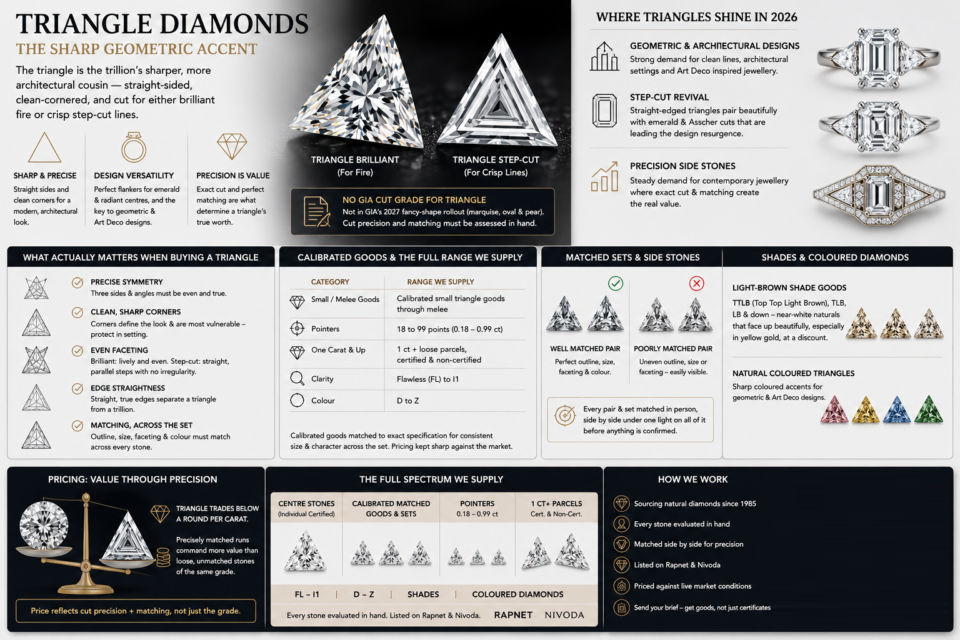
The triangle is carried by two of the year’s strongest design currents at once: the appetite for geometric, architectural settings, and the step-cut revival. Straight-edged triangles — particularly step-cut ones — pair naturally with the emerald and Asscher cuts that are surging in 2026, and with the clean, Art Deco-influenced design that’s back in fashion. As a precision side stone and accent, the triangle is in steady demand for contemporary work, and its value sits squarely on cut precision and matching. As across the whole 2026 market — premium and distinctive goods holding firm while lab-grown commoditises the generic stone — what a knowledgeable desk brings to the triangle is exact, consistent, well-matched goods.
What GIA’s report covers — and what it doesn’t
Color Diamonds Collections:
Natural Yellow Diamonds | Natural Pink Diamonds | Natural Blue Diamonds | Natural Green Diamonds | Natural Brown Diamonds | Natural Chameleon Diamonds | Natural Purple Diamonds | Natural Orange Diamonds | Natural Gray Diamonds
Diamond Shaped Collections:
Natural Round Brilliant Diamonds | Natural Pear Shaped Diamonds | Natural Oval Diamonds | Natural Marquise Diamonds | Natural Radiant Cut Diamonds | Natural Emerald Cut Diamonds | Natural Cushion Cut Diamonds
GIA issues no cut grade for the triangle, and it is not in the 2027 fancy-shape rollout (marquise, oval and pear) — so there’s no cut grade coming. The report, where a stone is individually certified, gives polish, symmetry, measurements and depth; whether a triangle is cleanly cut, sharp-cornered and precisely matched to its set is a matter of seeing the goods.
What actually matters when you’re buying a triangle
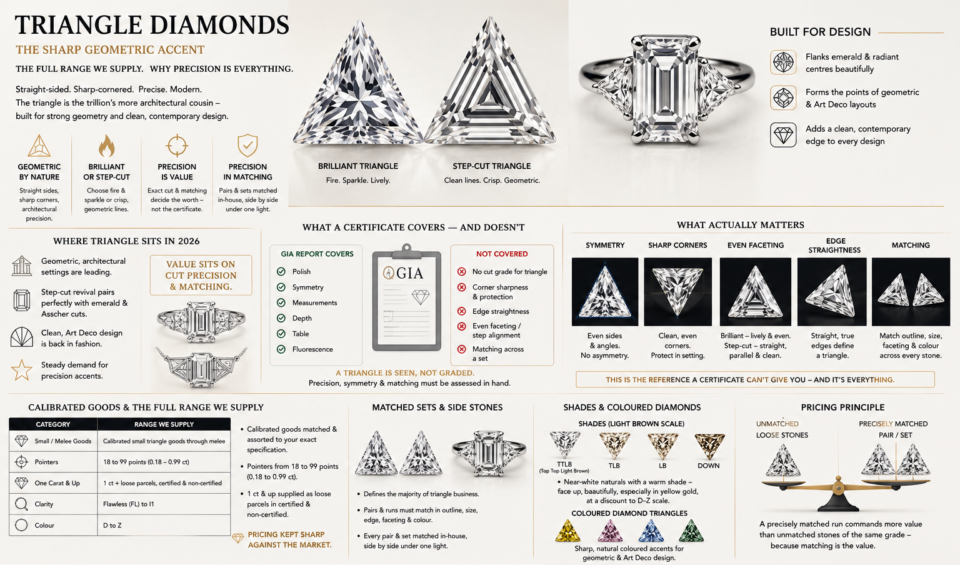
- Precise symmetry. The three sides and angles should be even and true; in a geometric accent, the smallest asymmetry is glaring once set, especially in a matched run.
- Clean, sharp corners. The corners define the triangle’s crisp look and are its most vulnerable points — they should be cleanly formed and even, and protected in setting.
- Even faceting. In a brilliant triangle, the faceting should be lively and even; in a step-cut triangle, the steps should be straight, parallel and clean, with no irregularity to break the geometry.
- Edge straightness. Straight, true edges are what separate a triangle from a trillion; a wavy or uneven edge undermines the whole effect.
- Matching, across the set. As with all accent stones, a pair or run of triangles must match in outline, size, faceting and colour — assessed across every stone at once.
This is the reference a certificate can’t give you, and for the precision-accent work this shape exists to do, it’s everything.
Calibrated goods and the full range
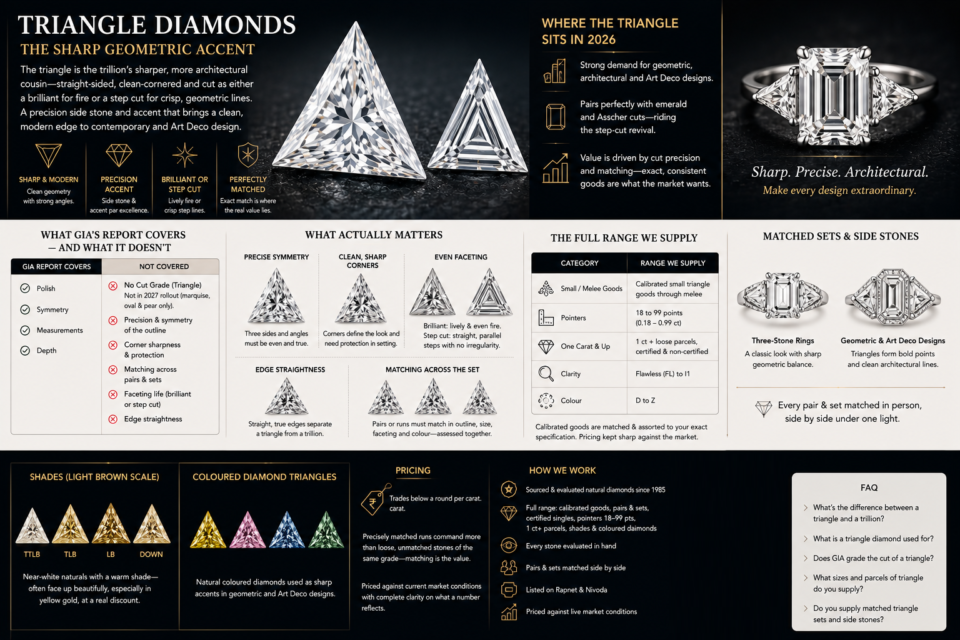
The triangle is predominantly a calibrated accent, so we supply it as calibrated matched goods, pairs and sets, with individually certified single stones available where a larger triangle is used on its own. We carry the full range.
| Category | Range we supply |
| Small / melee goods | calibrated small triangle goods through melee |
| Pointers | 18 to 99 points (0.18 – 0.99 ct) |
| One carat and up | 1 ct + loose parcels, certified and non-certified |
| Clarity | Flawless (FL) to I1 |
| Colour | D to Z |
Calibrated goods are matched and assorted to a buyer’s exact specification for consistent size and character across the set; pointers run from 18 to 99 points (0.18 to 0.99 carat); and at one carat and above we supply triangles as loose parcels in both certified and non-certified form. Pricing is kept sharp against the market.
Matched sets and side stones
The defining triangle order is a matched pair or run of accents, and precision is the entire point: triangles set as a pair beside a centre, or in a geometric layout, must agree exactly in outline, size, edge and faceting, or the geometry reads as off. We match every triangle pair and set it in person, side by side under one light, on all of it, before anything is confirmed.
Shades and coloured diamonds
Two categories sit alongside the white goods. The first is shade goods on the light-brown scale — TTLB (Top Top Light Brown), TLB, LB and down — near-white naturals carrying a faint warm shade that often face up well, especially in yellow gold, at a discount to the D-Z scale. The second is natural coloured-diamond triangles, used as sharp coloured accents in geometric and Art Deco design. We supply both.
Pricing
A triangle trades below a round per carat, and as a calibrated accent its value runs on precision and matching: a precisely matched run commands more than loose, unmatched stones of the same grade, because the matching is the value. We price against current market conditions and tell you plainly what a number reflects.
How we work
Raremonds has sourced and evaluated natural diamonds since 1985, and the triangle is a shape where our matching and precision discipline earns its keep, because a geometric accent is only as good as how exactly it’s cut and matched. We supply the full range: calibrated matched goods, pairs and sets, individually certified single stones where needed, pointers from 18 to 99 points, certified and non-certified loose parcels at one carat and up, light-brown shade goods and natural coloured diamonds. Every stone evaluated in hand, every set matched side by side, listed on Rapnet and Nivoda, priced against live conditions. Send a brief — carat range, the centre or layout you’re matching to, quality window and stone count — and we’ll come back with goods evaluated, not just certified, at the right price for what they are.
Send your requirement to Raremonds → WhatsApp Parth directly: +91 98193 47999
Triangle Diamonds
The triangle is the sharp, straight-sided, geometric triangular cut — the trillion’s more architectural cousin — used above all as a precision side stone and accent in modern and Art Deco design, and riding the step-cut revival. Its value is in cut precision and exact matching, which the report doesn’t measure. There’s no GIA cut grade for triangle and none coming. We supply the full range — calibrated matched goods, pairs and sets, certified singles, pointers 0.18 to 0.99, certified and non-certified parcels at a carat and up, shade goods and coloured diamonds — matched and evaluated in hand and priced to what a stone is actually worth.
FAQ
What’s the difference between a triangle and a trillion?
Both are triangular, but the triangle is straight-sided, sharp-cornered and more geometric, and is often step-cut, while the trillion (trilliant) is typically a brilliant cut with softer, sometimes curved sides and more fire. The triangle suits clean, architectural and Art Deco design; the trillion reads bolder and sparklier.
What is a triangle diamond used for?
Primarily as a precision side stone and geometric accent — flanking emerald and radiant centres, forming the points of Art Deco and geometric layouts, and bringing a sharp, contemporary edge. Larger triangles are occasionally used on their own.
Does GIA grade the cut of a triangle?
No, and the triangle is not in GIA’s 2027 fancy-shape rollout, so there’s no cut grade coming. Precision, corner quality and matching all have to be assessed in hand.
What sizes and parcels of triangle do you supply?
The full range: calibrated small and accent goods through melee, pointers from 18 to 99 points (0.18 to 0.99 ct), and one-carat-and-larger goods as loose parcels in both certified and non-certified form, in every clarity from FL to I1 and every colour from D to Z, plus shade goods and coloured diamonds.
Do you supply matched triangle sets and side stones?
Yes — this is the core of the shape. Pairs and runs are matched in hand on outline, size, edge straightness, faceting and colour together, side by side, before anything is confirmed.

.png)