

The heart is the most personal cut in the diamond world, and the most unforgiving. It’s a modified brilliant carrying two lobes, a cleft and a point, and every one of those features has to be cut precisely or the whole stone reads as a near-miss. Get it right and a heart is unmistakable and charming; get it slightly wrong and it looks like an oval that couldn’t decide. The certificate will not tell you which one you’re looking at.
After two generations in the natural diamond trade, the heart is among the shapes we read with the most exacting eye, because the gap between a heart that’s correctly graded and one that’s beautifully cut is as wide as any shape we handle — and it’s all in symmetry the report doesn’t measure. This is a straight account of where the heart market sits in 2026, the full range we supply, and the expertise that decides whether a heart is worth what it costs.
Where heart sits in 2026
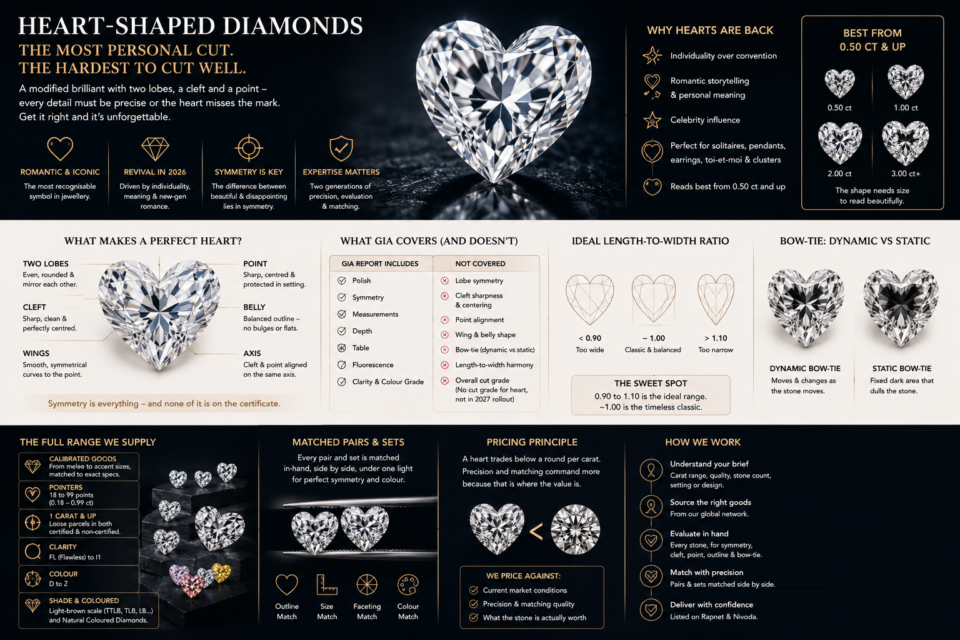
After years as a shape people were almost embarrassed to ask for, the heart is enjoying a genuine, irony-free revival. It’s being driven by the broader 2026 move toward individuality and romantic storytelling, by a new generation drawn to meaning over convention, and by celebrity stones that have made the shape feel current rather than kitsch. It shows up across categories — solitaires for clients who want something openly romantic, pendants and earrings where the silhouette reads beautifully, toi-et-moi pairings, and clusters — and it has one commercial advantage no other shape can claim: the heart is the most recognisable symbol in jewellery, which gives it a directness that sells.
Two things shape how a buyer should approach it. First, the heart needs size to read — below roughly half a carat the lobes and cleft get hard to see, especially once the stone is set, so the shape works best from about 0.50 carat upward and comes into its own in the larger sizes the revival favours. Second, like every shape, lab-grown has made large hearts cheap and commoditised the generic stone, which pushes the value in natural hearts onto make, size and the goods lab-grown serves poorly — above all the coloured-diamond hearts the shape is famous for. Reading all of that for a client is the core of what we do in heart.
What GIA’s report covers — and why the heart stays ungraded
Color Diamonds Collections:
Natural Yellow Diamonds | Natural Pink Diamonds | Natural Blue Diamonds | Natural Green Diamonds | Natural Brown Diamonds | Natural Chameleon Diamonds | Natural Purple Diamonds | Natural Orange Diamonds | Natural Gray Diamonds
Diamond Shaped Collections:
Natural Round Brilliant Diamonds | Natural Pear Shaped Diamonds | Natural Oval Diamonds | Natural Marquise Diamonds | Natural Radiant Cut Diamonds | Natural Emerald Cut Diamonds | Natural Cushion Cut Diamonds
GIA issues no overall cut grade for heart, as for all fancy shapes: the report gives polish, symmetry, measurements, depth and table, but no light-performance assessment. And it’s worth being precise here — GIA’s first wave of fancy-shape cut grades, arriving in 2027, covers oval, pear and marquise only. The heart is not in that initial group, so for the foreseeable future a heart will continue to carry no cut grade at all. That makes physical evaluation not just the best assessment of a heart but the only one — which, given how much of a heart’s success rides on symmetry, matters more here than almost anywhere.
What actually matters when you’re buying a heart
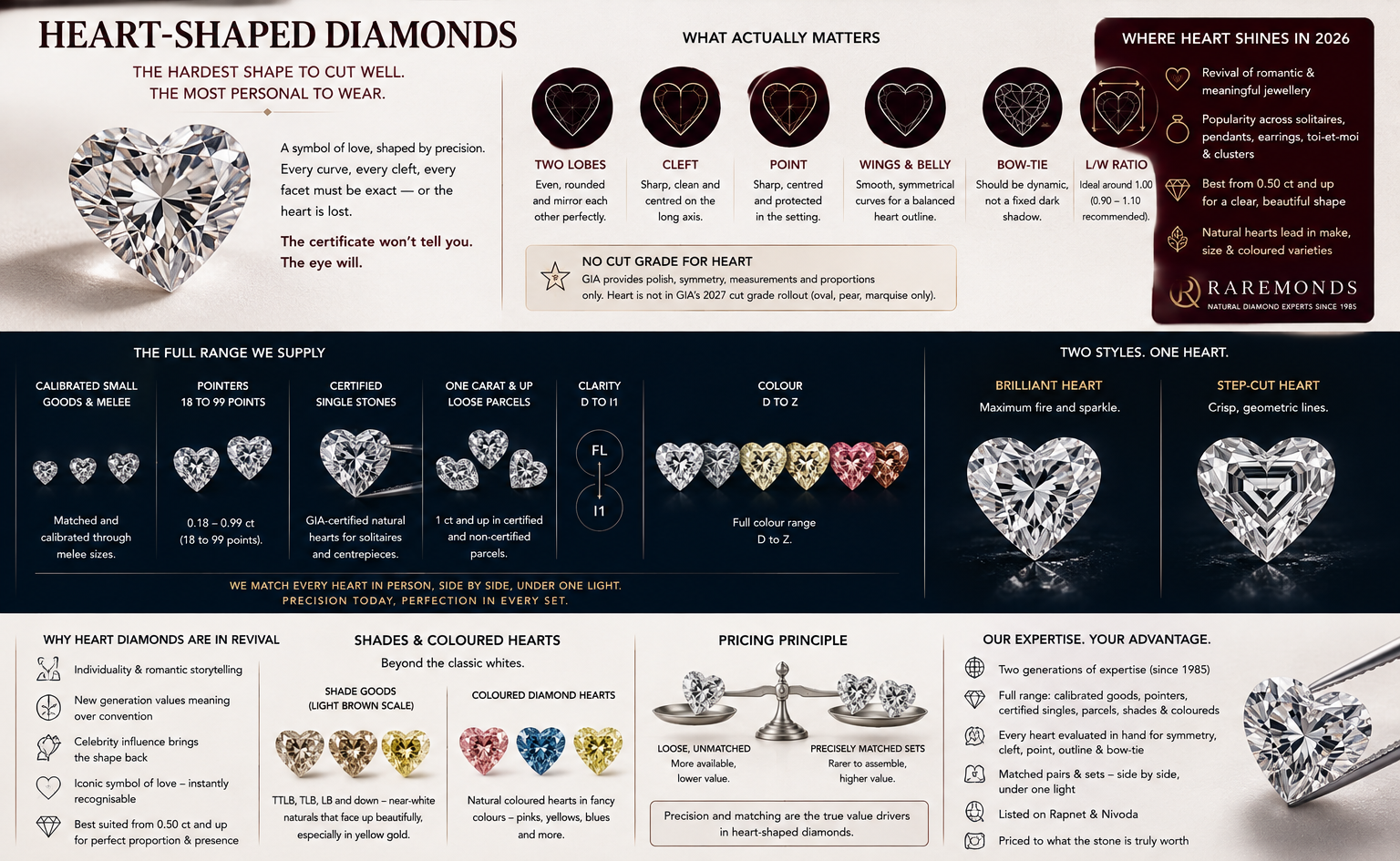
A heart lives or dies on symmetry, and none of it is on the certificate:
- The two lobes. They must be even, rounded and mirror each other in size, height and shape. The eye catches an uneven lobe instantly, even on a client who can’t say what’s wrong — and it can’t be corrected at setting.
- The cleft. The notch between the lobes should be sharp, clean and centred precisely on the long axis. A shallow, off-centre or rounded cleft is the fastest way for a heart to stop reading as a heart.
- The point. Sharp, centred under the cleft on the same axis, and protected in the setting — the point carries the same chipping risk as any tapered shape, so a V-prong or bezel belongs in the conversation.
- The wings and belly. The curves from the lobes down to the point should be smooth and symmetrical, neither bulging nor flat, so the outline reads as a balanced heart rather than a lopsided one.
- The bow-tie. Like other brilliant fancies, a heart can carry a bow-tie across the centre; whether it’s dynamic or a fixed shadow is a call only the stone in hand will answer.
- Length-to-width ratio. Around 1.00 is classic — a heart that’s as wide as it is long; slightly under reads broader, slightly over reads narrower. Outside roughly 0.90 to 1.10 it starts to look off, and the right point in that band is a matter of the setting and the brief.
This is the reference a certificate can’t give you, and on a heart it’s everything — because the difference between a beautiful heart and a disappointing one is symmetry the report doesn’t grade. At Raremonds that reference spans two generations.
Certified single stones
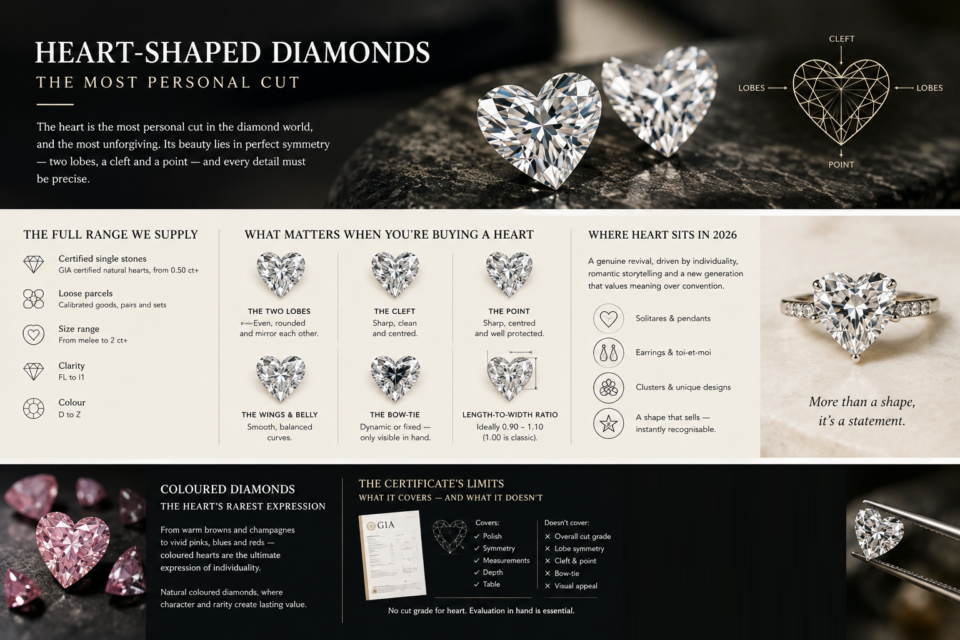
For solitaires, pendants and centrepiece commissions we supply GIA-certified natural hearts across sizes, colours and clarities, each evaluated in hand for lobe symmetry, cleft, point, outline and bow-tie, and sourced to the look the brief calls for — generally from about half a carat upward, where the shape reads cleanly. The certificate starts that conversation; it doesn’t finish it.
Loose parcels and the size range
The heart is less of a tiny-melee shape than the elongated brilliants, precisely because it needs size to read — but it’s supplied across calibrated small goods and parcels for layouts, suites and accents, and upward into the single sizes. We carry the range, with the shape’s minimum-size reality built in.
| Category | Range we supply |
| Sieve / small goods | -7, +7, and the +11 and +14 sizes |
| Pointers | 18 to 99 points (0.18 – 0.99 ct) |
| One carat and up | 1 ct + loose parcels, certified and non-certified |
| Clarity | Flawless (FL) to I1 |
| Colour | D to Z |
Small calibrated hearts run through the sieve sizes for accents and suites; pointers from 18 to 99 points (0.18 to 0.99 carat); and at one carat and above we supply hearts as loose parcels in both certified and non-certified form. The one caveat we’re always straight about: the smaller the heart, the harder the shape is to read once set, so for accent goods we sort for the cleanest outlines and steer clients toward sizes where the heart actually shows. Across the range the discipline is accurate sorting, consistent make, and pricing kept sharp against the market.
Matched pairs
A matched pair of hearts — for earrings, or a toi-et-moi — compounds every symmetry variable across two stones: lobe shape and height, cleft depth and centring, point alignment, outline, ratio, colour temperature and fluorescence all have to agree, side by side, not just on two separate reports. Fluorescence is where pairs most often fail, reading evenly in some light and unevenly under UV-rich daylight with no fix after setting. We match every heart pair in person on all of it before either stone is confirmed.
Shades and coloured diamonds
Two categories sit alongside the white goods, and for the heart the second is the headline. Shade goods on the light-brown scale — TTLB (Top Top Light Brown), TLB, LB and down — are near-white naturals with a faint warm shade that often face up white, especially in yellow gold, at a discount to the equivalent face-up-white stone; the heart’s brilliant faceting hides a faint shade well, though the point shows colour more, so the call on which face up clean is one experience makes. But the heart is, above all, an icon in colour: pink and yellow hearts are among the most romantic and sought-after coloured stones in the trade, and the shape’s symbolism and a saturated colour reinforce each other in a way few other cuts manage. We supply both the shade goods and natural coloured-diamond hearts — and for a client who wants colour in the most expressive shape there is, a well-cut coloured-diamond heart is one of the most compelling things we can source.
Pricing
Hearts generally trade below round per carat, but within the shape make drives the spread, because a poorly cut heart isn’t just lower quality — it stops reading as a heart, which is a commercial failure no grade compensates for. Well-cut hearts with clean lobes, a sharp centred cleft and a balanced outline command a premium over symmetric-on-paper goods, and small hearts carry the added difficulty of reading the shape at size. Coloured-diamond hearts are their own market, priced on colour first. We price against current market conditions rather than static markups, read where a specific stone sits on cut, and tell you plainly when a low number reflects a cut that won’t carry the shape.
How we work — the Raremonds position
Raremonds has sourced and evaluated natural diamonds since 1985, and heart is among the shapes where our eye matters most, because so much of the stone’s success rides on symmetry the certificate doesn’t grade — and will continue not to grade past 2027. We supply the full range: GIA-certified single stones, pendants and centrepieces sourced where the shape reads cleanly, calibrated small goods for accents and suites, matched pairs and toi-et-moi pairings, pointers from 18 to 99 points, certified and non-certified loose parcels at one carat and up, light-brown shade goods, and natural coloured-diamond hearts. Every stone evaluated in hand — lobes, cleft, point, outline, bow-tie — every pair matched side by side, listed on Rapnet and Nivoda, priced against live market conditions, and we’re straight with you about where a stone really sits. Send a brief — carat range, quality window, colour, setting type and stone count — and we’ll come back with stones that have been evaluated, not just certified, at the right price for what they are.
Send your requirement to Raremonds → WhatsApp Parth directly: +91 98193 47999
The short version
The heart is the most personal cut and the hardest to cut well — its success rides on lobe symmetry, a sharp centred cleft, a clean point and a balanced outline, none of which is on the report, and none of which a GIA cut grade will cover even after the 2027 fancy-shape rollout (which is oval, pear and marquise only). It needs size to read, works best from about half a carat up, and is enjoying a genuine, irony-free revival led by romance and individuality. We supply the full range — certified single stones and pendants, calibrated accent goods, matched pairs, pointers 0.18 to 0.99, certified and non-certified parcels at a carat and up, shade goods, and the coloured-diamond hearts the shape is famous for — evaluated in hand and priced to what a stone is actually worth. That evaluation is the work.
FAQ
Does GIA issue a cut grade for heart-shaped diamonds?
No — and unlike oval, pear and marquise, the heart is not part of GIA’s first wave of fancy-shape cut grades arriving in 2027, so for the foreseeable future a heart carries no cut grade at all. The report gives polish, symmetry, measurements and depth, none of which is a light-performance assessment, which makes physical evaluation of lobe symmetry, cleft, point and outline the only reliable way to judge a heart.
What makes a heart-shaped diamond well cut?
Symmetry, above all: two even, mirror-image lobes; a sharp, clean, centred cleft; a point centred under the cleft on the same axis; and smooth, balanced curves down to the point. An uneven lobe or an off-centre cleft makes a heart stop reading as a heart, even to someone who can’t say why — and none of it can be fixed at setting.
Is there a minimum size for a heart-shaped diamond?
In practice, yes. Below roughly half a carat the lobes and cleft get hard to see, especially once the stone is set, so the heart reads best from about 0.50 carat upward. For smaller accent hearts we sort for the cleanest outlines and are honest about where the shape stops showing clearly.
What sizes and parcels of heart do you supply?
The full range: calibrated small goods through the -7, +7, +11 and +14 sizes for accents and suites, pointer goods from 18 to 99 points (0.18 to 0.99 ct), and one-carat-and-larger goods as loose parcels in both certified and non-certified form, in every clarity from Flawless to I1 and every colour from D to Z — with the minimum-size reality of the shape built into how we sort and advise.
Do you supply coloured-diamond and shade-good hearts?
Yes, and colour is where the heart shines. We supply natural coloured-diamond hearts — pink and yellow especially, where the symbolism and a saturated colour reinforce each other — as well as light-brown shade goods on the TTLB scale and down, near-white naturals that often face up white in yellow gold at a discount to the equivalent face-up-white stone.
Do you supply matched heart pairs?
Yes — for earrings and toi-et-moi pairings. Every pair is matched in hand on lobe symmetry, cleft, point, outline, ratio, colour and fluorescence simultaneously, side by side under consistent light, because identical grades alone don’t make two hearts match.

.png)