

The rose cut is the antique that breaks every modern rule, and that is exactly why it has come back. Dating to the 1500s, it has no pavilion at all: a flat back and a domed top covered in triangular facets that rise to a point, like the petals of a rosebud. It throws no fire and no bright sparkle — instead it gives a soft, gentle, almost glassy glow, low and luminous, and it sits flatter and more discreetly than any faceted stone. In a market saturated with maximum brilliance, that quiet, vintage character has made the rose cut a favourite of alternative bridal, minimalist and bohemian design.
It is also a cutting style rather than a single outline — and this is central to how the rose cut trades. The rose treatment (flat back, faceted dome) is applied across a whole family of shapes: round, oval and cushion, but also pear, marquise, kite, hexagon, shield, triangle and more, so a “rose cut” can take almost any outline a design calls for. On top of that it is two markets in one stone: the clean, soft, elegant rose cut, and the included, “salt-and-pepper” rose cut whose rustic character is the whole appeal. After two generations in the natural diamond trade, we supply rose cuts across the full range — every outline, melee for pavé and accents, larger statement stones, clean and salt-and-pepper, in white, warm and colour. This is where the cut sits, what we carry, and how to buy it well.
Where the rose cut sits in 2026
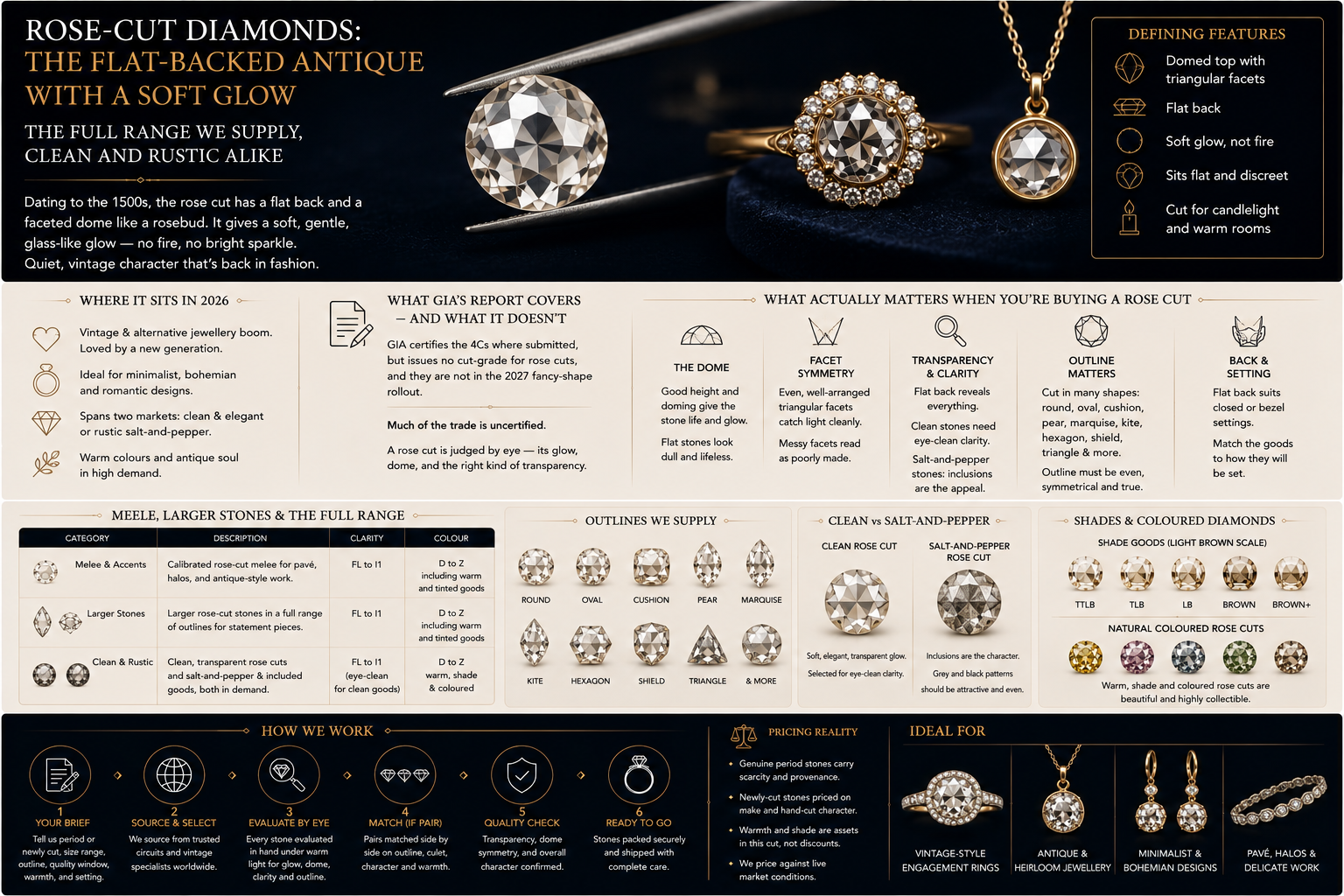
The rose cut rides the vintage-and-alternative current that runs right through 2026. As buyers move toward romance, individuality and quiet luxury — and away from the idea that a diamond has to be an icy, maximum-sparkle white — the rose cut’s soft glow and antique soul have found a wide audience in vintage-inspired, minimalist and bohemian jewellery. Its low profile makes it ideal for delicate, everyday and stacking designs, and rose-cut melee is a staple of antique-style pavé and halo work.
Commercially, the rose cut spans an unusually wide range. At one end, clean rose cuts give a soft, elegant, transparent look; at the other, salt-and-pepper and included rose cuts — full of grey and black inclusions that read as character rather than flaw — serve the booming rustic and alternative market at very accessible prices. As across the whole 2026 market — where lab-grown has commoditised the generic white stone — the rose cut offers something else entirely: a look, a feel and a price point the generic stone doesn’t reach. Sourcing it well, across both its clean and rustic markets, is what we bring.
What GIA’s report covers — and what it doesn’t
GIA certifies rose cuts for the 4Cs where a stone is submitted, but issues no cut-quality grade, and they are not in the 2027 fancy-shape rollout. Much rose-cut business — particularly melee and salt-and-pepper goods — trades uncertified, on the goods themselves. Either way, a rose cut is judged by eye: its glow, its dome and, crucially, its transparency, since the flat back makes the stone a window you look straight into.
What actually matters when you’re buying a rose cut
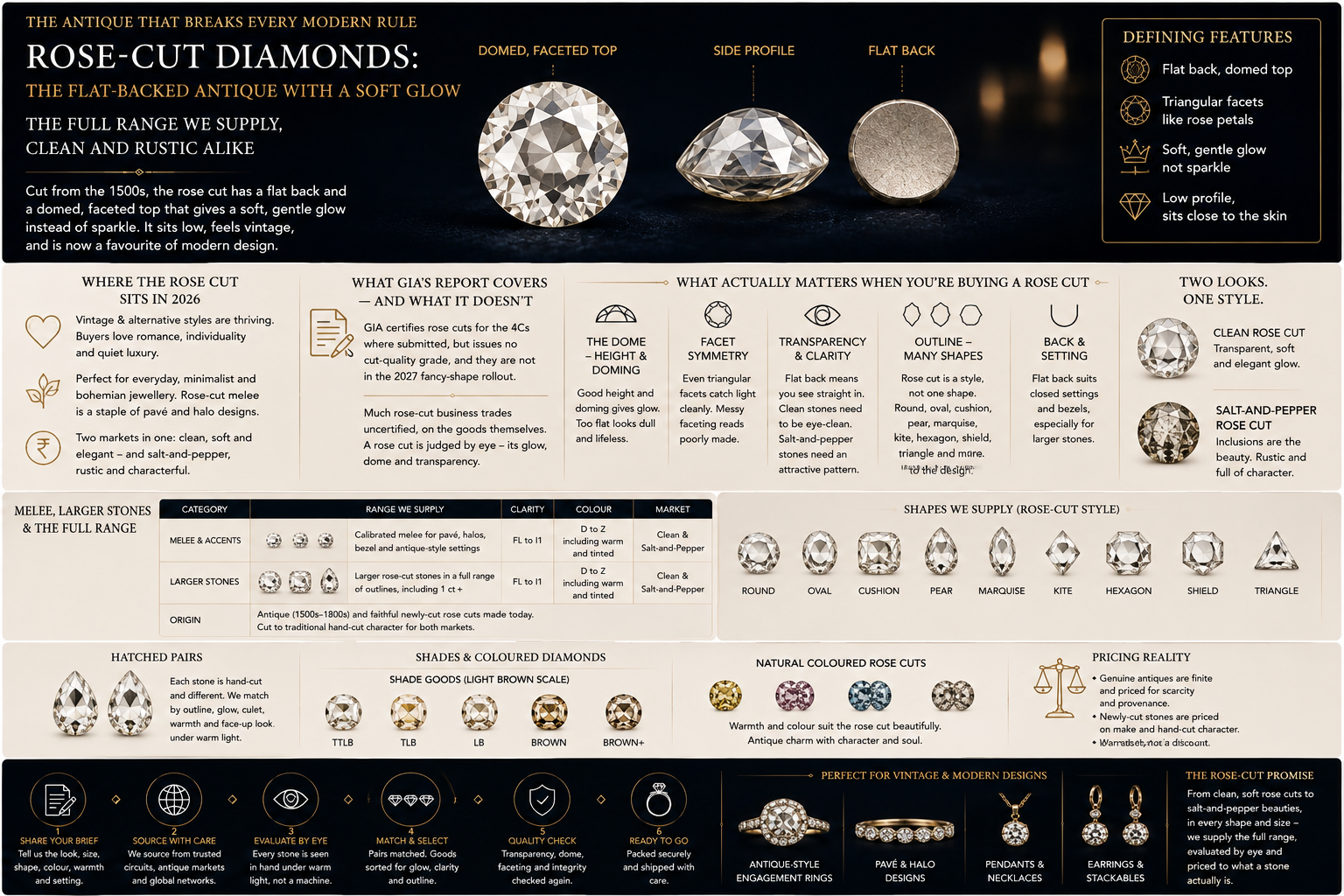
- The dome — height and doming. The rose cut’s beauty is its domed, faceted top; a well-domed stone with good height glows, while a flat, shallow rose cut looks dull and lifeless. Dome quality is the first thing to read.
- Facet symmetry on the dome. The triangular facets should be even and well-arranged so the dome catches light cleanly; messy faceting reads as poorly made.
- Transparency and clarity — and which market you’re in. The flat back means you see straight into the stone, so clarity shows plainly. For a clean rose cut, that means selecting genuinely transparent, eye-clean goods; for a salt-and-pepper rose cut, the inclusions are the point, and the judgement is whether the pattern of grey and black is attractive and even. These are two different selections for two different briefs.
- Outline — and which one you want. Because the rose cut is a style, not one shape, it is cut to almost any outline: round, oval, cushion, pear, marquise, kite, hexagon, shield, triangle and beyond. That breadth is part of the appeal, but it also means the outline is something you specify with the order — and whichever it is, it should be even, symmetrical and true to the shape intended (a pear rose cut wants a clean point and even shoulders; a hexagon or kite wants crisp, matched edges; a triangle wants true, equal sides).
- The back and the setting. Because the back is flat, larger rose cuts are often set in closed or bezel settings; it’s worth matching the goods to how they’ll be set.
This is the reference a certificate can’t give you, because the rose cut is judged on glow, dome and the right kind of transparency for the look — none of which a grade captures.
Color Diamonds Collections:
Natural Yellow Diamonds | Natural Pink Diamonds | Natural Blue Diamonds | Natural Green Diamonds | Natural Brown Diamonds | Natural Chameleon Diamonds | Natural Purple Diamonds | Natural Orange Diamonds | Natural Gray Diamonds
Diamond Shaped Collections:
Natural Round Brilliant Diamonds | Natural Pear Shaped Diamonds | Natural Oval Diamonds | Natural Marquise Diamonds | Natural Radiant Cut Diamonds | Natural Emerald Cut Diamonds | Natural Cushion Cut Diamonds
Melee, larger stones and the full range
We supply rose cuts as calibrated melee for pavé and accents, as larger statement stones, in a full range of outlines — round, oval, cushion, pear, marquise, kite, hexagon, shield, triangle and more — and across both the clean and salt-and-pepper markets. We carry the full range.
| Category | Range we supply |
| Melee / small goods | calibrated rose-cut melee for pavé, halos and accents |
| Larger stones | individual rose cuts, certified and non-certified, including 1 ct + and statement sizes |
| Clarity | eye-clean and transparent through to characterful salt-and-pepper goods |
| Colour | D to Z, plus warm, grey and coloured-diamond goods suited to the cut |
Melee is calibrated and matched for pavé and accent work; larger stones run through one carat and well above in both certified and non-certified form; and we supply both clean, transparent goods and salt-and-pepper goods to suit the brief. Pricing is kept sharp against the market across both.
Matched goods and layouts
Rose-cut melee for a pavé or halo must match in outline, dome and transparency across the run, and a pair of larger rose cuts must agree in glow, dome and — for salt-and-pepper goods — inclusion character, or the piece reads uneven. We match rose-cut goods in person, laid out together, before anything is confirmed.
Shades and coloured diamonds
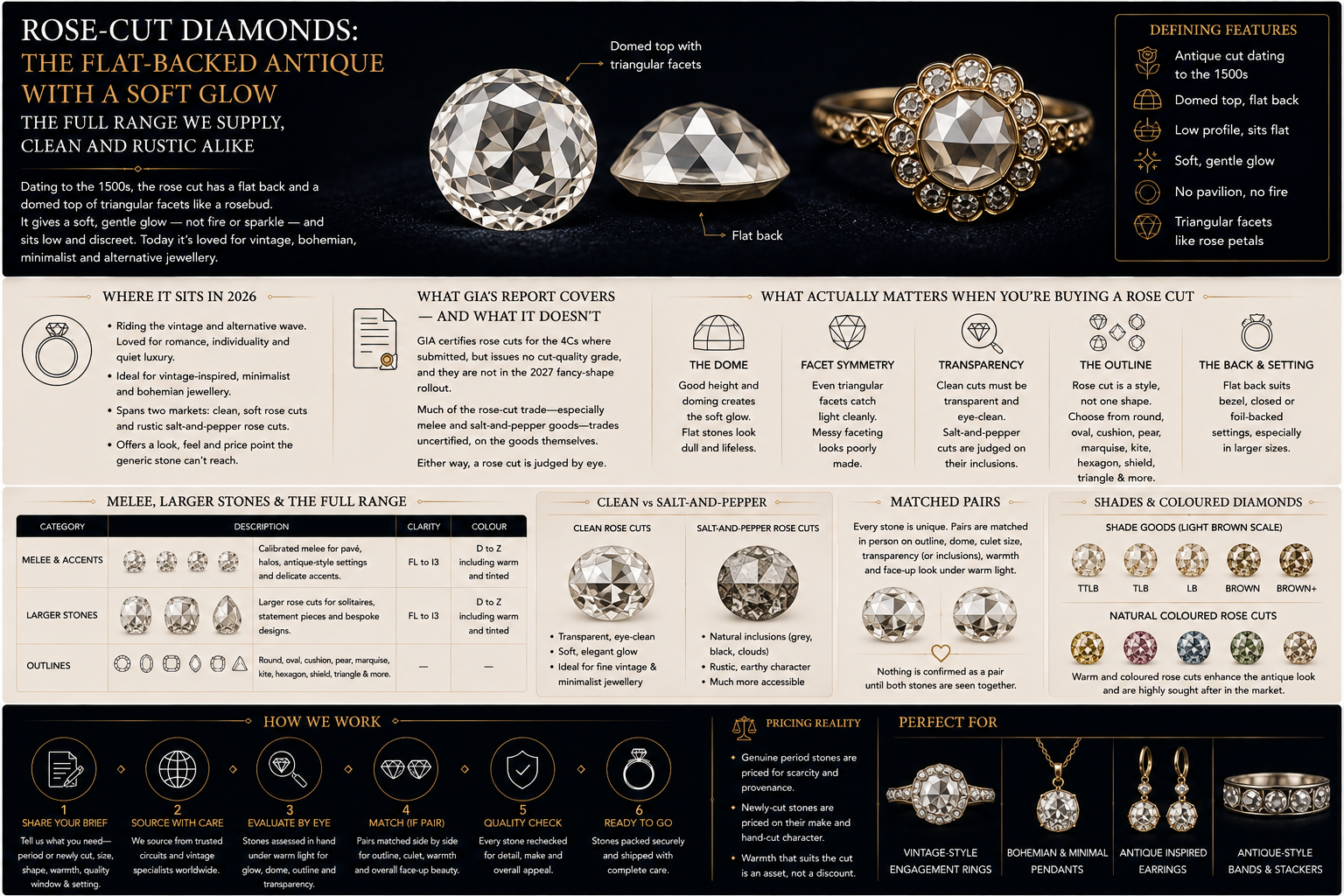
The rose cut’s aesthetic embraces exactly the goods a brilliant would discount, which makes its colour story unusually rich. Shade goods on the light-brown scale — TTLB (Top Top Light Brown) and down — and warm tints suit the soft, vintage, yellow-gold look the cut is made for. Grey and salt-and-pepper goods are a category of their own, central to the rustic market. And natural coloured-diamond rose cuts — yellows and beyond — bring colour to the cut’s gentle glow beautifully. We supply all of it.
Pricing
The rose cut spans a wide price range. Clean, well-domed, transparent rose cuts in good sizes are priced on their make and clarity; salt-and-pepper and heavily included goods are highly accessible and serve the rustic market at low price points; and rose-cut melee is priced as accent goods on calibration and matching. We price against current market conditions across both markets, and tell you plainly what a stone or parcel reflects.
How we work
Raremonds has sourced and evaluated natural diamonds since 1985, and the rose cut is a shape where our eye earns its keep across two very different markets — selecting genuinely transparent, well-domed clean goods on one hand, and attractive, characterful salt-and-pepper goods on the other. We supply the full range: calibrated rose-cut melee for pavé and accents, larger statement stones certified and non-certified, clean and salt-and-pepper goods, warm and shade goods, grey goods and natural coloured diamonds. Every stone evaluated in hand, every run matched, listed on Rapnet and Nivoda, priced against live conditions. Tell us what you’re after — clean or rustic, outline, size, the look you’re building and quantity — and we’ll come back with goods evaluated for glow and dome and the right transparency, at the right price for what they are.
Send your requirement to Raremonds → WhatsApp Parth directly: +91 98193 47999
The short version
The rose cut is the flat-backed antique with no pavilion — a domed, faceted top that glows softly rather than sparkling, low and discreet, with a 1500s pedigree and a strong place in vintage, minimalist and bohemian design. It’s a cutting style, not a single shape, so it comes in almost any outline — round, oval, pear, cushion, marquise, kite, hexagon, shield, triangle and more. It’s also two markets at once: clean, transparent, elegant goods, and rustic salt-and-pepper goods whose inclusions are the appeal. It’s judged on dome, glow and the right kind of transparency, none of it on a grade. We supply the full range — calibrated melee, larger statement stones, clean and salt-and-pepper, warm, grey and coloured-diamond goods, certified and non-certified — evaluated in hand and priced to what a stone actually is.
FAQ
What makes a rose cut different from other diamond cuts?
A rose cut has no pavilion at all — just a flat back and a domed top covered in triangular facets. It produces a soft, gentle glow rather than fire and sparkle, and sits much flatter and more discreetly than a faceted brilliant. It’s an antique cut (dating to the 1500s) prized today for its quiet, vintage character.
What outlines does a rose cut come in?
Almost any — the rose cut is a faceting style (flat back, faceted dome), not a single shape, so it’s cut to round, oval, cushion, pear, marquise, kite, hexagon, shield, triangle and other outlines. The outline is part of what you specify when ordering, and that versatility is much of why the cut suits bespoke and alternative design. We supply rose cuts across the full range of outlines, clean and salt-and-pepper, in melee and larger sizes.
What is a salt-and-pepper rose cut?
A rose cut full of grey and black inclusions that read as character rather than flaw. Because the flat back makes the stone transparent, those inclusions are visible and become the whole aesthetic — rustic, individual and very accessible in price. It’s a distinct market from clean, transparent rose cuts, and we supply both.
Does GIA grade the cut of a rose cut?
GIA certifies the 4Cs where a stone is submitted but issues no cut-quality grade, and rose cuts aren’t in the 2027 rollout. Much rose-cut business, especially melee and salt-and-pepper goods, trades uncertified on the goods themselves. The cut is judged by eye, dome, glow and transparency.
What sizes and goods of rose cut do you supply?
The full range: calibrated rose-cut melee for pavé and accents, and larger individual stones through one carat and statement sizes, in both certified and non-certified form — across clean, transparent goods and characterful salt-and-pepper goods, plus warm, grey and coloured-diamond goods.
Do you supply rose-cut melee for pavé and accents?
Yes — calibrated and matched for outline, dome and transparency across the run, for antique-style pavé, halos and accent work.

.png)