

The Old Mine cut is the oldest of the antique cuts still in active demand, and right now one of the most wanted. Cut by hand from the 1700s into the 1800s, before machinery and modern optics, it has a soft, squarish “cushion” outline, a tall crown, a small table and a large open culet — the forerunner of the Old European and, through it, of the modern round. Every Old Mine is a little different, because every one was cut by eye to follow its rough, and that individuality, together with a warm, flickering candlelight glow, is exactly what a new generation of buyers has fallen for.
It is also the cut behind some of the most talked-about engagement rings of the moment, which has pulled antique cushions firmly into the spotlight. After two generations in the natural diamond trade, we supply the Old Mine across the full range — genuine period stones and faithful newly-cut goods, single stones and accents, in white, warm and colour. This is where it sits, what we carry, and how to buy it well.
Where the Old Mine sits in 2026
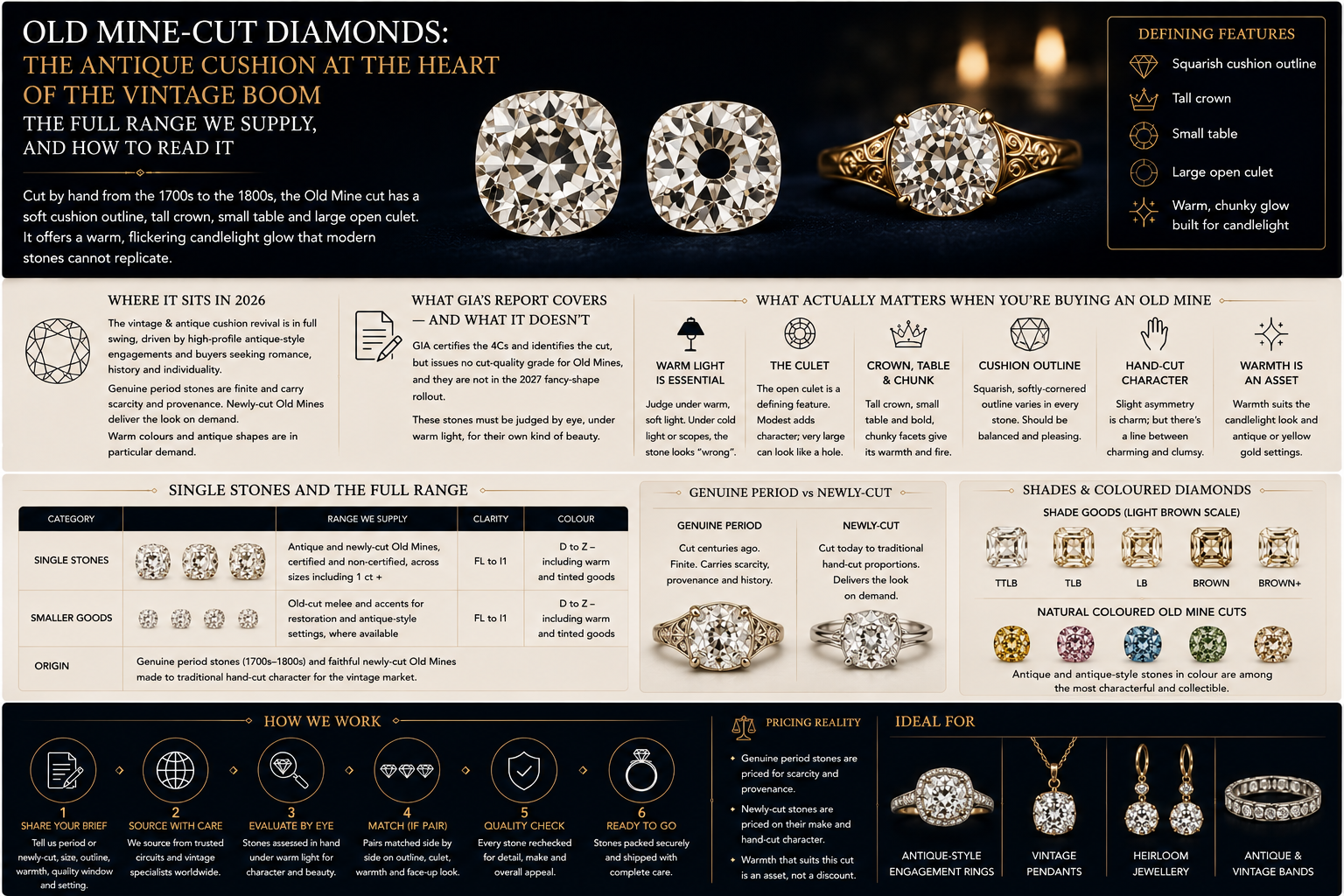
The Old Mine is at the heart of the year’s biggest aesthetic story: the vintage and antique-cushion revival. High-profile antique-style engagements have put soft, hand-cut cushions back at the centre of the conversation, and dealers are reporting particular interest in antique shapes and warm colours. Buyers — Gen Z especially — are drawn to the romance, the history and the quiet luxury of a stone that feels personal and old rather than mass-produced, and the Old Mine, as the original antique cushion, is exactly that.
Commercially, the picture mirrors the Old European. Genuine period Old Mines are finite, cut centuries ago and never to be made again, so original stones carry scarcity and provenance, with a real tension between preserving an original and recutting it (which erases its antique value). Newly-cut Old Mines, made today to the traditional hand-cut character for the vintage market, give a buyer the look on demand. As across the whole 2026 market — where lab-grown has commoditised the generic modern stone — the Old Mine offers warmth, individuality and a story the generic stone can’t. Reading and sourcing it well is what we bring.
What GIA’s report covers — and what it doesn’t
GIA certifies Old Mine cuts for the 4Cs and identifies the cut, but issues no cut-quality grade for them, and they are not in the 2027 fancy-shape rollout. As with the Old European, a modern cut grade would be the wrong tool: an Old Mine is not trying to perform like a modern stone, so it has to be judged for its own kind of beauty, by eye, under the right light.
What actually matters when you’re buying an Old Mine
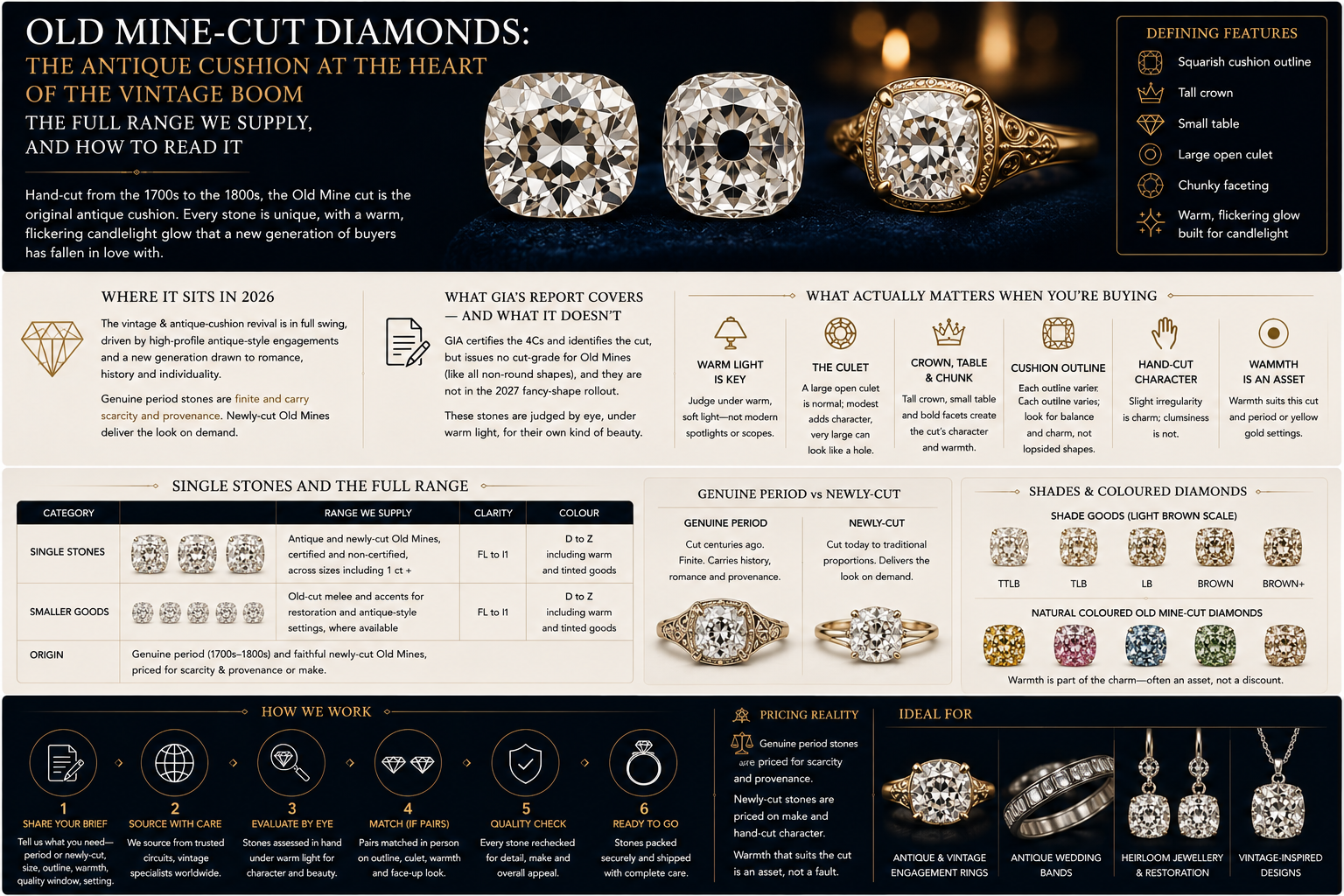
- Judge it under warm light, on its own terms. The Old Mine was cut for candlelight, and its warm, soft, flickering glow reads properly under warm light — not under a cold lamp or a brilliance scope, where it will look “wrong” because it’s answering a different question entirely.
- The cushion outline and its character. The squarish, softly-cornered outline varies from stone to stone; it should be balanced and pleasing, with the hand-cut individuality reading as charm rather than as a lopsided outline.
- The culet. The large open culet is a defining feature seen as a circle at the centre; a modest one adds character, a very large one can read as a visible opening. Which it is is a judgement call.
- Crown, table and chunk. A tall crown, small table and bold, chunky faceting give the Old Mine its character and warmth; these should be present, not flattened toward a modern look.
- Warmth as part of the picture. Old Mines very often carry warmth, and in a period or yellow-gold setting that warmth is an asset, not a fault — it’s part of why the cut is loved.
This is the reference a certificate can’t give you, because the Old Mine, more than almost any stone, is judged on individuality and a kind of beauty modern grading doesn’t measure.
Color Diamonds Collections:
Natural Yellow Diamonds | Natural Pink Diamonds | Natural Blue Diamonds | Natural Green Diamonds | Natural Brown Diamonds | Natural Chameleon Diamonds | Natural Purple Diamonds | Natural Orange Diamonds | Natural Gray Diamonds
Diamond Shaped Collections:
Natural Round Brilliant Diamonds | Natural Pear Shaped Diamonds | Natural Oval Diamonds | Natural Marquise Diamonds | Natural Radiant Cut Diamonds | Natural Emerald Cut Diamonds | Natural Cushion Cut Diamonds
Single stones and the full range
We supply Old Mine cuts as GIA-certified and non-certified single stones — both genuine period stones and faithful newly-cut goods — and as smaller old-cut goods for accents and restoration. We carry the full range.
| Category | Range we supply |
| Single stones | antique and newly-cut Old Mines, certified and non-certified, across sizes including 1 ct + |
| Smaller goods | old-cut melee and accents for restoration and antique-style settings, where available |
| Clarity | Flawless (FL) to I1 |
| Colour | D to Z — including warm and tinted goods suited to the cut |
Single stones run from smaller sizes through one carat and well above, in both certified and non-certified form; smaller old-cut goods are available for restoration and accent work; and pricing is kept sharp against the market, with genuine period stones priced for their scarcity and newly-cut goods for their make.
Matched pairs
Pairs of Old Mines vary more than almost any goods, because each was hand-cut to its own rough, so matching is done in person on outline, cut character, culet, warmth and face-up look — two that grade alike can read very differently. We confirm nothing as a pair until both stones have been seen together under warm light.
Shades and coloured diamonds
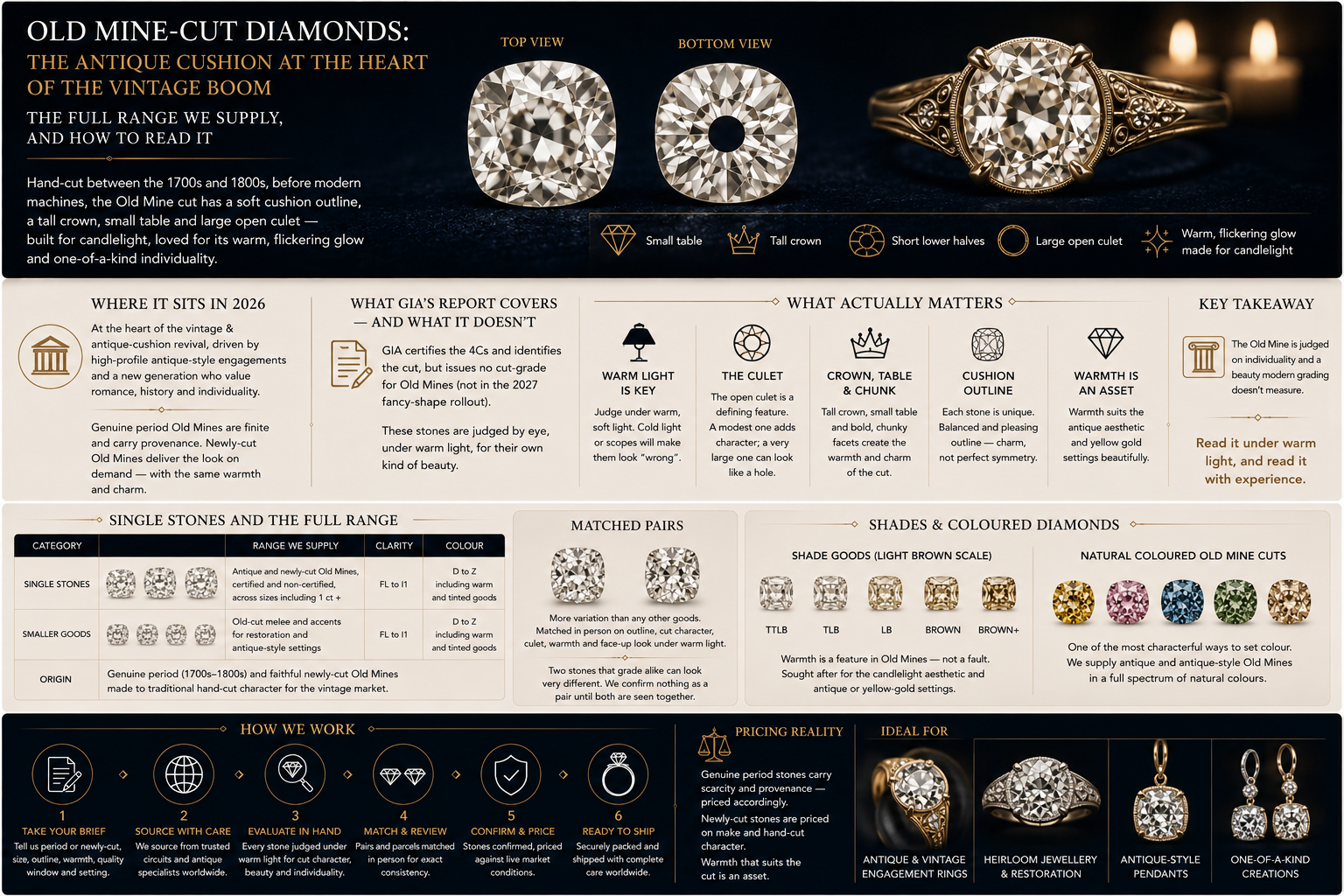
Warmth is central to this cut, which changes how colour works. Shade goods on the light-brown scale — TTLB (Top Top Light Brown), TLB, LB and down — aren’t just value in an Old Mine; their warmth suits the candlelight aesthetic and antique and yellow-gold settings, so warm goods are sought for these cuts rather than discounted. And natural coloured-diamond Old Mines — antique and antique-style stones in yellow and beyond — are among the most characterful and collectible coloured stones there are. We supply both.
Pricing
Old Mine pricing splits two ways, as with the Old European. Genuine period stones carry scarcity and provenance, especially fine, unrecut originals, and are priced for it. Newly-cut Old Mines are priced on their make and the hand-cut character the style demands. In both, warmth that suits the cut is an asset rather than a discount. We price against current market conditions, tell you plainly whether a stone is period or newly cut, and what its number reflects.
How we work
Raremonds has sourced and evaluated natural diamonds since 1985, and the Old Mine is a cut where our eye earns its keep, because it’s judged on individuality and a beauty modern grading doesn’t capture — and telling a fine original from a tired one, and reading outline, culet and warmth, takes experience. We supply the full range: genuine period and faithful newly-cut single stones, certified and non-certified, smaller old-cut goods for restoration and accents, warm and shade goods, and natural coloured diamonds. Every stone evaluated in hand under the right light, every pair matched, listed on Rapnet and Nivoda, priced against live conditions. Tell us what you’re after — period or newly cut, size, outline, warmth, quality window and setting — and we’ll come back with stones evaluated for the cut’s own kind of beauty, at the right price for what they are.
Send your requirement to Raremonds → WhatsApp Parth directly: +91 98193 47999
The short version
The Old Mine is the original antique cushion — hand-cut in the 1700s and 1800s, with a squarish outline, tall crown, small table and large open culet, and a warm candlelight glow. It’s at the heart of 2026’s vintage-and-antique-cushion boom, and every stone is individual, so it’s judged on its own terms under warm light, not a modern checklist. Genuine period stones are finite and carry provenance; newly-cut stones give the look on demand. Warmth is a feature here, not a fault. We supply the full range — period and newly-cut single stones, certified and non-certified, old-cut accents, warm and shade goods, and coloured diamonds — evaluated in hand and priced to what a stone actually is.
FAQ
What’s the difference between an Old Mine and an Old European cut?
Both are antique and share a tall crown, small table and open culet. The Old Mine is older (1700s–1800s) and has a squarish, hand-cut cushion outline; the Old European (1890s–1930s) is round and slightly more uniform, as cutting became more precise. The Old Mine is the more irregular, individual and “antique-looking” of the two.
Why is the Old Mine cut so popular right now?
The vintage and antique-cushion revival — driven by high-profile antique-style engagement rings and a new generation drawn to romance, history and individuality — has put soft, hand-cut cushions firmly in demand, with particular interest in antique shapes and warm colours. The Old Mine is the original antique cushion.
Does GIA grade the cut of an Old Mine?
GIA certifies the 4Cs and identifies the cut, but issues no cut-quality grade for Old Mines, and they’re not in the 2027 rollout — and a modern cut grade would be the wrong measure. The cut is judged by eye, under warm light.
Do you supply genuine antique Old Mines or newly-cut ones?
Both — genuine period stones, priced for scarcity and provenance, and faithful newly-cut Old Mines made to the traditional hand-cut character, priced on their make. We tell you plainly which stone is.
Is warmth a problem in an Old Mine?
No — it’s usually an asset. Warmth suits the candlelight aesthetic and antique and yellow-gold settings, so warm and TTLB-scale goods are sought for these cuts rather than discounted, and we supply them specifically.

.png)