

Every coloured diamond category has a rarity story. Only one category has a rarity story with no footnotes: the natural red diamond. Not rare in the way a fine blue is rare, not scarce in the way a large vivid pink is scarce — genuinely, structurally, categorically rare, in a way that places true red diamonds outside every normal framework of coloured diamond sourcing, pricing, and commercial reasoning. There are more famous red diamonds in museum and private collections than there are available for sale in any given year. The category is that small.
Red diamonds sit at the extreme end of our coloured-diamond work at Raremonds — the rarest category we handle, sourced stone by stone through specialist networks rather than stocked in any depth — and this is written for trade buyers the way our chameleon memo was: what natural red colour actually is, how laboratories grade and confirm it, where value concentrates, the honest commercial case including liquidity, and how we source and document these goods.
What a Natural Red Diamond Actually Is
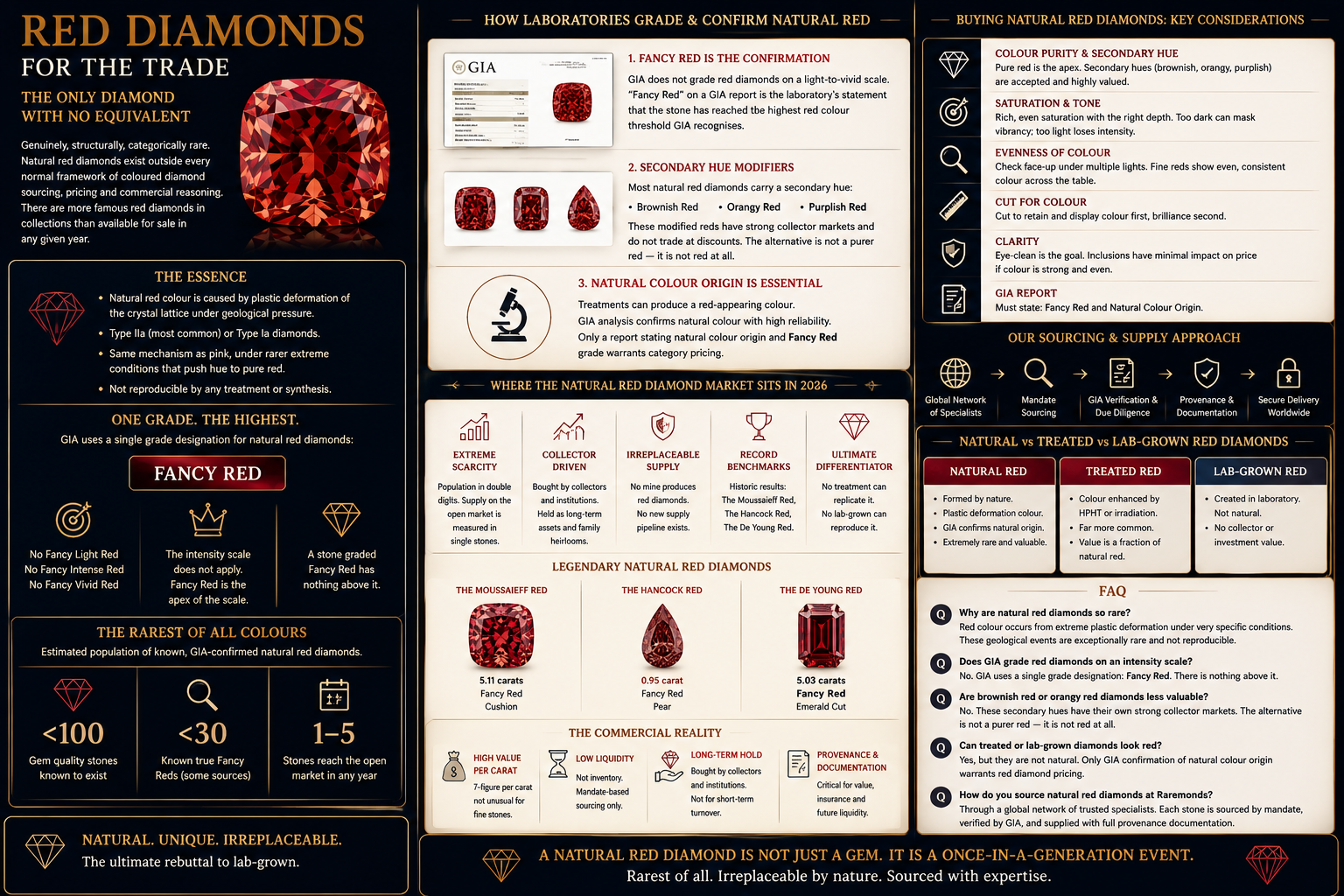
A natural red diamond is a Type IIa or Type Ia diamond whose colour is caused by plastic deformation of the crystal lattice under geological pressure during or after formation — the same structural distortion mechanism believed to produce pink colour, but occurring in conditions that push the resulting hue all the way to a pure red rather than stopping at pink. The science is closely related to pink diamond colour theory, but the conditions producing genuine red are narrower, rarer, and not reproducible by any known treatment or synthesis.
The result is a colour so uncommon that GIA’s grading notation for natural red diamonds uses a single, unambiguous grade designation — Fancy Red — with no Fancy Light Red, no Fancy Intense Red, no Fancy Vivid Red. The intensity scale that governs every other colour in the fancy diamond category does not apply here, because the population of genuine natural reds is too small, and the saturation range too narrow, to justify further subdivision. A stone graded Fancy Red by GIA is at the top of the red diamond intensity scale by definition. There is nothing above it.
How the Laboratories Grade and Confirm Natural Red
The grading documentation for natural red diamonds has specific characteristics that every trade buyer must understand before approaching this category.
The Fancy Red designation itself is the confirmation. Because GIA does not grade red diamonds on a light-to-vivid scale, the appearance of “Fancy Red” on a GIA grading report is the laboratory’s statement that the stone has cleared the highest red colour threshold GIA recognises. It is worth being precise about what this means commercially: a stone graded Fancy Red is not a low-saturation red waiting for a Fancy Vivid to sit above it. It is the category itself.
Secondary hue modifiers appear on most red diamond reports, and their presence on a certificate does not diminish a stone’s red character in the way a secondary modifier reduces the premium on a pink. Brownish Red, Orangy Red, and Purplish Red are the most common secondary expressions — and unlike in most other fancy colours, these modified reds have their own collector markets and command prices that are not meaningfully below pure red, because the alternative to a modified natural red is not a purer red at a similar price. It is not red at all.
Natural colour origin must be confirmed by laboratory analysis, as with all intensely coloured fancy diamonds. Treatment can introduce a red-appearing colour into a stone — HPHT processing can shift a pink toward red in some cases — and laboratory confirmation of natural colour is non-negotiable for any serious purchase in this category. GIA’s analysis separates natural from treated colour with a high degree of reliability, and only a report carrying natural colour confirmation and a Fancy Red grade warrants category pricing.
Where the Natural Red Diamond Market Sits in 2026
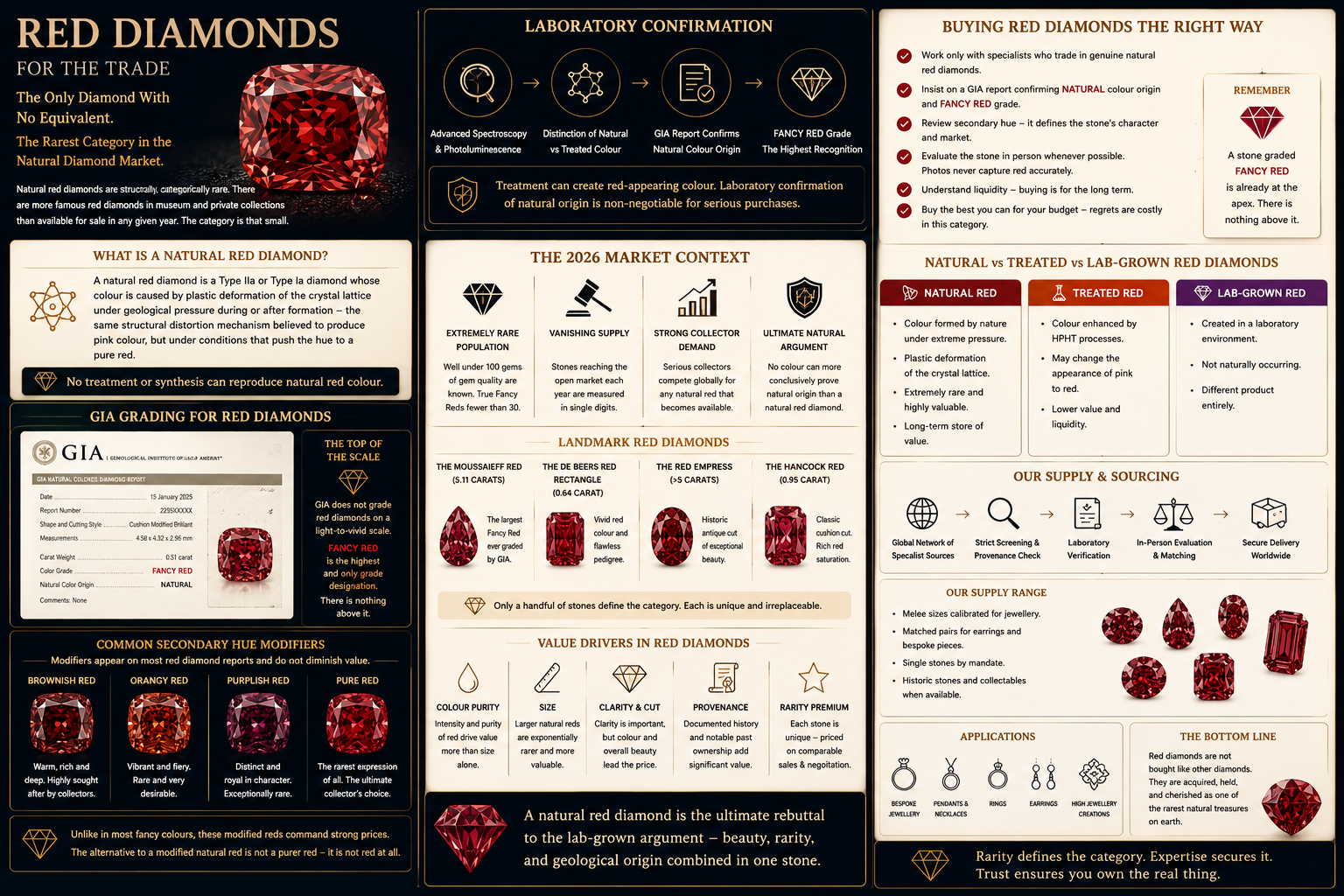
The population of known, GIA-confirmed natural red diamonds is estimated at well under a hundred stones of gem quality — some sources put the number of known true Fancy Reds at fewer than thirty. The supply reaching the open market in any year is measured in single digits. This is not a category with a price curve, a Rapaport grid, or a meaningful parcel trade. It is a category of individual events — specific stones, specific buyers, specific moments — and the commercial frameworks that apply to every other fancy colour category apply here only loosely and by analogy.
The 2026 market context amplifies the category’s position. The industry’s response to lab-grown commoditisation has concentrated marketing energy on natural colour and natural character as the proof of genuine origin — and no stone makes that argument more conclusively than a natural red diamond, whose colour mechanism cannot be manufactured, whose supply cannot be increased, and whose population is genuinely finite. A natural red diamond is the ultimate rebuttal to every lab-grown conversation, and buyers who understand the category understand it on those terms.
Color Diamonds Collections:
Natural Yellow Diamonds | Natural Pink Diamonds | Natural Blue Diamonds | Natural Green Diamonds | Natural Brown Diamonds | Natural Chameleon Diamonds | Natural Purple Diamonds | Natural Orange Diamonds | Natural Gray Diamonds
Diamond Shaped Collections:
Natural Round Brilliant Diamonds | Natural Pear Shaped Diamonds | Natural Oval Diamonds | Natural Marquise Diamonds | Natural Radiant Cut Diamonds | Natural Emerald Cut Diamonds | Natural Cushion Cut Diamonds
Where Value Concentrates
The value drivers in natural red diamonds follow the same logic as every other fancy colour — colour quality, size, clarity, make, and documentation — but with specific weightings that reflect the category’s unique position.
Purity of red is the primary driver, but the framing is different from other colours. Because modified reds are commercially strong in their own right, the premium for pure unmodified Fancy Red is real but not so extreme as to make modified goods uninteresting to serious buyers. A Purplish Red or Orangy Red at fine quality is a genuinely significant stone.
Size commands a premium that is more severe here than anywhere else in the fancy colour category. Most natural red diamonds are small — under one carat, frequently under half a carat. A natural red at one carat or above is exceptional territory. Above two carats, the word exceptional no longer covers it.
Clarity is secondary in this category, as it is in chameleons — the colour is the primary asset, and the market prices it accordingly. SI clarity in a natural Fancy Red is not a commercial problem; I clarity begins to affect face-up transparency in a way that matters.
Make matters specifically because red colour, like pink, is often distributed unevenly through the rough, and cut orientation decisions directly affect how much colour is retained and how it reads face-up. A well-oriented cut concentrating red through the table is meaningfully more valuable than a weight-retention cut that dilutes the face-up colour despite identical grading.
The laboratory documentation — specifically the Fancy Red grade and the natural colour origin confirmation — is, as with chameleons, among the most valuable elements of the stone’s commercial position. A stone represented as a natural red without both elements is not a natural red diamond in the commercial sense of the category.
The Commercial Case — Including the Honest Part
For a retailer, designer, or brand, a natural red diamond is not a stock item; it is an event. One verified stone does work that no other piece in a collection can do — it establishes the house as a genuine participant in the rarest end of the natural coloured diamond trade, attracts collector clientele who return for the next rarity, generates the kind of editorial and client attention that commercial goods cannot produce, and sits permanently beyond any lab-grown conversation.
The honest part of the commercial case: liquidity in this category is highly selective. Natural red diamonds trade into a collector and specialist market that is small, knowledgeable, and patient. Exit routes run through specialist dealers, major auction houses, and private placement with collector networks — not open trading platforms, not quick sales to the general trade. A fine stone at the right price appreciates; a mediocre stone at the wrong number is genuinely difficult to move. The category rewards quality and patience and punishes impulse buying and inflated entry prices.
The appreciation record for fine, documented natural red diamonds is strong over the medium and long term, consistent with a supply that is finite and cannot be augmented. But the category is not for every buyer, and we would rather make that clear at the outset than after a stone has been purchased.
How We Source and Supply
Natural red diamonds cannot be stocked to order; they are sourced stone by stone on mandate through specialist and collector networks. Our approach for every stone we handle in this category: confirmation of laboratory grading with Fancy Red designation and natural colour origin before any stone is evaluated further; physical evaluation of colour face-up, cut performance, and clarity transparency in hand; both-state documentation — face-up photography under multiple light sources — as standard; honest comparables-based pricing referenced against recent specialist-market results and auction records; and a transparent account of the liquidity picture before any purchase decision is made.
Matched pairs in natural red diamonds exist but are vanishingly rare — assembling two stones that agree in colour, make, and size takes years rather than months, and multi-stone red diamond pieces represent the most significant sourcing achievements in the coloured diamond trade. We take pair and suite briefs on mandate with honest timelines stated from the outset.
Pricing
There is no published price list, no Rapaport grid, and no per-carat convention that applies meaningfully across the natural red diamond category. Fine Fancy Red stones trade at price levels that place them among the most expensive natural materials on earth per carat. Pricing is established stone by stone, referenced against specialist-market comparables and documented auction results, weighted specifically by colour purity, size, clarity, make, and the completeness of laboratory documentation.
We price straight, against evidence, and we tell you plainly what you are paying for — the colour on its own merits, the documentation confirming the category, and the scarcity premium that reflects a supply measured in single digits per year globally.
FAQ
What makes a natural red diamond different from a very dark pink diamond?
The colour mechanism is related — both involve plastic deformation of the crystal lattice — but the conditions producing genuine red are narrower and rarer, pushing the colour past the pink saturation threshold into a range GIA designates as a separate grade entirely: Fancy Red, with no light-to-vivid scale above or below it. A stone graded Fancy Red is at the top of GIA’s red colour designation by definition.
Why does GIA use only one grade for red diamonds when other colours have a full intensity scale?
Because the population of genuine natural red diamonds is too small and the saturation range too narrow to justify further subdivision. Fancy Red is the grade — there is no Fancy Light Red, no Fancy Intense, no Fancy Vivid. The category itself is the designation.
Do secondary hue modifiers — Brownish Red, Orangy Red, Purplish Red — significantly reduce value?
Less so than in most other fancy colours, because the alternative to a modified natural red is not a purer red at a similar price — it is no natural red at all. Modified reds have their own serious collector markets and command prices that reflect their genuine rarity, not a discount from a widely available pure alternative.
Can red colour be introduced into a diamond by treatment?
Yes — HPHT treatment can shift some pink diamonds toward red in certain cases. This is precisely why laboratory confirmation of natural colour origin is non-negotiable for any serious purchase in this category. GIA’s analysis separates natural from treated red colour reliably, and only a report carrying both the Fancy Red grade and natural colour confirmation warrants category pricing.
How rare are natural red diamonds above one carat?
Genuinely exceptional. Most natural red diamonds are under one carat, and many fine stones are under half a carat. A confirmed natural Fancy Red at one carat or above is among the rarest gem materials in commercial circulation. Above two carats, the number of known examples globally is counted on the fingers of one hand.
What is the liquidity picture for natural red diamonds?
Selective and specialist. Exits run through specialist dealers, major auction houses, and private placement with collector networks — not open trading platforms. A fine stone at a correct entry price has a strong appreciation record over the medium and long term. A mediocre stone at an inflated number is genuinely difficult to move. We advise entering on quality with realistic liquidity expectations stated clearly before purchase.
Do matched natural red diamond pairs exist?
They exist and are among the most significant achievements in coloured diamond sourcing. Assembling two stones that agree in colour, face-up character, and size takes years, and multi-stone red diamond pieces are genuinely historic when they appear. We take pair and suite briefs on mandate with honest timelines.
How does Raremonds source natural red diamonds?
Stone by stone on mandate through specialist and collector networks, with laboratory confirmation, physical evaluation in hand, documented face-up photography under multiple light sources, and comparables-based pricing against recent specialist-market results — with a transparent account of the liquidity picture before any purchase decision is made.

.png)