

Our purple memo drew the line the trade most often blurs: purple and violet are separate GIA hues, with no in-between. This memo is the other side of that line. Violet is the cooler, blue-leaning colour — twilight where purple is orchid — and it is a genuinely different animal in every way that matters to a buying desk: different chemistry, a different (and now closed) source, different modifiers, different sizes, and a different market. It is also, by any honest count, one of the smallest categories in coloured diamonds — a micro-market measured in a handful of significant stones per generation, which is precisely why the desks that understand it are few.
Violets are part of our special-category work at Raremonds, sourced the way our purples, reds and chameleons are: stone by stone, on mandate. This memo covers what makes violet violet, why Argyle’s closure effectively ended the colour’s production, how the grades actually read, where value sits, and the honest commercial picture.
Where violets sit in 2026
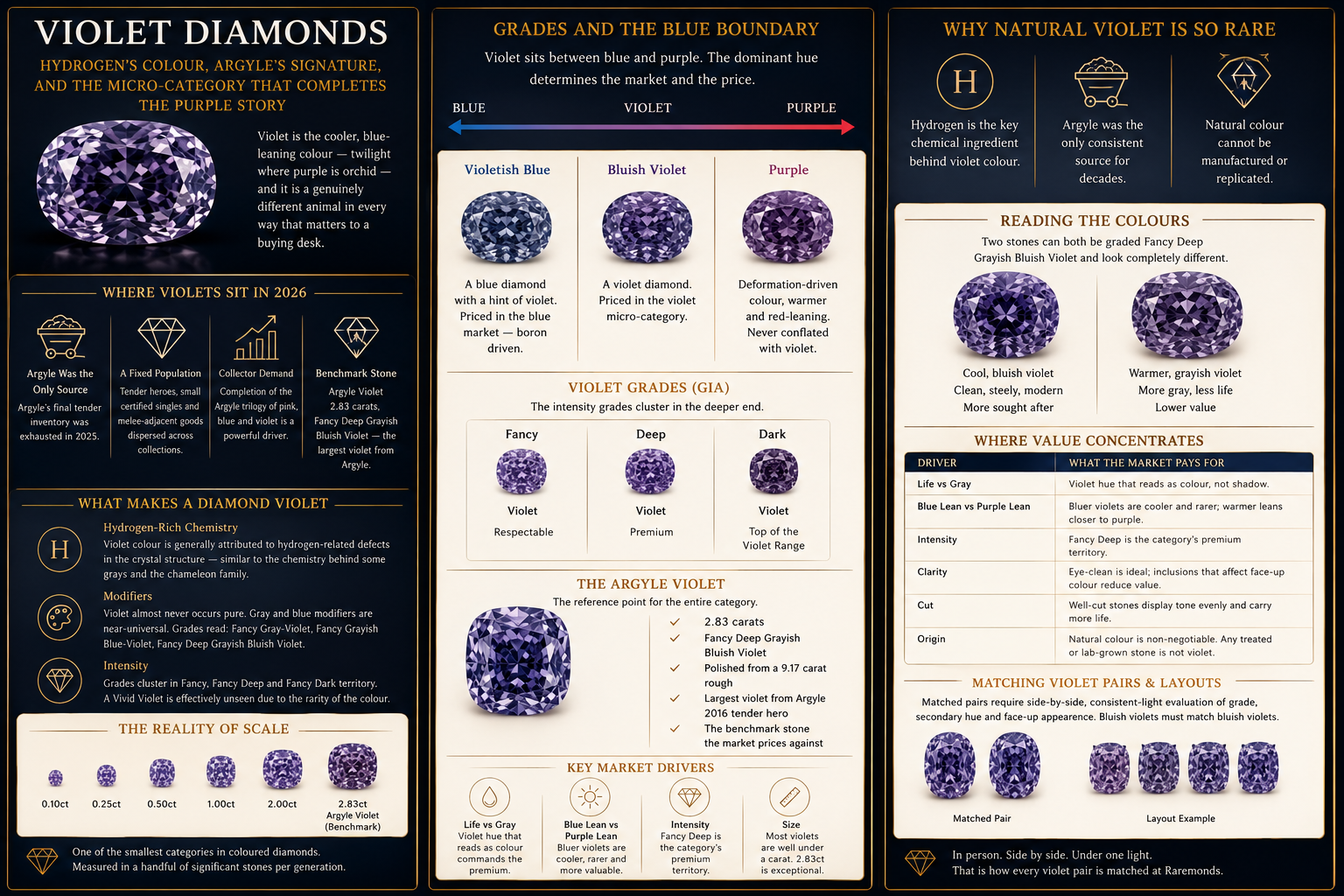
One fact organises the entire category: violet was, commercially speaking, an Argyle colour — a signature of the mine’s unusual chemistry, appearing among the 0.1 percent of its production that comprised the pinks, reds, blues and violets — and Argyle is closed, its final tender inventory exhausted in 2025. There was never another consistent source, and there is none now. What circulates is a fixed population: tender heroes, small certified singles, and melee-adjacent goods dispersed across collections over four decades. That makes violet the purest expression of the finite-supply story the Argyle memo tells — a colour that is not merely rare but, in production terms, over.
Demand-side, violet rides the same collector currents as purple and red: the migration beyond pink and blue toward the colours nobody can restock, plus a specific completion dynamic — collectors assembling the Argyle trilogy of pink, blue and violet, for which the violet is almost always the last and hardest acquisition. The benchmark that anchors the whole market is the Argyle Violet: 2.83 carats, Fancy Deep Grayish Bluish Violet, polished from a 9.17-carat rough and the largest violet the mine ever produced — a hero of the 2016 tender and the reference stone the category prices against.
Color Diamonds Collections:
Natural Yellow Diamonds | Natural Pink Diamonds | Natural Blue Diamonds | Natural Green Diamonds | Natural Brown Diamonds | Natural Chameleon Diamonds | Natural Purple Diamonds | Natural Orange Diamonds | Natural Gray Diamonds
Diamond Shaped Collections:
Natural Round Brilliant Diamonds | Natural Pear Shaped Diamonds | Natural Oval Diamonds | Natural Marquise Diamonds | Natural Radiant Cut Diamonds | Natural Emerald Cut Diamonds | Natural Cushion Cut Diamonds
What makes a diamond violet
Where purple’s engine is plastic deformation, violet is generally attributed to hydrogen-rich chemistry — the same unusual hydrogen involvement that runs through certain grays and through the chameleon family, a kinship worth noticing across this library. That chemistry has three practical consequences. First, violet almost never occurs pure: gray and blue modifiers are near-universal, and the classic violet grade reads like the benchmark’s — Grayish Bluish Violet — with the connoisseur’s question being how little gray and how much life a given stone carries. Second, tones run moody and deep rather than bright: the intensity grades cluster in Fancy, Fancy Deep and Fancy Dark territory, and a Vivid Violet is effectively unseen. Third, sizes are tiny even by rare-colour standards: most violets are well under a carat, and the 2.83-carat benchmark is, for this colour, a giant.
Reading the grades — and the blue boundary
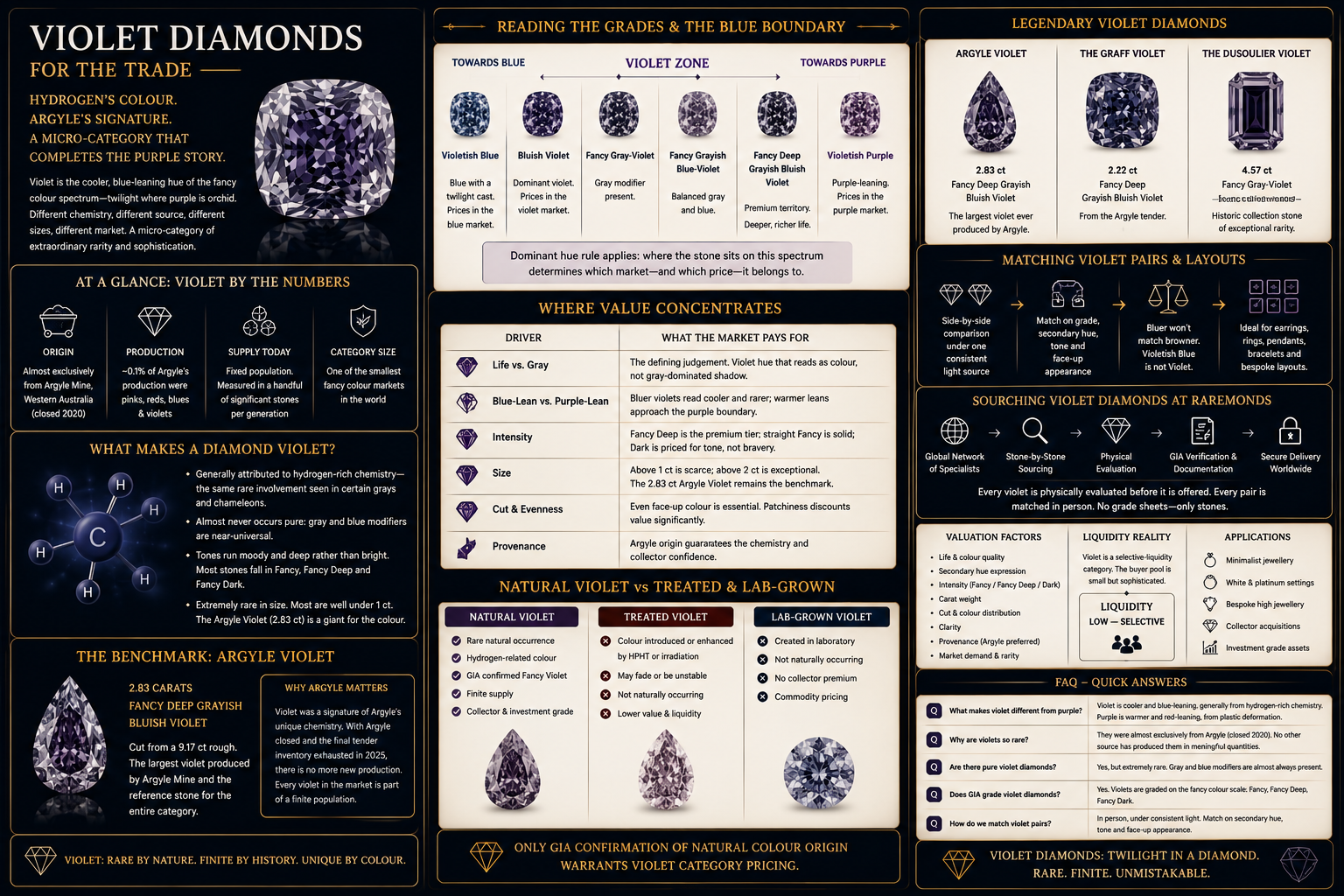
The dominant-hue rule runs violet’s borders exactly as it runs purple’s. On one side sits blue: a Violetish Blue is a blue diamond with a twilight cast, priced in the blue market with its boron-driven comparables; a Bluish Violet is a violet diamond, priced in this micro-category. On the other side sits purple, across the hue line our purple memo mapped — warmer, red-leaning, deformation-driven, and never conflated with violet on a competent desk. In between, the violet grades themselves are an exercise in reading modifiers: Fancy Gray-Violet, Fancy Grayish Blue-Violet, Fancy Deep Grayish Bluish Violet — each word placing the stone on the gray-blue-violet triangle, and each placement moving the price. The desk skill is the same one our gray and chameleon work trains: judging, face-up, how much of the colour is living hue and how much is mask.
Where value concentrates
| Driver | What the market pays for |
| Life versus gray | the defining judgement — violet hue that reads as colour, over gray-dominated stones that read as shadow |
| Blue-lean versus purple-lean character | a matter of the brief: bluer violets read cooler and rarer; warmer leans court the purple boundary |
| Intensity | Fancy Deep is the category’s premium territory; straight Fancy respectable; Dark priced for its tone |
| Size | most goods well under a carat; anything approaching the 2.83 ct benchmark is a generational stone |
| Argyle provenance | inscription, certificate and lot documentation carry a real premium — for most violets, Argyle papers are the expected norm rather than a bonus |
| Certification | natural colour on a major-laboratory report, without exception |
Clarity, as across the rare colours, is secondary — and in stones this small and this dark, it is close to irrelevant next to the colour read.
The commercial case — including the honest part
Violet is a mandate category in its purest form. There is no assortment to build, no melee programme to run at scale, no bridge business with everyday liquidity — there is the single stone, sourced patiently, for the client who understands what it is. Three client profiles account for essentially the whole market: the Argyle trilogy collector completing pink-blue-violet; the rare-colour connoisseur who already holds purple and wants its cool twin; and the designer building a one-off piece around a colour nobody else will have. For all three, the violet is a credential acquisition — small, dark, unphotogenic next to a vivid pink, and precisely for those reasons a mark of genuine sophistication.
The honest part: liquidity is the thinnest in this entire library. The buyer pool is small and knowledgeable, placement runs through specialists and takes time, and a violet bought at the wrong number waits years for its market. The mitigations are the ones this category rewards anyway — Argyle papers, honest gray-versus-life quality, and entry pricing set against real comparables rather than romantic ones. We say this as plainly for violet as we did for pure purple, because the clients who buy well here are exactly the ones who appreciate being told.
How we source and supply, and pricing
Violets run through our mandate discipline at its most patient: specialist, collector and tender-resale networks, candidates read in hand for life-versus-gray and hue lean, Argyle documentation verified through the inscription-certificate-lot chain wherever it exists, natural-colour certification without exception, and face-up documentation under standardised light so a buyer sees precisely what the gray question looks like on the actual stone. Pairs are close to a contradiction in terms — matched violets are assembled across years if at all, and we quote such briefs with honest timelines or honest refusals. Pricing is per stone against a thin but real comparable set (tender-resale results above all), with the Argyle premium and the gray read doing most of the work; there is no list, and any violet priced as if from one deserves suspicion.
Send your requirement to Raremonds → WhatsApp Parth directly: +91 98193 47999
The short version
Violet is purple’s cool, blue-leaning twin across a hard GIA hue line — hydrogen’s colour where purple is deformation’s, Argyle’s signature where purple was Siberia’s, and a category whose production effectively ended with the mine. It almost never occurs pure: gray and blue modifiers are near-universal, grades cluster in Fancy, Fancy Deep and Fancy Dark, Vivid is effectively unseen, and sizes are tiny — the 2.83-carat Fancy Deep Grayish Bluish Violet Argyle Violet is the colour’s giant and its benchmark. Value runs on life-versus-gray, hue lean, Argyle papers and size; liquidity is the thinnest in coloured diamonds and rewards patient, correctly priced entry. We source violets on mandate, verify the Argyle chain, document face-up, and complete more Argyle trilogies with this stone than with any other.
FAQ
What’s the difference between violet and purple diamonds?
They are separate GIA hues with no in-between: violet leans blue and cool, purple leans red and warm. The chemistry differs too — violet is generally attributed to hydrogen-rich composition, purple to plastic deformation — as do the sources: violet was effectively an Argyle colour, purple’s famous stones trace largely to Siberia. A competent desk never conflates them.
Why is Argyle so central to violet diamonds?
Because the mine was the colour’s only consistent commercial source — violets appeared among the 0.1 percent of Argyle production comprising its pinks, reds, blues and violets — and Argyle closed in 2020 with its final tender inventory exhausted in 2025. Violet is therefore not just rare but finished, in production terms: the existing population is the market.
What is the benchmark violet diamond?
The Argyle Violet: 2.83 carats, Fancy Deep Grayish Bluish Violet, polished from a 9.17-carat rough — the largest violet the mine produced and the hero of the 2016 tender. For this colour, 2.83 carats is a giant; most violets are well under a carat.
Do pure violet diamonds exist?
Effectively no — gray and blue modifiers are near-universal, and the classic grades read Grayish Bluish Violet and similar. The connoisseur’s judgement is how little gray and how much living violet a stone shows face-up; a Fancy Vivid Violet is essentially unseen in practice.
How does a violetish blue differ from a bluish violet?
By the last word — the dominant hue. A Violetish Blue is a blue diamond with a twilight cast, priced in the boron-blue market. A Bluish Violet is a violet diamond, priced in this micro-category. One word, two markets — the same boundary economics that run purple-pink and orange-yellow.
Can Raremonds source a violet diamond?
On mandate, yes — through specialist, collector and tender-resale networks, with the Argyle inscription-certificate-lot chain verified wherever it exists, natural-colour certification without exception, and honest timelines. Matched violet pairs are quoted honestly as multi-year assemblies, or honestly declined.

.png)