

Black is the colour that inverts every rule this library has taught. Everywhere else, inclusions are the enemy or, at best, tolerated; in black, the inclusions are the colour — dense clouds of graphite and other dark minerals so pervasive that the stone gives up transparency altogether and turns its metallic, adamantine face to the light. Everywhere else, the intensity ladder does the pricing; black, like red and white, is a single-intensity colour: Fancy Black, one grade, no ladder. And everywhere else, treatment is a corner-case caution; in black, it is the market itself — the overwhelming majority of black diamonds in circulation are treated, a fact the laboratories state plainly and much of the trade prefers to mumble.
That inversion is exactly why black belongs in a specialist’s library. It is two businesses wearing one name — a commodity treated-goods trade and a genuine natural rarity — and the entire discipline of the category is never letting a client confuse them. This memo covers what black actually is (including carbonado, the strangest material in diamonds), how the laboratories handle a stone they cannot grade normally, the treatment economics, the famous-stone canon, and how we supply both businesses with the line between them drawn in ink.
Where blacks sit in 2026
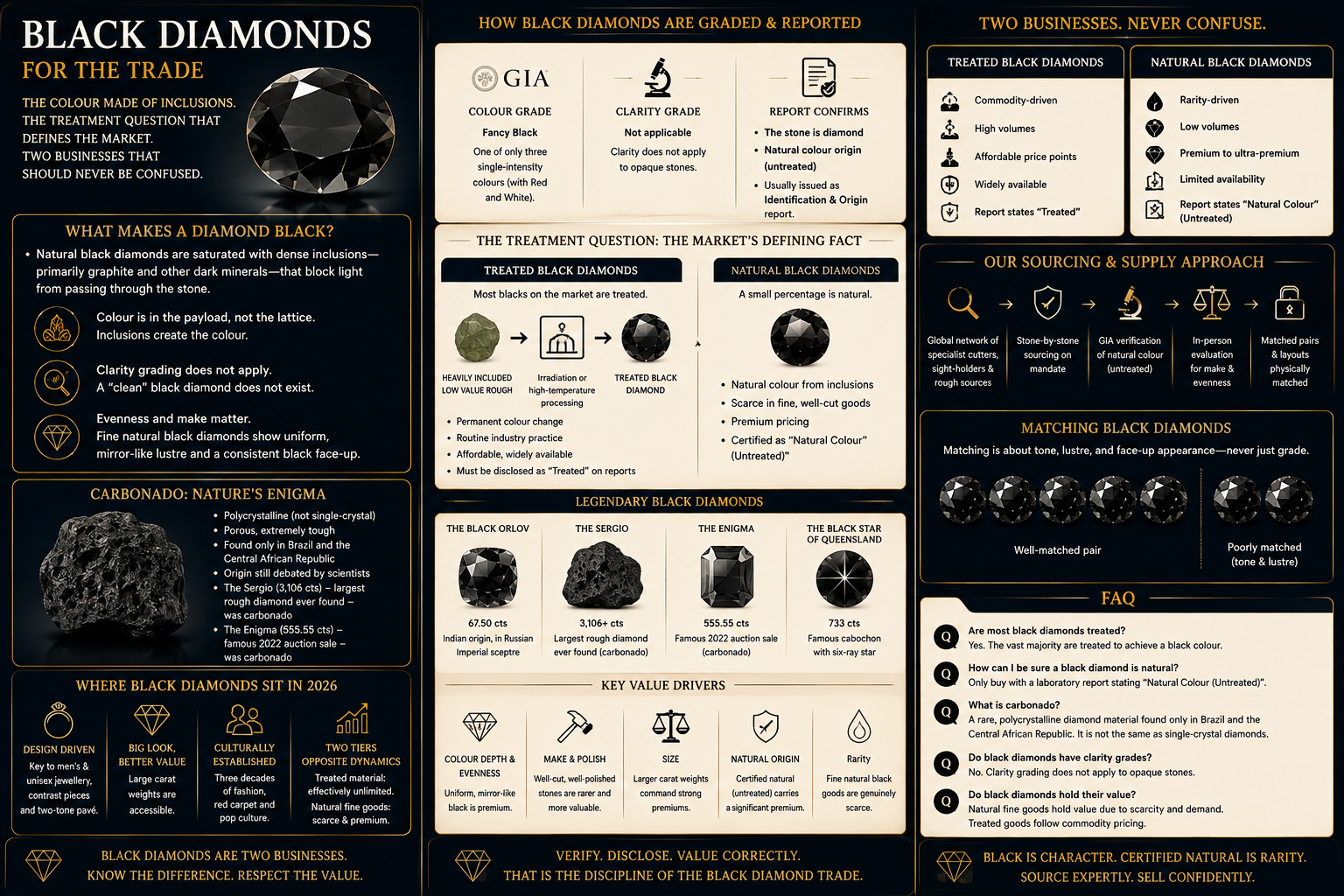
Black’s demand base is design, and it is durable. The colour anchors men’s and unisex fine jewellery — the fastest-expanding design-led segment in the trade — supplies the contrast element in two-tone pavé work that never really cycles out, and delivers the biggest look-per-dollar in diamonds: black is the one colour where genuinely large carat weights are accessible, which makes it the statement-piece material of choice for design houses. Culturally it has never needed help — black diamond jewellery has had recurring fashion moments for three decades, from the design houses that built collections on it to its red-carpet and screen appearances — and the current individuality-over-perfection climate documented across this library suits a colour that is, literally, made of character. On the supply side the two tiers behave oppositely: treated black material is effectively unlimited, manufactured to demand from ordinary rough; natural Fancy Black in fine, even, well-cut form is scarce, and certified natural goods carry a premium the treated tier never touches.
Color Diamonds Collections:
Natural Yellow Diamonds | Natural Pink Diamonds | Natural Blue Diamonds | Natural Green Diamonds | Natural Brown Diamonds | Natural Chameleon Diamonds | Natural Purple Diamonds | Natural Orange Diamonds | Natural Gray Diamonds
Diamond Shaped Collections:
Natural Round Brilliant Diamonds | Natural Pear Shaped Diamonds | Natural Oval Diamonds | Natural Marquise Diamonds | Natural Radiant Cut Diamonds | Natural Emerald Cut Diamonds | Natural Cushion Cut Diamonds
What black actually is — and the carbonado footnote that isn’t a footnote
A natural black diamond is a diamond so saturated with dark inclusions — graphite above all, with other mineral clouds — that light stops passing through. The colour is not in the lattice; it is in the payload. Three consequences follow. First, clarity grading is meaningless: there is no “clean” black, because a clean black would not be black. Second, the goods are hard to work: inclusion-dense material polishes unpredictably, resists a fine finish, and punishes careless setting — which is why a well-cut, evenly lustrous natural black is rarer than the raw material suggests and why make is a genuine value driver here. Third, evenness is the beauty standard: the fine natural black reads as a uniform, mirror-lustred void, not a mottled dark gray.
Then there is carbonado — a separate material altogether. Polycrystalline rather than single-crystal, porous, found essentially only in Brazil and the Central African Republic, tougher than ordinary diamond and with an origin scientists still argue about (theories run from deep-crustal processes to extraterrestrial delivery). The largest rough diamond ever found — the Sergio, at over 3,100 carats — was a carbonado, and the most publicised black diamond sale of recent years, the 555.55-carat Enigma auctioned in 2022, was carbonado too. For a desk, the point is precision: carbonado is a legitimate, storied material with its own collector niche, and it should be named as what it is, never blurred into single-crystal black goods or priced off their comparables.
How the laboratories handle black
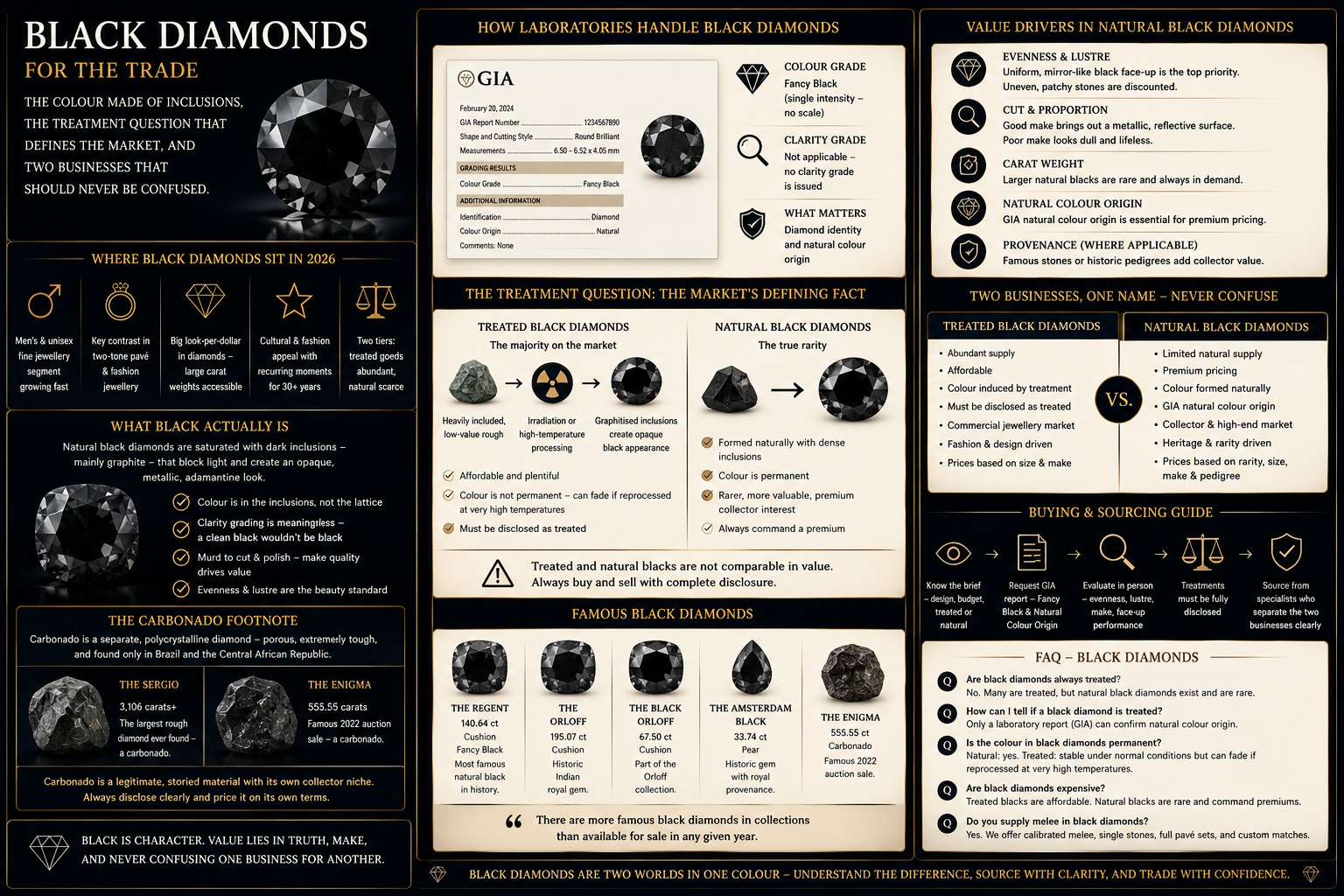
Black diamonds get the grading treatment their nature demands: the colour grade is Fancy Black, full stop — one of only three single-intensity colours, alongside red and white — and no clarity grade is issued, because the concept does not apply to an opaque stone. What the laboratory report does carry is the two determinations that hold all the value: that the stone is diamond, and that the colour is natural rather than treated. GIA typically handles natural blacks under identification-and-origin style reporting for exactly this reason — in this category, the paper is not describing quality so much as establishing identity, and that identity is the entire price.
The treatment question: the market’s defining fact
Say it plainly, because the laboratories do: most black diamonds on the market are treated. The standard route takes heavily included, low-value greenish or ordinary rough and drives it — by irradiation, or by high-temperature processing that graphitises the inclusions — to a colour so dark it reads black. Lab-grown blacks circulate as well. None of this is scandalous in itself: treated black is honest, useful design material at commodity prices, and we supply it as exactly that. The scandal is only ever in the blur — treated goods sold on natural-rarity language, or natural stones bought at treated-tier prices by desks that never asked. The discipline is one sentence long: every black diamond is treated until a laboratory report says otherwise, and the price must match the paper. The gap between the tiers is not a margin; it is a multiple.
The canon
| Stone | Weight | Why it matters |
| Sergio | 3,167 ct rough | the largest diamond ever found — a carbonado |
| Enigma | 555.55 ct | the carbonado whose 2022 auction made black diamonds global news |
| Spirit of de Grisogono | 312.24 ct | the largest cut black diamond, from the house that built modern black-diamond fashion |
| Korloff Noir | 88 ct | house-defining black, insured celebrity of the genre |
| Black Orlov | 67.50 ct | the “Eye of Brahma” — the legend-carrying black of the auction age |
Note what the canon is made of: enormous weights and stories. That is the category’s honest character — black’s trophies are narrative objects, and the same logic scales down to the counter, where a black diamond sells on presence and story in a way no grading column captures.
The product landscape: how black actually gets used
Black is the most format-diverse colour in diamonds — the only one whose opacity, affordability at size and graphic character have pushed it far beyond the ring tray — and a trade desk should know the whole landscape, because each format is its own business with its own specifications:
-
- Melee and calibrated pavé goods. The workhorse: contrast pavé against white goods, blackout pavé fields in men’s and fashion pieces, and the watch trade’s dials, bezels and fully set cases — programmes that demand tight millimetre calibration and, above all, evenness of black across the run, because a pavé field mismatched in lustre reads instantly.
-
- Singles and centres. Statement rings — including the culture-defining black solitaire moments — men’s signets, and unisex pieces where a large, mirror-lustred black delivers the category’s signature look-per-dollar.
-
- Faceted beads, strands and malas — the category’s quiet giant. Drilled, faceted black diamond beads strung as necklaces are one of the largest black-diamond products in the world, and nowhere more than in Indian fine jewellery, where black diamond bead strands — single and multi-line, often stationed with gold, polki or pearls — and full malas (classically 108 beads plus the guru bead, with 54- and 27-bead variants) sit at the luxury end of a deep tradition. Beads are a specification business: bought by the strand (length, bead diameter in millimetres, uniform or graduated), matched bead-to-bead for colour and lustre and strand-to-strand for multi-line pieces, and judged on facet quality, polish and drill work — clean, consistent holes that string true and wear without cutting the thread. Most bead goods are treated, priced and disclosed as such; natural black bead strands exist and command the same natural premium as everything else in this memo.
-
- Briolettes and drops. Drilled drops for earrings, tassels and pendant work — the same drilling and matching disciplines as beads, pair-matched by eye.
-
- Rose cuts, flat backs and raw crystals. Black rose cuts serve the alternative and vintage market our rose-cut memo maps; raw black crystals and lightly polished naturals feed the organic-design end.
-
- Decorative and objet work — including the bottle business. Black pavé travels beyond jewellery entirely: watch dials and cases, writing instruments, cufflinks, buttons and couture hardware, objets d’art — and the luxury-packaging niche in which spirits and champagne houses commission diamond-set limited editions, decanters and pavé emblems for bottles. These are calibration-and-evenness programmes at heart, quoted like pavé work, and black’s opacity and price point make it the one diamond that decorative budgets can actually deploy at scale.
Where value concentrates
Natural origin first and overwhelmingly — the laboratory determination is the price. Then evenness and lustre: the uniform mirror-black over the mottled or grayish. Then make, precisely because the material fights the cutter — a crisp, well-polished natural black is the connoisseur’s tell. Then size, where black uniquely rewards ambition: large natural blacks are scarce, while large treated blacks are merely large. Carbonado prices as its own collector material on provenance and story. And across every tier, durability diligence: inclusion-dense goods and porous carbonado both demand setting-aware selection, which is a service, not a caveat.
The commercial case — two businesses, one rule
The commodity business: treated black melee, calibrated goods, beads and singles for pavé contrast, men’s lines, the strand-and-mala trade and statement fashion — priced honestly, supplied in volume, disclosed always. It is good business precisely because it is cheap character, and it needs no costume. The rarity business: certified natural Fancy Black singles and the occasional carbonado, sold on the identity paper, the evenness and the story, at prices the commodity tier never approaches. The rule that governs both: the two businesses share a colour and nothing else, and the desk that lets a client confuse them — in either direction — has failed at the category’s only real test. Liquidity mirrors the split: treated goods trade like the design material they are; fine natural blacks place through the story-driven end of the market at their own pace.
How we source and supply, and pricing
We supply both tiers with the line drawn in ink: treated black goods — melee, calibrated parcels, singles, faceted beads and drilled goods — matched for evenness and lustre across the run (treated black varies more than buyers expect, and a mismatched pavé field or bead strand reads instantly) and invoiced as treated, always; bead strands and malas assembled to specification — length, bead diameter, uniform or graduated, count (108-plus-guru and its variants for mala work) — matched bead-to-bead and strand-to-strand, with drill quality checked before stringing; decorative and pavé programmes — watch, accessory and bottle work — quoted on calibration and evenness like the pavé jobs they are; natural Fancy Black singles and natural bead goods sourced against laboratory identification-and-origin reporting, selected for uniformity, lustre and make, with setting-suitability assessed stone by stone; and carbonado on mandate for the collector briefs that want the strange original. Pricing is tier-honest: commodity goods at commodity numbers, natural blacks on the paper and the evenness, carbonado on provenance — and, as everywhere in this library, we tell you which business you are in before we tell you the number.
Send your requirement to Raremonds → WhatsApp Parth directly: +91 98193 47999
The short version
Black is the inverted colour: made of inclusions rather than marred by them, graded at a single intensity (Fancy Black — one of three such colours, with red and white), issued no clarity grade because the concept cannot apply, and defined commercially by one fact the laboratories state plainly — most black diamonds are treated. That makes black two businesses in one name: an honest commodity trade in treated design material (melee, pavé contrast, statement carats), and a genuine rarity trade in certified natural Fancy Black and carbonado, where the identity paper is the price. Value runs on natural origin, evenness and lustre, make in a material that fights the cutter, and size where black uniquely delivers it. The canon — Sergio, Enigma, Spirit of de Grisogono, Black Orlov — is a canon of weights and stories, which is the category’s honest character top to bottom. And the product landscape is the widest in coloured diamonds: pavé and melee, statement singles, the bead-and-mala trade at the heart of Indian fine jewellery, briolettes, rose cuts and raw crystals, and decorative programmes from watch dials to diamond-set bottles — every format running on the same two-tier honesty. We supply both tiers, disclosed always, and never let them blur.
FAQ
What makes a diamond black?
Dense clouds of dark inclusions — graphite above all — so pervasive that the stone becomes opaque. The colour is the inclusions: there is no clean black diamond, which is why clarity grading doesn’t apply and why evenness and lustre, not clarity, are the beauty standards of the category.
Are most black diamonds treated?
Yes — the laboratories say so plainly. Most black diamonds in circulation are ordinary or heavily included rough driven to near-black by irradiation or high-temperature processing, and lab-grown blacks circulate too. Treated black is legitimate design material at commodity prices; the only sin is the blur. Our rule: every black is treated until a laboratory report says otherwise, and the price must match the paper.
How is a black diamond graded?
As Fancy Black, full stop — one of only three single-intensity colours, alongside red and white. No clarity grade is issued, and the laboratory report’s real work is identity: confirming the stone is diamond and the colour natural. That determination carries essentially all of the value.
What is a carbonado?
A separate polycrystalline black diamond material — porous, tougher than ordinary diamond, found essentially only in Brazil and the Central African Republic, with an origin science still debated. The largest rough diamond ever found (the 3,167-carat Sergio) and the famous 555.55-carat Enigma were both carbon dated. It is its own collector niche and should never be blurred into single-crystal black goods.
Why are natural black diamonds hard to cut?
Because the inclusion-dense material polishes unpredictably and punishes careless work — which is exactly why a crisp, evenly lustrous, well-made natural black is scarcer than the raw material suggests, and why make is a genuine value driver in this colour when it is nearly irrelevant in red.
What products do black diamonds come in?
The widest range in coloured diamonds: calibrated melee and pavé goods (including watch dials, bezels and set cases), statement singles and men’s pieces, faceted beads strung as necklaces and malas, briolettes and drilled drops, black rose cuts and raw crystals for the alternative market, and decorative programmes — writing instruments, couture hardware, objets d’art, and the diamond-set bottles and decanters commissioned by spirits and champagne houses. Each format is a specification business of its own, and the natural-versus-treated disclosure rule runs through all of them.
What should I check when buying black diamond beads or a mala?
Five things. The strand specification — length, bead diameter in millimetres, uniform or graduated, and count (a classic mala runs 108 beads plus the guru bead; 54- and 27-bead variants exist). Matching — bead-to-bead for colour and lustre, and strand-to-strand on multi-line pieces, because one dull or brownish bead reads instantly. Drill quality — clean, consistent holes that string true and won’t cut the thread in wear. Facet and polish quality across the strand. And the paper: most bead goods are treated and should be priced and invoiced as such; natural black bead strands exist at a genuine premium and deserve laboratory support.
What black goods does Raremonds supply?
Both businesses, never blurred: treated black melee, calibrated goods, faceted beads, drilled goods and singles for pavé, men’s, strand-and-mala and statement design work — matched for evenness across the run and always disclosed — bead strands and malas assembled to specification, decorative and bottle programmes quoted as the calibration work they are, and certified natural Fancy Black singles plus carbonado on mandate, sourced against laboratory identification-and-origin reporting and selected for uniformity, lustre, make and setting-suitability.

.png)