

Every special category we supply has a story. Only one has a demonstration. A chameleon diamond, sitting in your hand in its stable olive green, will — gently warmed, or kept in the dark overnight — turn a bright yellow to orangy yellow in front of the client, and then drift back to green within moments of cooling in the light. No other diamond does this. No treatment reproduces it. No laboratory has fully explained it. And in a market where every jeweller is searching for something a lab-grown stone cannot imitate, a natural diamond that visibly performs is about as far from a commodity as this trade gets.
Chameleons sit at the extreme end of our coloured-diamond work at Raremonds — the rarest category we handle, sourced stone by stone rather than stocked in depth — and this memo is written for trade buyers the way our brown-diamond memo was: what the phenomenon actually is (classic and reverse), how the laboratories grade and annotate it, where value concentrates, how to verify and demonstrate a stone safely, the honest commercial case including liquidity, and how we source and document these goods for clients.
What a chameleon diamond actually does
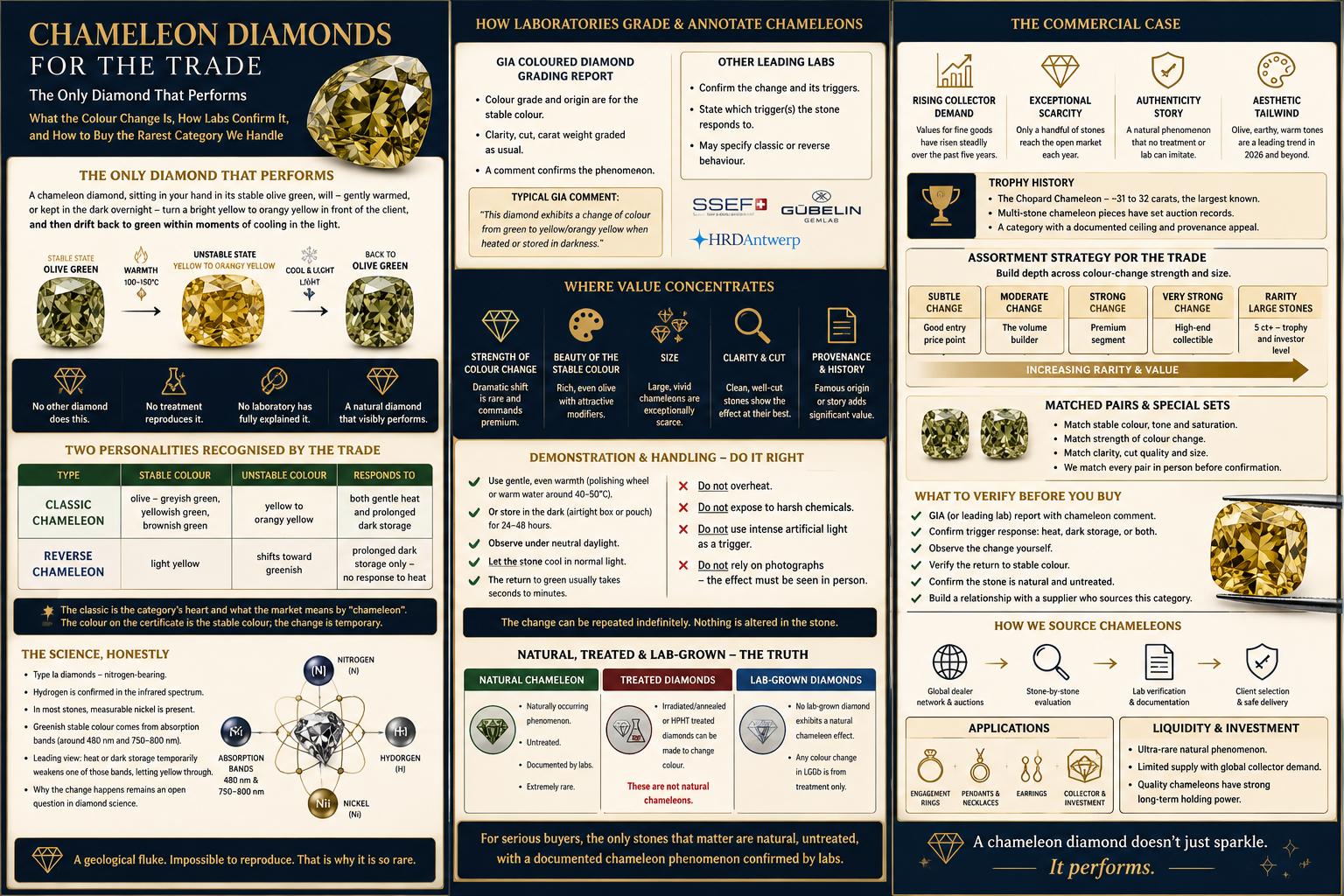
A chameleon is a natural diamond whose colour changes temporarily and reversibly in response to two triggers: gentle heat, and prolonged absence of light. In its stable state the classic chameleon sits in the olive family — greyish green, yellowish green, brownish green. Warm it gently (the effect appears around 100–150°C, the warmth of a polishing wheel, which is how the phenomenon was first noticed in the 1940s) or store it in darkness for a day or more, and the stone shifts to its unstable colour: a stronger yellow to orangy yellow. Return it to light and room temperature and the olive green comes back, typically within seconds to minutes. Nothing about the stone is altered; the change can be repeated indefinitely.
The trade recognises two personalities:
| Type | Stable colour | Unstable colour | Responds to |
| Classic chameleon | olive — greyish / yellowish / brownish green | yellow to orangy yellow | both gentle heat and prolonged dark storage |
| Reverse chameleon | light yellow | shifts toward greenish | prolonged dark storage only — no response to heat |
The classic is the category’s heart and what the market means by “chameleon”; the reverse is rarer still and something of a connoisseur’s footnote. In both cases the defining fact for a buyer is the same: the colour on the certificate is the stable colour, and the change is a temporary performance, not a second identity.
Where chameleons sit in 2026
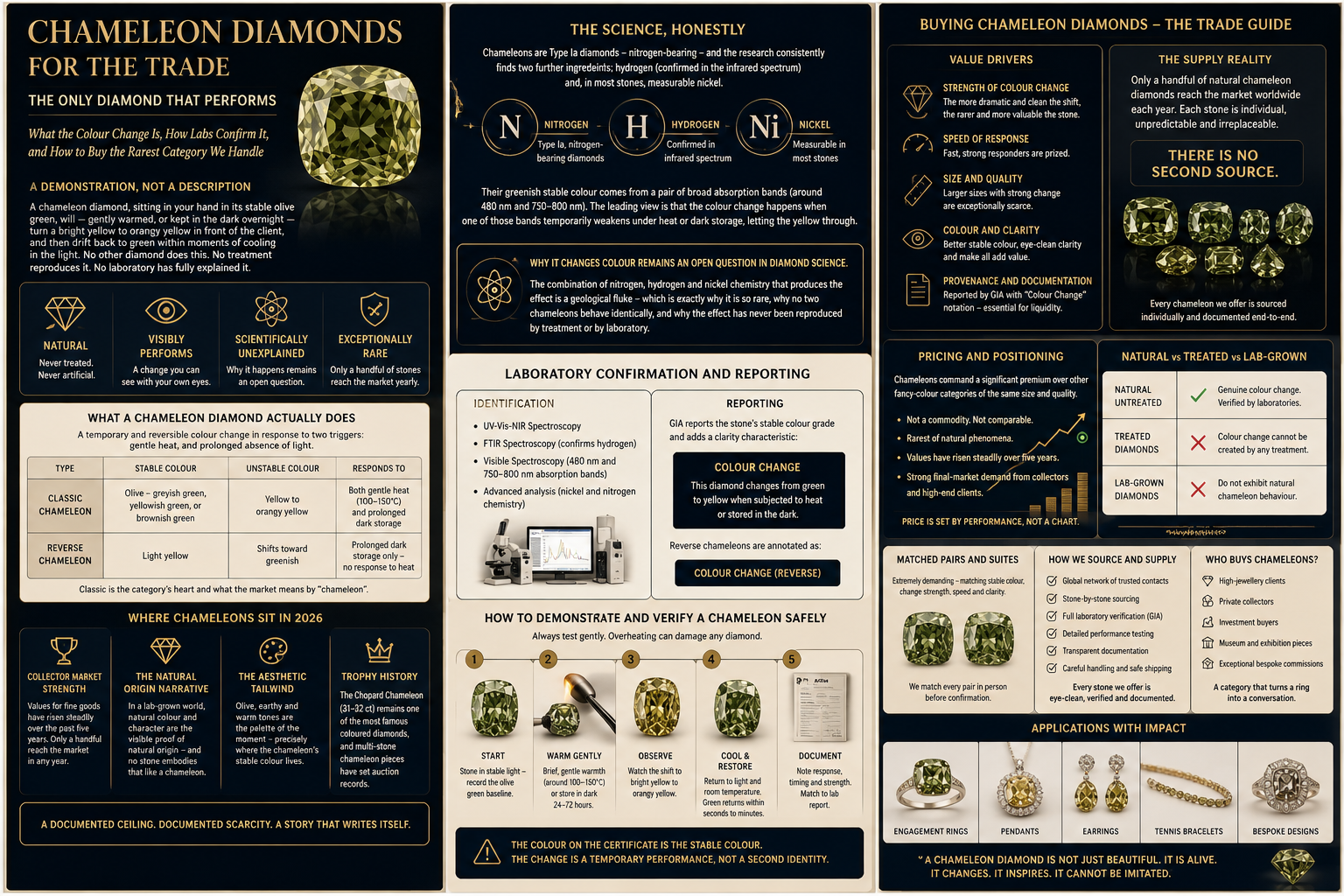
Three currents make this a live category rather than a curiosity. First, the collector market for them has strengthened steadily — values for fine goods have risen over the past five years, only a handful of stones reach the open market in any year, and strong, dramatic colour-change stones are exceptionally scarce even within that trickle. Second, the industry’s whole 2026 narrative is running the chameleon’s way: with lab-grown goods commoditising icy perfection, natural colour and character are being marketed as the visible proof of natural origin — and no stone embodies that argument like the one whose behaviour cannot be manufactured at all. Third, the aesthetic tailwind: the olive, earthy, warm-toned palette the market is currently celebrating is precisely where the chameleon’s stable colour lives.
The category also has genuine trophy history to sell against: the Chopard Chameleon, at roughly 31 to 32 carats the largest known, remains one of the famous coloured diamonds of the modern era, and multi-stone chameleon pieces have set auction records of their own. For a trade buyer, the point is not that every client wants a trophy — it’s that the category has a documented ceiling, a documented scarcity, and a story that writes itself.
Color Diamonds Collections:
Natural Yellow Diamonds | Natural Pink Diamonds | Natural Blue Diamonds | Natural Green Diamonds | Natural Brown Diamonds | Natural Chameleon Diamonds | Natural Purple Diamonds | Natural Orange Diamonds | Natural Gray Diamonds
Diamond Shaped Collections:
Natural Round Brilliant Diamonds | Natural Pear Shaped Diamonds | Natural Oval Diamonds | Natural Marquise Diamonds | Natural Radiant Cut Diamonds | Natural Emerald Cut Diamonds | Natural Cushion Cut Diamonds
The science, honestly
Chameleons are Type Ia diamonds — nitrogen-bearing — and the research consistently finds two further ingredients: hydrogen, confirmed in the infrared spectrum, and, in most stones, measurable nickel. Their greenish stable colour comes from a pair of broad absorption bands (around 480 nm and 750–800 nm), and the leading view is that the colour change happens when one of those bands temporarily weakens under heat or dark storage, letting the yellow through. But here is the honest expert position, and we’d rather give it to you straight: why chameleon diamonds change colour remains an open question in diamond science. The combination of nitrogen, hydrogen and nickel chemistry that produces the effect is a geological fluke — which is exactly why it is so rare, why no two chameleons behave identically, and why the effect has never been reproduced by treatment or synthesis. In this category, the mystery is not a gap in the sales story. It is the sales story.
How the laboratories grade and annotate a chameleon
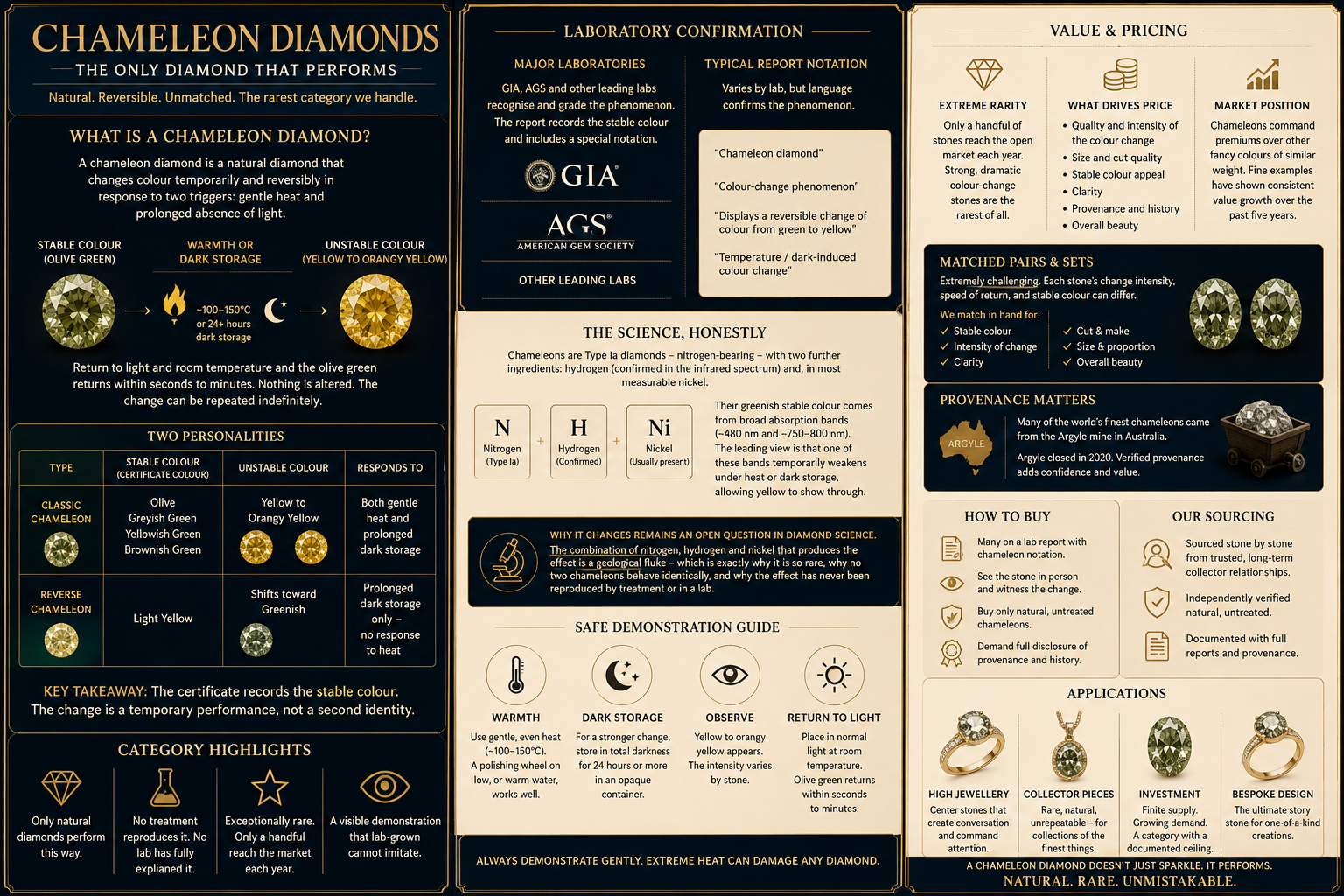
Three things a trade desk should know about the paperwork:
- The colour grade describes the stable state. Real GIA-graded chameleons carry olive-family grades — Fancy Dark Gray-Yellowish Green, Fancy Grayish Yellowish Green, Fancy Deep Brownish Greenish Yellow, Fancy Dark Gray-Green and similar. The intensity ladder in this family runs to Fancy, Fancy Dark and Fancy Deep — tone-heavy grades, consistent with the olive character — and, as everywhere in our library, “Fancy” on the report is doing exactly one job: stating intensity.
- “Chameleon” is a laboratory annotation, not a colour. The word appears on the report only after the laboratory has confirmed the temporary colour change under controlled conditions. Only a small number of stones are ever formally recognised as chameleons — and that annotation is the single most valuable line on the certificate, because it is what separates a verified chameleon from an ordinary olive-green stone.
- Natural colour, by definition. Because no known treatment or growth process reproduces genuine chameleon behaviour, a laboratory-confirmed chameleon is inherently a natural-colour stone — but note the direction of that logic. The phenomenon proves natural character only when a laboratory has confirmed the phenomenon. Some ordinary stones show faint temporary shifts under heat; a desk should never self-certify a chameleon from a counter test. The lab makes the call; the report carries the value.
Where value concentrates
| Driver | What the market pays for |
| Strength of the change | the delta between stable and unstable colour — a dramatic, complete shift is the category’s premium quality, and documented both-state imagery is part of the stone’s value |
| Quality of the stable colour | greener, cleaner olive reads finer; heavily grey- or brown-dominated stables sit lower |
| Intensity grade | Fancy Dark and Fancy Deep goods are generally preferred — stronger body colour, stronger performance |
| Size | most chameleons are small; fine stones above two carats are scarce, and five carats and up is exceptional territory |
| Clarity | secondary — the category commonly runs SI to I, the olive body colour is forgiving, and the market prices the phenomenon first |
| Make | colour-holding cuts dominate — cushions, radiants, ovals — and the cut must serve the stable colour, since that is the stone’s everyday face |
| The annotation | laboratory confirmation of chameleon behaviour on the report is non-negotiable for full category value |
The practical summary for a buyer: you are buying three things — the stable colour on its own merits as an olive coloured diamond, the performance as verified and documented, and the certificate line that ties them together. A stone weak on any of the three is not a category piece at a category price.
Verification, handling and the counter demonstration
- See both states before committing. A chameleon should be bought with both-state documentation — photographs or video of stable and unstable colour — and ideally witnessed. We document both states as standard on every chameleon we handle; it protects the buyer, supports insurance and resale, and frankly, it is the best sales asset the stone has.
- Demonstrate gently. The safe retail demonstration is dark storage — the stone left boxed overnight emerges in its unstable yellow and shifts back in the light in front of the client — or brief, gentle warmth. Never torch a diamond for theatre: aggressive uncontrolled heating is an unnecessary thermal-shock risk, and the effect needs none of it.
- Set expectations correctly. The change is temporary, harmless and repeatable; the stable olive is the stone’s everyday colour and the one the design should be built around. A client who expects a permanently two-toned stone has been sold wrongly.
- Mounting and care are normal. A chameleon wears like any diamond; the phenomenon imposes no special fragility. Bench heat during setting or repair will simply, and briefly, show the trick.
The commercial case for the trade — including the honest part
For a retailer, designer or brand, a chameleon is not an assortment; it is an anchor. One verified stone does work that a tray of commercial goods cannot: it is the piece clients come in to see, the story local press writes about, the demonstration that no lab-grown or simulant counter-offer can follow, and the credential that marks a jeweller as a genuine coloured-stone house. It builds collector clientele — the customer who buys a chameleon is a customer who returns for the next rarity — and because there is no list price and no comparison shopping in this category, margin is a matter of the story, the stone and the documentation.
The honest part, which we will always give you: liquidity is selective. Chameleons trade into a small, knowledgeable collector market; exits typically run through specialist dealers and auction houses rather than the open trading platforms, and the right stone can take time to place. This is a category to buy correctly, with guidance, at the right number — because the appreciation record rewards the patient owner of a fine stone and punishes the impulsive owner of a mediocre one. We advise entering on quality, not on price.
How we source and supply
Chameleons cannot be stocked to order like champagne parcels; they are sourced. Our approach: mandate-based sourcing of certified singles through the collector and specialist networks, with every candidate evaluated in hand for stable-colour quality, change strength and make; both-state photo and video documentation as standard; laboratory confirmation on every stone, no exceptions; and honest comparables-based pricing with a plain account of the liquidity picture. The category sits naturally beside our other olive and green work — our green-diamond desk deals daily in colour-origin questions, and that discipline carries directly into chameleon verification. Pairs and suites exist but are genuinely exceptional; multi-stone chameleon jewellery has set records precisely because assembling matched goods takes years. If a pair or set is brief, we run it through the same patient, forward-sourcing network we use for our hardest matched-pair work — and we tell you honestly what the timeline looks like.
Pricing
There is no price list, no grid and no meaningful per-carat convention across the category — fine certified chameleons trade deep into five-figure-per-carat territory, exceptional and large stones well beyond it, and weak stones deserve neither. Value moves on the drivers above: change strength, stable-colour quality, intensity, size and the laboratory annotation. We price stone by stone against specialist-market comparables and recent results, and we tell you plainly which of the three things you are paying for — the colour, the performance, or the paper — and in what proportion.
Send your requirement to Raremonds → WhatsApp Parth directly: +91 98193 47999
The short version
A chameleon diamond is the only diamond that performs: a natural olive-green stone that temporarily turns yellow to orangy yellow under gentle heat or after dark storage, reverting in the light within moments — a phenomenon confirmed but not fully explained by science, never reproduced by treatment, and formally recognised on only a small number of laboratory reports. The grade describes the stable colour (olive-family Fancy, Fancy Dark and Fancy Deep grades); the “chameleon” annotation is the value line. Buy on three things together — stable-colour quality, documented change strength, and the lab confirmation — with size scarce above two carats and clarity secondary. Commercially it is an anchor stone, not an assortment: the ultimate differentiation piece against lab-grown, a collector-clientele builder, and a category with a real appreciation record and honestly selective liquidity. We source chameleons on mandate, document both states as standard, and price them straight.
FAQ
What is a chameleon diamond, and is the colour change permanent?
A natural diamond that temporarily changes colour — classically from a stable olive green to a stronger yellow or orangy yellow — when gently heated or kept in darkness for an extended period, reverting within seconds to minutes of cooling in the light. The change is temporary, harmless and repeatable indefinitely; the certificate colour is the stable colour, which is the stone’s everyday face.
What is the difference between a classic and a reverse chameleon?
A classic chameleon is stable olive green and shifts to yellow/orangy yellow under both gentle heat and prolonged dark storage. A reverse chameleon is stable light yellow and shifts toward greenish after dark storage only, with no response to heat. The classic is the category’s core; the reverse is rarer still.
How does GIA handle chameleons on the report?
The colour grade states the stable colour — typically olive-family grades such as Fancy Dark Gray-Yellowish Green, Fancy Grayish Yellowish Green or Fancy Deep Brownish Greenish Yellow — and the laboratory adds a “chameleon” identification only after confirming the temporary colour change under controlled conditions. That annotation is the most valuable line on the certificate.
Can the chameleon effect be faked or created by treatment?
No known treatment or synthesis reproduces genuine chameleon behaviour, which is why a laboratory-confirmed chameleon is inherently a natural-colour stone. The caution runs the other way: some ordinary stones show faint temporary shifts, so a counter test is never a certification — only the laboratory call, and the report line, carries the value.
How do you demonstrate a chameleon safely?
Dark storage is the elegant method — boxed overnight, the stone emerges in its unstable yellow and shifts back in the light in front of the client — or brief, gentle warmth. Aggressive heating is unnecessary and an avoidable thermal-shock risk. We supply both-state photo and video documentation with every stone, which does the demonstrating before the stone ever travels.
What makes one chameleon worth far more than another?
The strength and completeness of the documented colour change first, then the quality of the stable colour (greener and cleaner over grey- or brown-heavy), the intensity grade (Fancy Dark and Fancy Deep preferred), size (scarce above two carats, exceptional above five), and always the laboratory annotation. Clarity is secondary in this category.
Do matched chameleon pairs exist, and can you source one?
They exist and they are genuinely exceptional — multi-stone chameleon pieces have set auction records precisely because matched goods take years to assemble. We take pair and suite briefs on mandate through our specialist and forward-sourcing networks, with an honest timeline stated upfront.
Why look at chameleons now?
Collector values for fine goods have strengthened over recent years against a supply of only a handful of market-ready stones annually; the industry’s own marketing is teaching consumers to read natural colour and character as proof of origin against lab-grown uniformity — an argument no stone makes better than the one whose behaviour cannot be manufactured; and the olive, earth-toned palette of the moment is exactly where the chameleon lives.

.png)