

Every other memo in this library is about a colour. This one is about a place — the only mine in history that became a brand, and the only provenance in diamonds that functions as a grading language, a certificate system and an asset class at once. The Argyle mine, in the East Kimberley of Western Australia, operated from 1983 to November 2020, produced more than 865 million carats of rough in its life — of which just 0.1 percent were the pinks, and rarer still the reds, blues and violets that made its name — and supplied, by most trade estimates, over 90 percent of the world’s pink diamonds. Its stones carried a colour character seen nowhere else: the saturated, pulsating candy pinks that redefined what the word meant.
And now the primary story is finished, precisely: the final tender of remaining inventory concluded in October 2025, making 2026 the first year in four decades with no new Argyle-certified stock entering the market at all. Everything from here is secondary — which is not the end of the Argyle business but the beginning of its purest phase, and the phase a specialist desk is built for. This memo covers the papers regime that defines authenticity, the Argyle grading language every serious buyer must read, the post-closure market numbers, the B2B playbook tier by tier, the investment case with its honest caveats, and the global sourcing network through which we find the best Argyle goods at the most marketable valuations.
The mine, the tenders, and what just changed
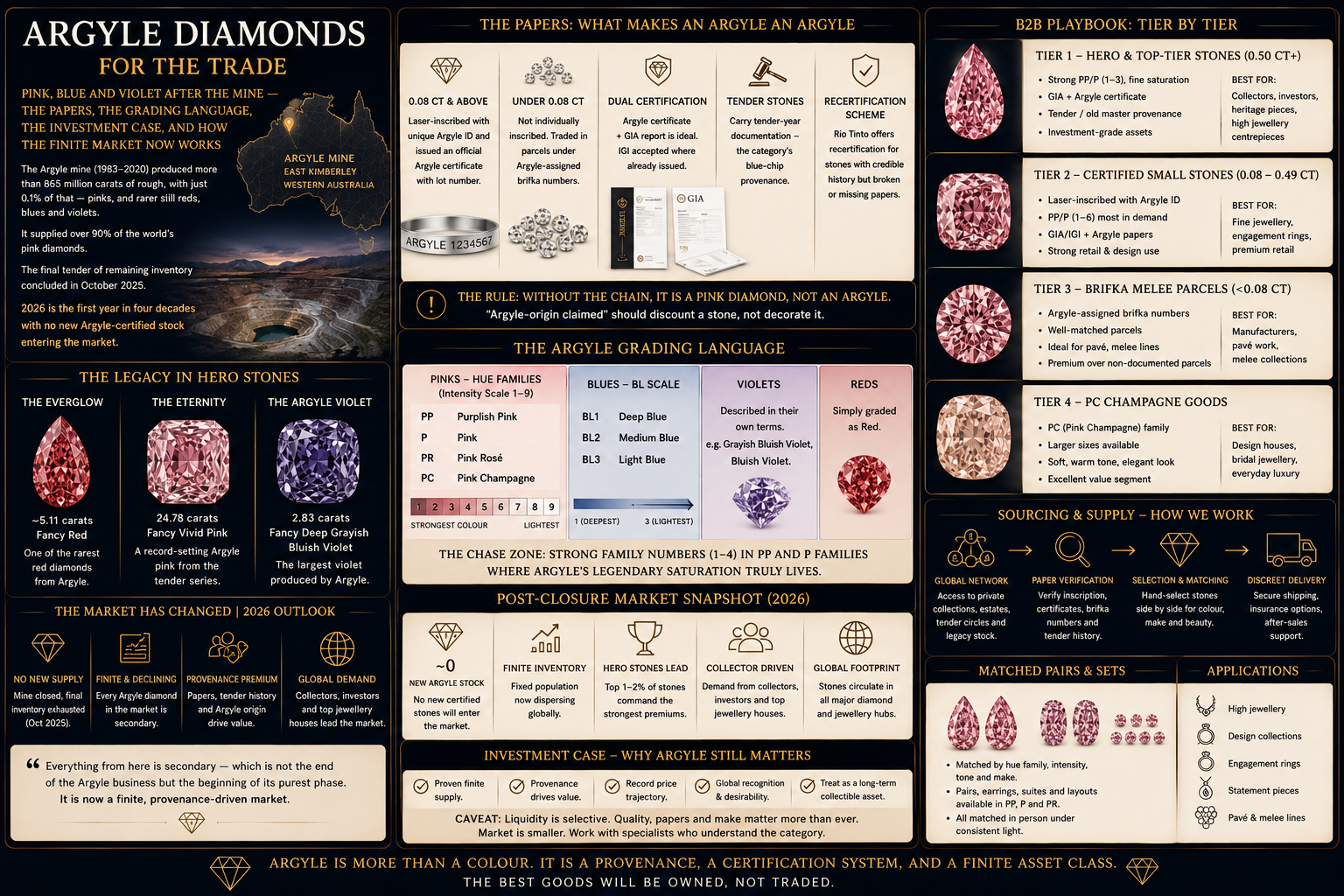
Argyle’s commercial architecture was as distinctive as its stones. From 1984, the mine’s finest pinks — mere tens of carats a year — were sold through the invitation-only, sealed-bid Pink Diamonds Tender, the event that turned the goods into trophies and the tender numbers into provenance. The hero stones of those tenders anchor the whole category’s record book: the Everglow among the reds, the Eternity among the pinks, the Argyle Violet as the colour’s benchmark. After closure, Rio Tinto chose custodianship over exit: it kept the brand, built a trade-only concierge platform for the secondary market, established a recertification and reauthentication scheme, and ran “Beyond Rare” tender events mixing the dwindling remaining inventory with “Old Masters” — hero stones returning from past collections. Tiffany’s 2023 purchase of a curated 35-stone collection marked the era; the October 2025 tender closed it. The remaining pipeline was described inside the trade, memorably, as a teaspoonful — and the teaspoon has now been poured.
Color Diamonds Collections:
Natural Yellow Diamonds | Natural Pink Diamonds | Natural Blue Diamonds | Natural Green Diamonds | Natural Brown Diamonds | Natural Chameleon Diamonds | Natural Purple Diamonds | Natural Orange Diamonds | Natural Gray Diamonds
Diamond Shaped Collections:
Natural Round Brilliant Diamonds | Natural Pear Shaped Diamonds | Natural Oval Diamonds | Natural Marquise Diamonds | Natural Radiant Cut Diamonds | Natural Emerald Cut Diamonds | Natural Cushion Cut Diamonds
The papers: what makes an Argyle an Argyle
Provenance is the entire premium, so the documentation chain is the first discipline of this category — and it is unusually precise:
- Stones of 0.08 carat and above were laser-inscribed with a unique Argyle identification number and issued an official Argyle certificate carrying a lot number. Inscription, certificate and lot must agree — that three-way match is the authenticity test.
- Melee under 0.08 carat was not individually inscribed; it trades in parcels under Argyle-assigned brifka numbers, which is why documented parcels carry a premium over loose claims.
- Dual certification — the Argyle papers alongside a GIA report — is the market’s ideal, marrying provenance to the grading laboratory the trade trusts most for natural goods. An IGI report has currency where a stone already carries one, but GIA with the Argyle certificate is the combination we arrange wherever the choice is ours.
- Tender stones carry the further layer of tender-year documentation, the category’s blue-chip provenance.
- Rio Tinto’s recertification scheme exists precisely because papers get separated from stones over forty years; a stone with a credible story but broken papers has a path back — and until it takes that path, it prices as unproven.
The rule we give every client is blunt: without the chain, it is a pink diamond, not an Argyle. “Argyle-origin claimed” is a phrase that should discount a stone, not decorate it.
The Argyle grading language
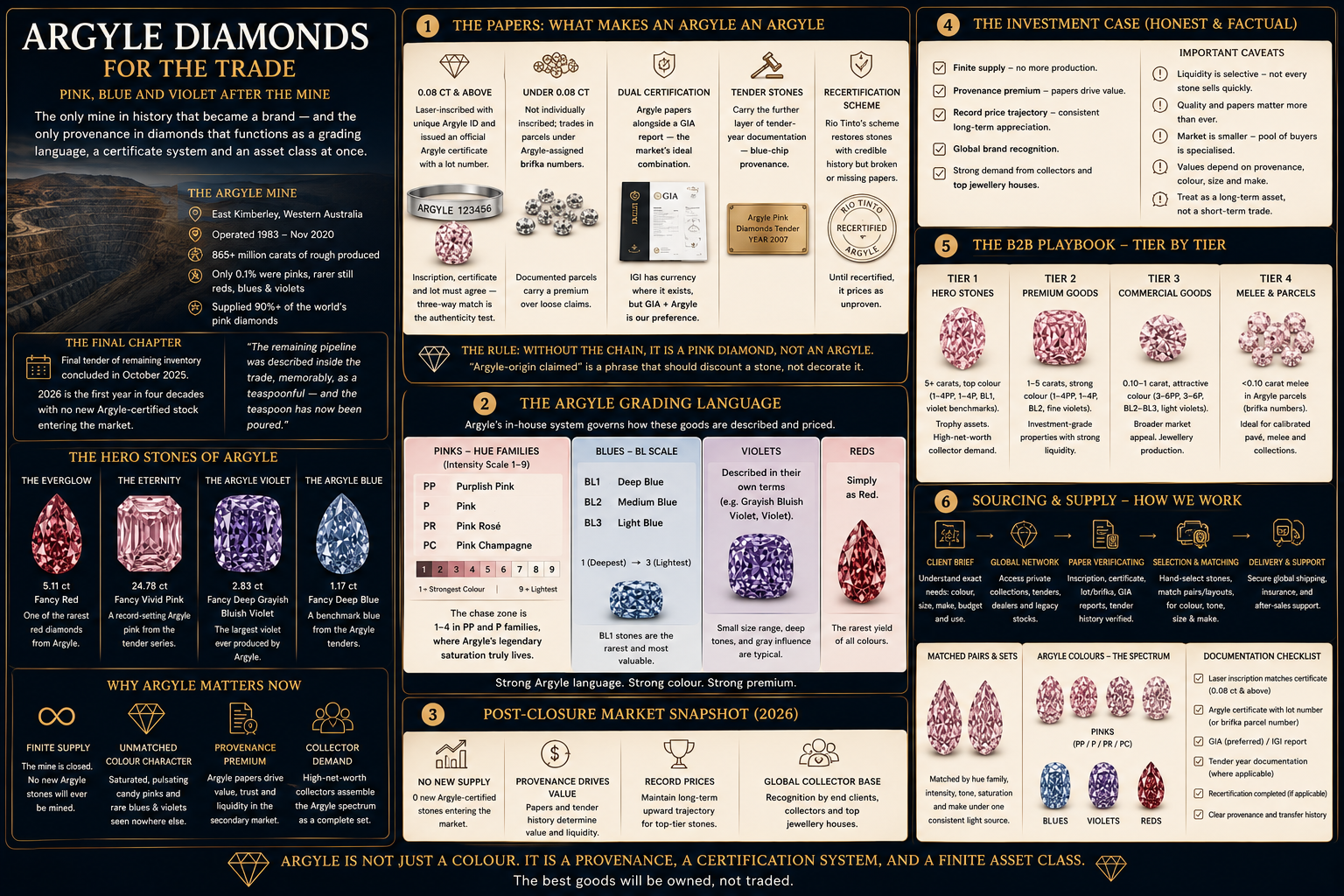
This library has now catalogued four grading languages — GIA’s, the champagne C-scale, the TTLB shade scale, the laboratory annotations — and Argyle’s is the fifth: an in-house system that still governs how these goods are described and priced on the secondary market. Pinks were graded into hue families — PP (purplish pink), P (pink), PR (pink rosé) and PC (pink champagne) — each on a numeric intensity scale running 1 for the strongest colour to 9 for the lightest, so a “2PP” reads as a near-top purplish pink while a “7P” is a light pink. Blues were graded on their own BL scale (BL1 deepest to BL3 lightest), violets described in their own terms, and the reds — the rarest yield of all — simply as Red. The chase zone of the secondary market is precise: strong family numbers, roughly 1 through 4, in the PP and P families, where the colour saturation that made Argyle’s name actually lives. A desk fluent in this language can read an Argyle certificate the way it reads a GIA report, translate between the two (a strong PP family stone will typically correspond to the Intense–Vivid purplish pink territory on a GIA report, though the systems do not map mechanically), and price accordingly. A desk that cannot is buying somebody else’s translation.
The market since closure: the numbers
The post-closure market has behaved exactly as terminal scarcity predicts. Fancy Colour Research Foundation data shows Argyle pinks appreciating at roughly 8–12 percent annually since the closure; Rio Tinto’s own sales leadership notes that Argyle tender pinks have outperformed all major equity markets over the past two decades with double-digit growth; and Argyle-certified stones are commonly cited as commanding premiums of 20–50 percent over comparable non-Argyle pinks — a spread that has widened, not narrowed, as inventory disperses. The record book keeps advancing across all three colours, most notably with the Argyle Phoenix, a 1.56-carat red, setting a $4.2 million benchmark at auction.
The three colours
| Colour | Character & scale | Benchmarks | Trade notes |
| Pink (and the reds above it) | the mine’s signature — saturated candy pinks; PP/P/PR/PC families, 1–9 | tender heroes (Eternity); the reds: Everglow 2.11 ct, Phoenix 1.56 ct | the deepest Argyle market; strongest PP/P grades in small sizes are the classic asset stones; the PC family bridges to our champagne desk |
| Blue | scarce, gray-inflected steel blues; BL1–BL3 | tender blues, rare in any size | a quiet corner prized by completion collectors; reads differently from boron blues and should be bought as its own thing |
| Violet | the mine’s rarest hue, near-always gray-blue modified | the Argyle Violet, 2.83 ct | effectively unique to Argyle; covered fully in our violet memo — the trilogy’s hardest acquisition |
The B2B playbook: building an Argyle business tier by tier
For a jeweller, designer, brand or trading desk, Argyle is not one business but four, and the discipline is knowing which tiers belong in your model:
- Inscribed certified smalls (roughly 0.08 to 0.50 carat) — the volume heart of the market. This is where most documented Argyle stones actually live, where entry capital is manageable, and where the asset-grade retail piece is built: a small stone whose inscription, certificate and lot number are themselves the display story. For a retail counter, the papers do the selling — the laser inscription under a loupe is the single best provenance demonstration in the diamond business, and no lab-grown or generic pink counter-offer can follow it.
- Brifka-documented melee — the designer’s play, and genuinely underused. Numbered parcels let a design house put authentic Argyle provenance into finished pieces at accessible per-piece cost: an Argyle-set halo, an accent line, a signature detail marketed truthfully as Argyle. The discipline is the parcel number; undocumented “Argyle-style” melee is just pink melee, and we treat it as such.
- The PC bridge — champagne-family goods into warm programmes. The pink champagne family connects directly to the desert-diamond and cognac demand our brown memo documents, letting a warm-palette programme carry genuine Argyle provenance at the accessible end of the scale.
- The mandate tier — tender stones, hero-adjacent goods, strong-number PP/P singles, blues and violets.Sourced patiently for collectors and investment buyers, including the trilogy briefs (pink, blue, violet) our violet memo describes. This tier is relationship business, not inventory business.
On margin and merchandising, one structural fact works in the trade buyer’s favour across all four tiers: there is no consumer-facing price list for Argyle goods, no Rapaport anchor, and no two identical stones — so pricing is built on provenance, colour and story, and the documented 20–50 percent provenance premium is margin architecture, not cost burden, for the desk that buys correctly. The stock-selection rules that protect that margin: colour over carat (a smaller strong-number stone outperforms a larger weak one, commercially and on resale), strong family numbers in PP and P first, full paper chains only, and condition checked stone by stone — forty-year-old small goods have lived lives, and chips or wear on a tiny stone matter more than buyers expect.
The investment case — the data, the discipline, and the caveats
Argyle pinks are the most widely cited investment story in diamonds, and unusually, the story has numbers behind it. The documented record: FCRF’s 8–12 percent average annual appreciation since closure; Rio Tinto’s two-decade outperformance of major equity markets; the widening 20–50 percent premium over equivalent non-Argyle pinks; and — per one 2026 investment guide’s compilation — appreciation in the first year after closure running strongest at the top of the ladder (roughly 23 percent for Fancy Pink territory, 29 percent for Intense, 39 percent for Vivid), consistent with top-grade pinks’ widely cited multi-hundred-percent appreciation over the past two decades. The structural logic is the cleanest in hard assets: supply is arithmetically fixed and can only shrink into jewellery, loss and museum cases, while demand is global and growing.
What the trade treats as investment-grade is specific, and it is where our buying discipline concentrates: the strongest colour the budget allows (Intense–Vivid GIA territory; family numbers 1–4 in PP or P), purity of hue over size, the complete paper chain with GIA alongside the Argyle certificate, tender provenance where attainable as the blue-chip layer, and honest condition. The rule of the category bears repeating: a one-carat weak pink is a jewellery stone; a quarter-carat strong PP is an asset.
The caveats, stated as plainly as the data — because this library does not sell romance. Argyle stones are illiquid relative to listed assets: exits run through specialist dealers, auction houses and Rio Tinto’s trade platform on their own timetable, not at the click of a button. Bid-ask spreads are real, and the buy-side premium must be earned back before appreciation begins — which is precisely why entry valuation is everything. The asset yields nothing while held, authentication risk is ever-present for the undisciplined buyer, and past appreciation is a record, not a promise. And one line we insist on: we are diamond specialists, not financial advisers — we will source, verify, document and value the stone with complete rigour, and the portfolio decision belongs with the client and their own advisers.
The Raremonds global sourcing network: finding the best Argyle goods at the right valuation
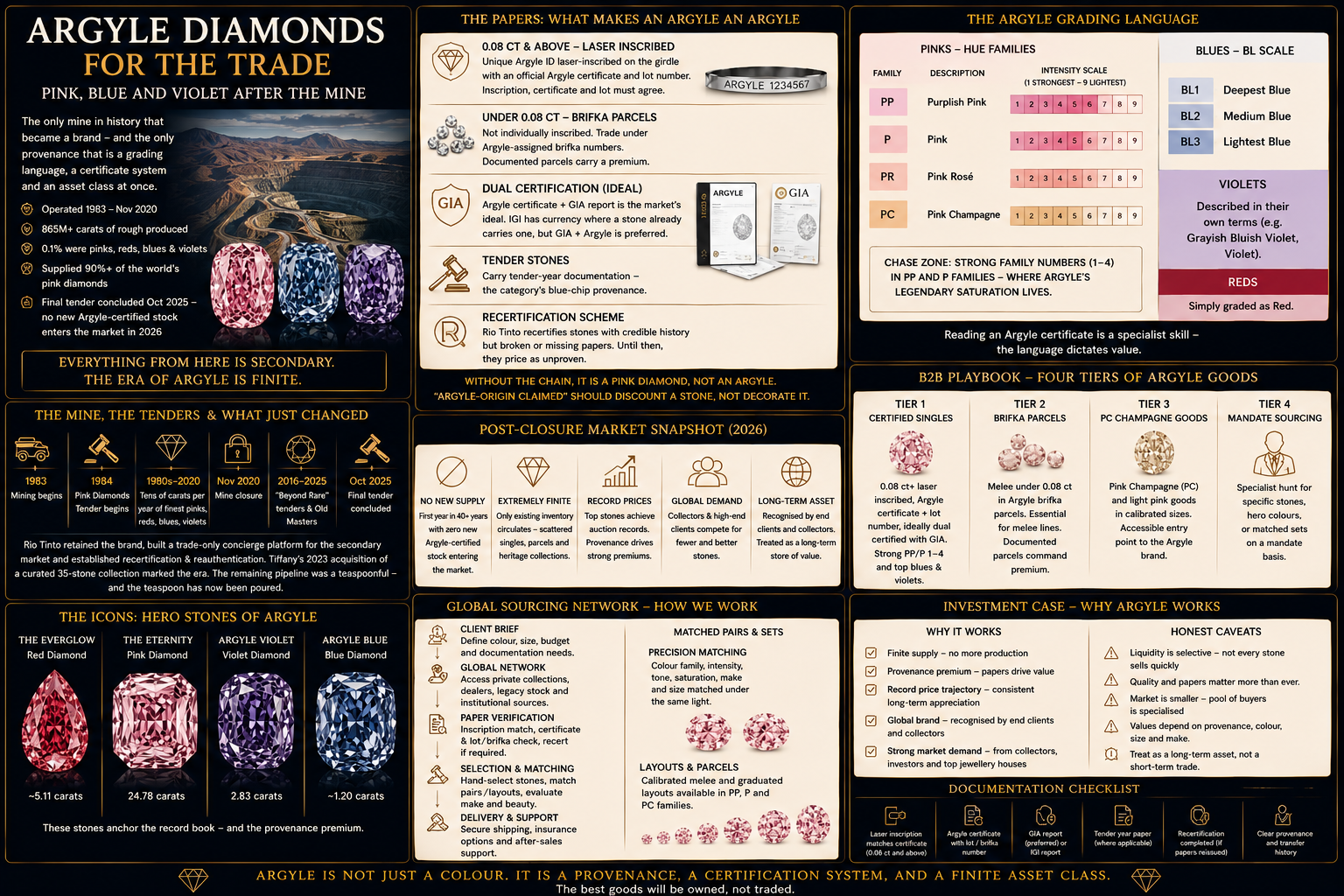
This is where two generations of relationships do the work no search bar can. Raremonds has traded natural diamonds since 1985 across a network spanning more than ten markets — Australia, Hong Kong, Japan, the UK, the USA, Turkey, China, Taiwan, Vietnam and New Zealand among them — and that footprint matters specifically for Argyle, because post-closure supply is scattered across exactly those geographies: Australian specialist dealers and Argyle-partner circles closest to the source, the Hong Kong and Japanese collections that absorbed tender goods for decades, estate and old-inventory surfacings in the Western markets, auction rooms everywhere, and the trade-only resale channels where documented stones change hands quietly. Our forward-sourcing model — the standing relationships that give us sight of goods before they list, described in our matched-pairs memo — applies here in its secondary-market form: we frequently know a documented Argyle stone is coming to market before the market does.
Finding the stone is half the discipline; the valuation is the other half, and it is where “the best Argyle at the most marketable price” stops being a slogan and becomes a method. Every candidate is benchmarked against tender-resale and auction comparables for its family, number, size and paper quality; the Argyle premium is quantified explicitly against the equivalent non-Argyle pink so the client sees precisely what the provenance is costing and what it has historically returned; marketability is scored honestly — strong-number PP/P smalls with full chains are the liquid heart of the market, and we say so when a romantic stone falls outside it; and the paper chain is verified before purchase, not after, with recertification counselled wherever the chain is broken. The result is the only version of this business worth running: the right stones, bought at valuations the resale market will actually honour, documented so thoroughly that the next buyer’s diligence is already done.
How we supply, and pricing
Across the four tiers we supply: inscribed certified singles with GIA arranged alongside the Argyle papers where absent; brifka-documented melee parcels; PC-family goods into warm programmes; and mandate sourcing for tender stones, strong-number singles, blues, violets and trilogy briefs — every stone with face-up documentation under standardised light as standard. Pricing is per stone against tender-resale and auction comparables, with the provenance premium quantified explicitly — and, as everywhere in this library, we tell you plainly when the answer to a brief is an Argyle, and when it is a better diamond without the postcode.
Send your requirement to Raremonds → WhatsApp Parth directly: +91 98193 47999
The short version
Argyle is the only provenance in diamonds that works as a brand, a grading language and an asset class — a closed Australian mine that supplied over 90 percent of the world’s pinks plus its rarest reds, blues and violets, whose final inventory tender concluded in October 2025, making 2026 the first fully secondary year in the category’s history. Authenticity is a paper chain: laser inscription, Argyle certificate and lot number in agreement (brifka numbers on melee parcels), ideally dual-certified with GIA — the ideal pairing with Argyle papers — and with Rio Tinto’s recertification scheme as the repair path. The in-house language — PP, P, PR and PC pink families graded 1 to 9, BL blues, straight Red — still governs pricing, with the chase zone at strong numbers 1–4 in PP and P. The B2B playbook runs four tiers: inscribed certified smalls, brifka melee, the PC-champagne bridge, and the mandate tier. The investment record is documented — FCRF’s 8–12 percent annual appreciation, a widening 20–50 percent provenance premium, strongest gains at the top grades — and so are the caveats: illiquidity, spreads, no yield, and our standing line that we are diamond specialists, not financial advisers. Our global network across ten-plus markets sources the stones where they now live, benchmarks every one against tender-resale and auction comparables, and quantifies the premium honestly — the best Argyle goods, at valuations the resale market will honour.
FAQ
Why do Argyle pinks command a premium over other pink diamonds?
Provenance with arithmetic behind it: the mine supplied over 90 percent of the world’s pinks, closed permanently in 2020, and poured its final tender inventory in October 2025 — so documented Argyle stones are a fixed population against permanent demand. The premium over comparable non-Argyle pinks is commonly cited at 20–50 percent and has widened as inventory disperses; FCRF data shows 8–12 percent annual appreciation since closure.
How do I verify a stone is genuinely Argyle?
Through the paper chain: stones of 0.08 carat and above carry a laser-inscribed Argyle ID that must match an official Argyle certificate and lot number; melee under 0.08 carat trades in Argyle-numbered brifka parcels. Dual certification — GIA alongside the Argyle certificate — is the ideal, and Rio Tinto’s recertification scheme exists for stones with broken papers. Without the chain, it prices as a pink diamond, not an Argyle.
What do Argyle grades like 4PP or 6P mean?
They’re the mine’s in-house grading language: hue families PP (purplish pink), P (pink), PR (pink rosé) and PC (pink champagne), each graded 1 (strongest colour) to 9 (lightest). Blues carried BL1–BL3; the rare reds were graded simply Red. The secondary market’s chase zone is numbers 1–4 in PP and P, and the scale translates — carefully, not mechanically — to GIA terms.
Are Argyle pink diamonds a good investment?
The documented record is strong: FCRF shows 8–12 percent annual appreciation since closure, Rio Tinto cites two decades of outperformance versus major equity markets, the provenance premium has widened, and post-closure gains ran strongest at the top grades. The trade’s investment-grade criteria are specific — strongest colour over carat, family numbers 1–4 in PP or P, complete papers with GIA alongside the Argyle certificate, tender provenance as the blue-chip layer. The honest caveats: illiquidity, real spreads, no yield, and past performance is a record, not a promise. We are diamond specialists, not financial advisers — we source, verify and value with complete rigour, and the portfolio decision belongs with you and your advisers.
Are Argyle diamonds still available to buy?
Yes — but only on the secondary market: dealer networks, tender resales, auctions, collections and Rio Tinto’s trade platform. Primary supply ended entirely with the October 2025 final tender. Documented goods trade actively; anyone offering easy Argyle volume is offering something that no longer exists.
How does Raremonds source Argyle diamonds?
Through a two-generation global network across more than ten markets — Australian specialist and Argyle-partner circles, the Hong Kong and Japanese collections that absorbed tender goods for decades, Western estate surfacings, auction rooms and trade-only resale channels — with forward-sourcing relationships that often show us documented stones before they list. Every candidate is benchmarked against tender-resale and auction comparables, its paper chain verified before purchase, its marketability scored honestly, and the provenance premium quantified against the equivalent non-Argyle pink.
Did Argyle produce colours other than pink?
Yes — the 0.1 percent of production that made its name included reds (the Everglow, and the record-setting Phoenix), gray-inflected blues on the BL scale, violets (effectively unique to the mine, benchmarked by the 2.83-carat Argyle Violet), and the champagne goods that feed the PC family and the C-scale our brown memo covers.
Is Argyle melee worth pursuing?
Genuinely yes — brifka-documented parcels let a designer or brand put authentic Argyle provenance into finished pieces at accessible cost, and it remains an underused play. The discipline is the parcel number: undocumented “Argyle-style” melee is just pink melee.
Should every pink-diamond brief be an Argyle brief?
No — and we’ll say so. A non-Argyle vivid pink can be the finer stone at a lower number; the Argyle premium buys provenance and the scarcity story. We quantify that premium explicitly against the equivalent non-Argyle stone so the client chooses with open eyes

.png)