

Where Pear Sits in 2026 — and How the Ratio Trend Changed the Market
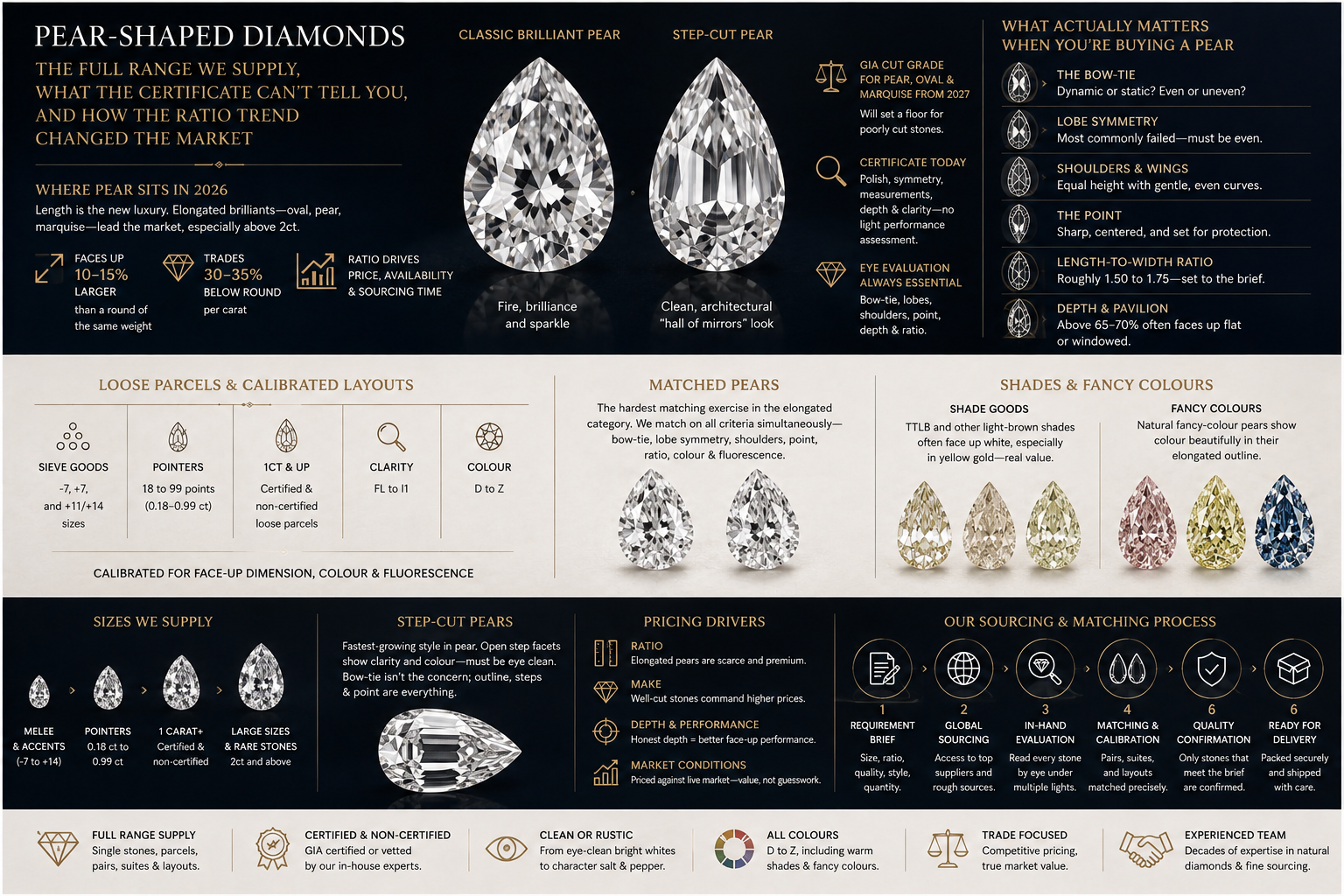
Length is the new luxury. Elongated brilliants — oval, pear, marquise — are where the market has moved, particularly above two carats, and pear is staging its biggest comeback in decades. An elongated pear faces up 10-15% larger than a round of the same weight and trades 30-35% below round per carat. The real shift is ratio: demand has pulled toward the dramatic, longer end of the band, but surveyed preference peaks around 1.70 — more elongated than rough comfortably yields. Long pears are structurally harder to cut, so well-cut elongated stones are genuinely scarce and command a premium, while plumper ratios (1.40-1.50) remain available and good value. Ratio is now a primary driver of price, availability, and sourcing timeline.
What GIA’s Report Covers — and the 2027 Cut Grade
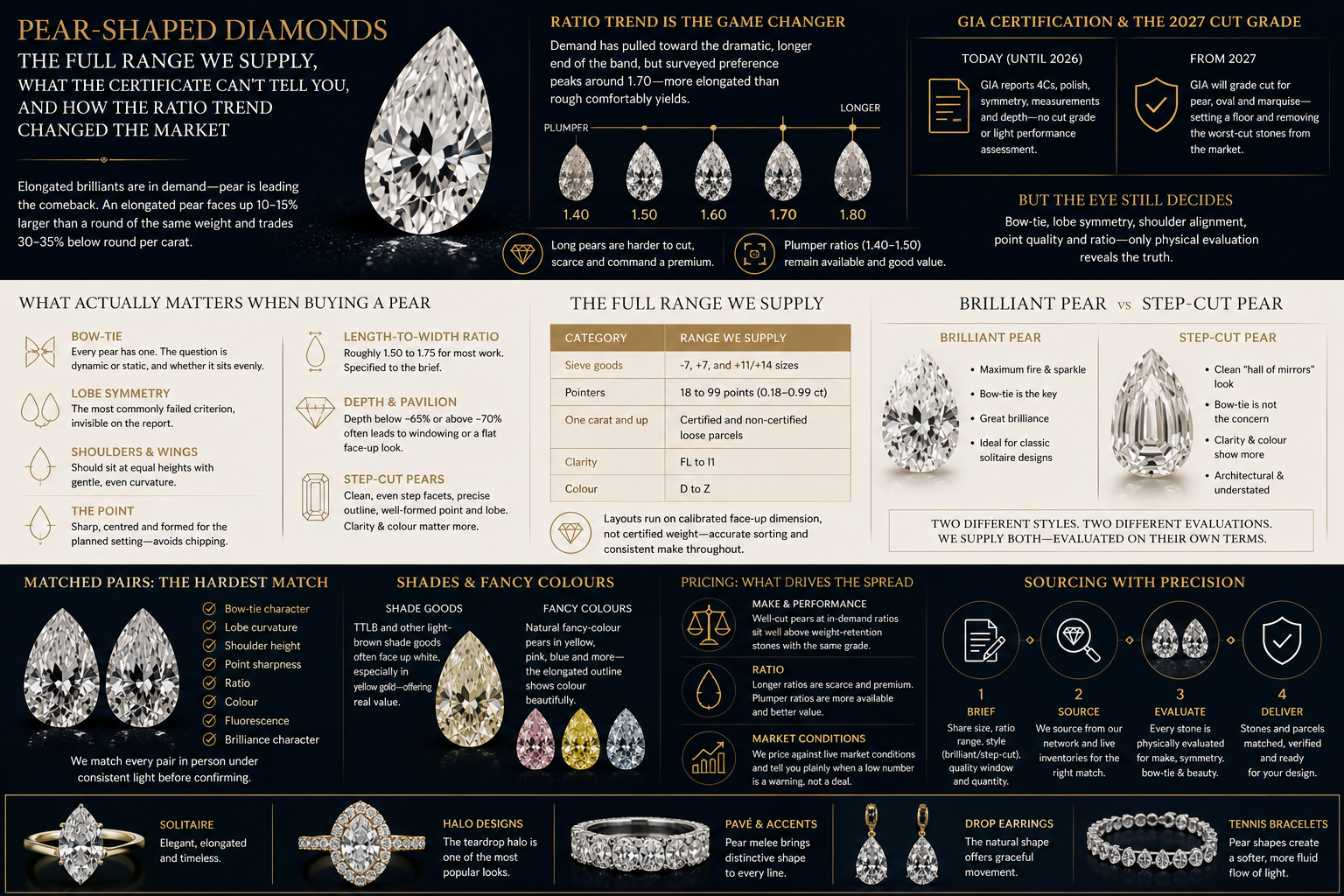
GIA issues no cut grade for pear today — the report gives polish, symmetry, measurements, and depth, with no light-performance assessment. GIA has confirmed cut grading for pear, oval, and marquise from 2027, which will set a floor filtering out the worst-cut stones. It won’t replace the eye reading bow-tie character, lobe symmetry, shoulder alignment, point quality, and ratio. Physical evaluation remains the only reliable assessment through 2026 and beyond.
What Actually Matters When You’re Buying a Pear
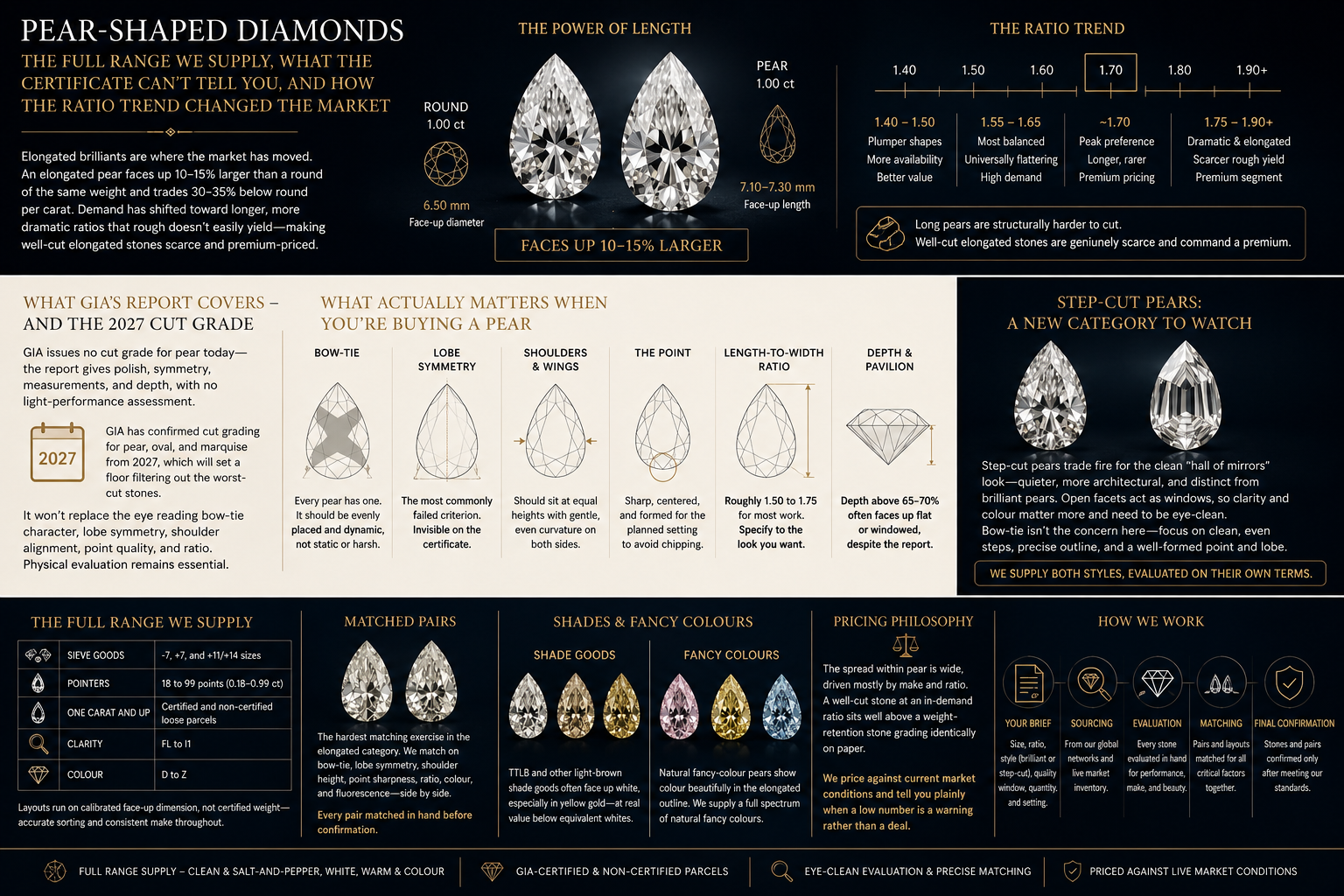
The bow-tie — every pear has one; the question is dynamic or static, and whether it sits evenly. Lobe symmetry — the most commonly failed criterion, invisible on the report. Shoulders and wings — should sit at equal heights with gentle, even curvature. The point — sharp, centred, and formed for the planned setting to avoid chipping. Length-to-width ratio — roughly 1.50 to 1.75 for most work, specified to the brief. Depth and pavilion — weight-retention cuts above 65-70% depth often face up flat or windowed despite looking fine on paper.
Color Diamonds Collections:
Natural Yellow Diamonds | Natural Pink Diamonds | Natural Blue Diamonds | Natural Green Diamonds | Natural Brown Diamonds | Natural Chameleon Diamonds | Natural Purple Diamonds | Natural Orange Diamonds | Natural Gray Diamonds
Diamond Shaped Collections:
Natural Round Brilliant Diamonds | Natural Pear Shaped Diamonds | Natural Oval Diamonds | Natural Marquise Diamonds | Natural Radiant Cut Diamonds | Natural Emerald Cut Diamonds | Natural Cushion Cut Diamonds
Step-Cut Pears: The New Category to Watch
The fastest-moving development in pear is faceting style, not ratio. Step-cut pears trade the brilliant pear’s fire for the clean “hall of mirrors” look of an emerald cut — quieter, more architectural, and genuinely distinctive against the now-ubiquitous brilliant pear. They evaluate differently: open facets act as windows, so clarity and colour matter more and need to be eye-clean. The bow-tie isn’t the concern here — clean even step facets, a precise outline, and a well-formed point and lobe are. We supply both styles, evaluated on their own terms.
Certified Single Stones
For solitaires and centrepieces, we supply GIA-certified natural pears across sizes, colours, clarities, and ratios — sourced to the specific look the brief calls for, not whatever the rough yielded.
Loose Parcels and Calibrated Layouts
| Category | Range We Supply |
| Sieve goods | -7, +7, and +11/+14 sizes |
| Pointers | 18 to 99 points (0.18–0.99 ct) |
| One carat and up | Certified and non-certified loose parcels |
| Clarity | FL to I1 |
| Colour | D to Z |
Layouts run on calibrated face-up dimension, not certified weight — accurate sorting and consistent make throughout.
Matched Pairs
Pear is the hardest matching exercise in the elongated category — bow-tie character, lobe curvature, shoulder height, point sharpness, ratio, colour, and fluorescence all need to agree across both stones simultaneously. Fluorescence is where pairs fail most often. We match every pair in person before confirming, whatever the individual certificates say.
Shades and Fancy Colours
TTLB and other light-brown shade goods often face up white, especially in yellow gold, at real value below equivalent white stones. We also supply natural fancy-colour pears, where the elongated outline shows colour particularly well.
Pricing
The spread within pear is wide, driven mostly by make and ratio. A well-cut stone at an in-demand ratio sits well above a weight-retention stone grading identically on paper. We price against current market conditions and tell you plainly when a low number is a warning rather than a deal.
FAQ
Does GIA grade cut on pear diamonds?
Not yet — confirmed coming from 2027 for pear, oval, and marquise. Until then, performance has to be read by physical inspection.
How has the ratio trend changed pear pricing?
Demand has shifted toward longer, more dramatic ratios that rough doesn’t easily yield, making well-cut elongated stones scarce and premium-priced, while plumper ratios remain better value.
What ratio is best for a pear?
Roughly 1.50 to 1.75 for most work, with 1.55–1.65 the most universally flattering. Longer reads dramatic; plumper reads vintage.
What sizes do you supply?
The full range — sieve goods through melee, pointers 0.18 to 0.99ct, and certified or non-certified parcels at a carat and up, across FL-I1 and D-Z.
What matters most when buying a pear?
Bow-tie character, lobe symmetry, shoulder alignment, point quality, and honest depth — none of it visible on the certificate.
What is a step-cut pear?
A teardrop cut with parallel step facets instead of brilliant faceting — clean and architectural rather than fiery. Clarity and colour matter more; bow-tie isn’t the concern.
Do you supply shade goods and fancy-colour pears?
Yes — light-brown shade goods that often face up white, and natural fancy-colour pears where the elongated outline shows colour beautifully.
Do you supply matched pairs and layouts?
Yes — single stones, matched pairs, graduated suites, and layouts, every pair matched in hand on all criteria before confirmation.

.png)