

The Asscher is the emerald’s square cousin and one of the most distinctive cuts in the trade: a near-square step cut with deeply cropped corners that give it an octagonal outline, a high crown, and concentric step facets that draw the eye inward in a mesmerising “windmill” or hall-of-mirrors pattern. It is the Art Deco cut, geometric and architectural, with a cool, vintage glamour that no brilliant can imitate — and in 2026, on the back of the step-cut and Art Deco revival, it is firmly on the rise.
Like every step cut, it also shows a stone honestly, which changes how it has to be bought. The Asscher’s open facets are windows: clarity and colour read plainly, and a feature that would hide in a brilliant sits in full view. After two generations in the natural diamond trade, the Asscher is a cut we select with a clarity-led eye, and we supply it across the full range — single stones, calibrated goods, matched pairs, shades and coloured diamonds. This is where it sits, what we carry, and what decides whether an Asscher is worth its price.
Where the Asscher sits in 2026
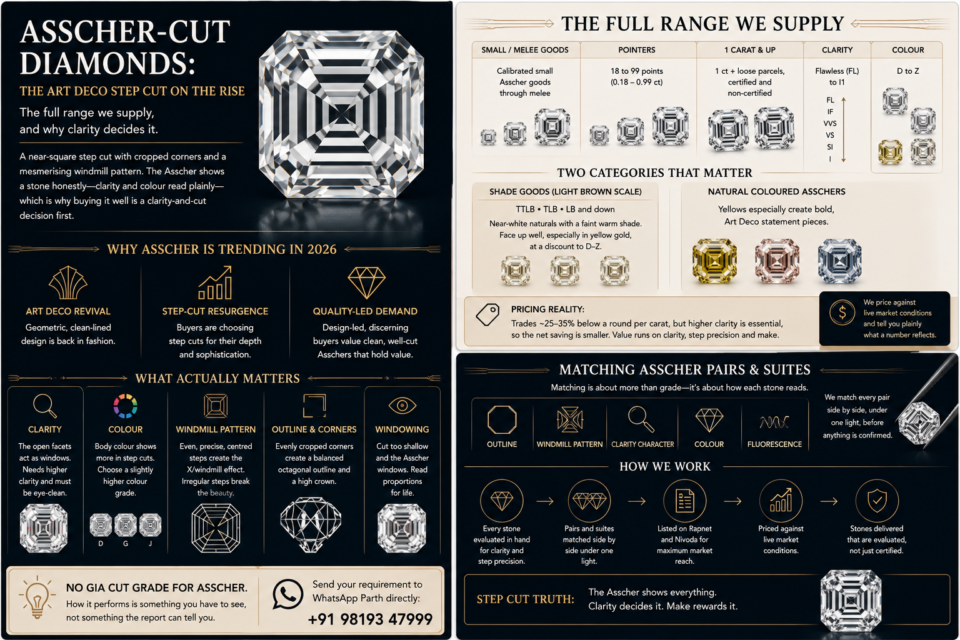
The Asscher rides the year’s strongest vintage current. The Art Deco revival, the return of geometric and clean-lined design, and the broad step-cut resurgence have all converged on it, and it has moved from a connoisseur’s choice toward a genuinely fashionable one. It remains niche in raw volume — it’s a distinctive, particular shape, not a mass-bridal default — but it is trending up, and the buyers it attracts are design-led and quality-conscious.
Commercially, the Asscher behaves like the emerald: because it hides nothing, the gap between a clean, well-cut stone and a flawed one is large and immediately visible, so well-made, eye-clean Asschers hold value while poorly chosen ones are hard to move. As across the whole 2026 market — premium and distinctive stones holding firm while lab-grown commoditises the generic stone — the value in a natural Asscher sits on clarity, the precision of its step pattern, and make. Buying one well is a clarity-and-cut decision first.
What GIA’s report covers — and what it doesn’t
GIA issues no cut grade for the Asscher, and it is not in the 2027 fancy-shape rollout (marquise, oval and pear) — so there’s no cut grade coming. The report gives polish, symmetry, measurements, depth and table; how the windmill pattern actually reads, and how clean the stone is through its open facets, is a matter of seeing it.
Color Diamonds Collections:
Natural Yellow Diamonds | Natural Pink Diamonds | Natural Blue Diamonds | Natural Green Diamonds | Natural Brown Diamonds | Natural Chameleon Diamonds | Natural Purple Diamonds | Natural Orange Diamonds | Natural Gray Diamonds
Diamond Shaped Collections:
Natural Round Brilliant Diamonds | Natural Pear Shaped Diamonds | Natural Oval Diamonds | Natural Marquise Diamonds | Natural Radiant Cut Diamonds | Natural Emerald Cut Diamonds | Natural Cushion Cut Diamonds
What actually matters when you’re buying an Asscher
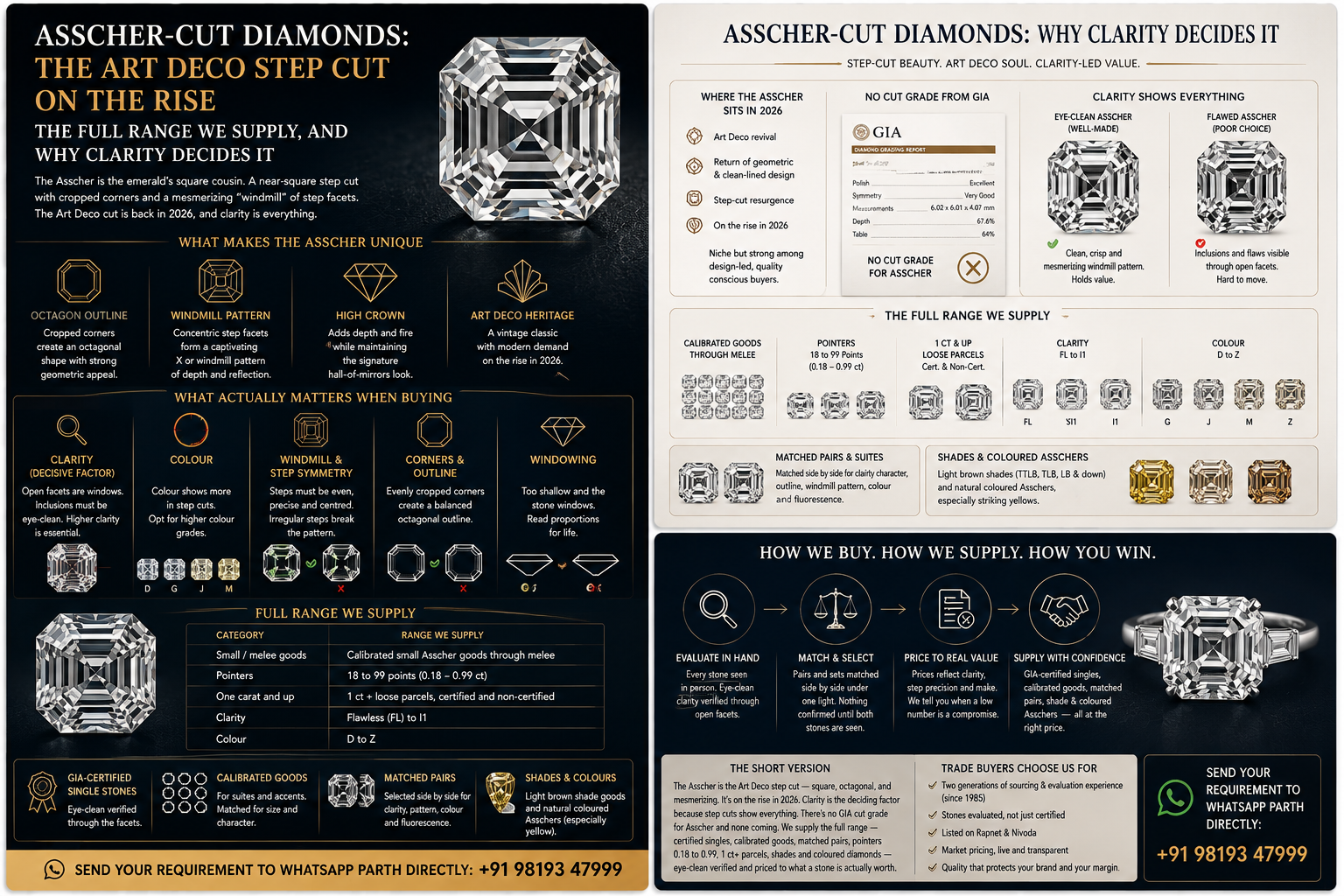
- Clarity, read through the facets — the decisive factor. The open step facets act as windows, so an Asscher needs a higher clarity than a brilliant of the same intent and must be checked eye-clean; an inclusion invisible in a round can sit in plain view here.
- Colour shows more. The same faceting reveals body colour, so a slightly higher colour grade often pays, and warm goods need careful placement.
- The windmill pattern and step symmetry. The Asscher’s beauty is its concentric, symmetrical step facets forming the X/windmill; they should be even, precise and centred — irregular steps break the effect.
- The corners and outline. The cropped corners should be even on all four, giving a balanced octagonal outline; the high crown should give depth without going dark.
- Windowing. Cut too shallow for weight, an Asscher windows and loses its depth of reflection; read the proportions for life.
This is the reference a certificate can’t give you in a step cut, and it’s what separates an Asscher that’s clean and alive from one that’s flawed or flat.
Certified single stones and calibrated goods: the full range
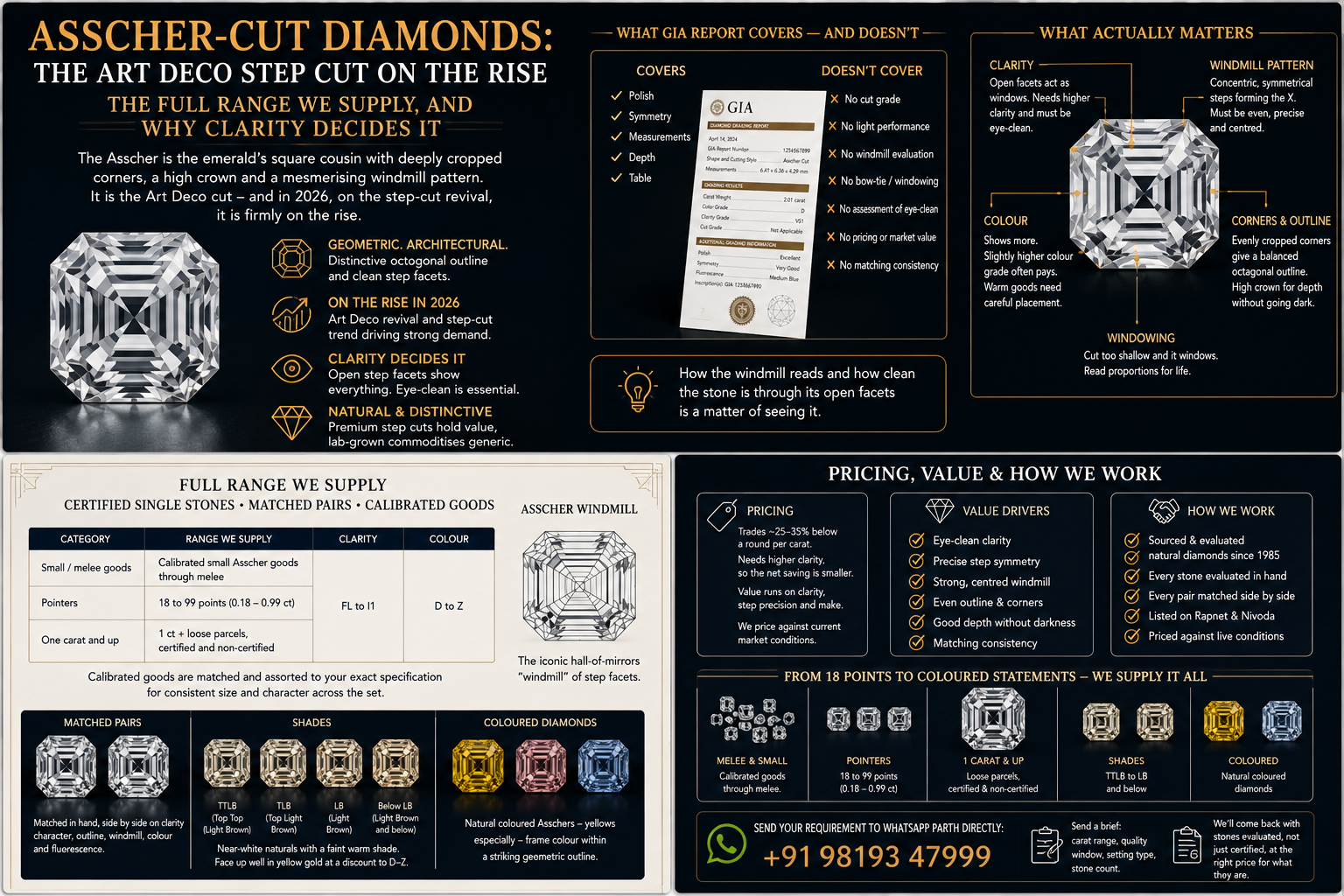
We supply the Asscher as GIA-certified single stones for centres, eye-clean-verified through the facets, and as calibrated goods where the shape is used in suites and accents. We carry the full range.
| Category | Range we supply |
| Small / melee goods | calibrated small Asscher goods through melee |
| Pointers | 18 to 99 points (0.18 – 0.99 ct) |
| One carat and up | 1 ct + loose parcels, certified and non-certified |
| Clarity | Flawless (FL) to I1 |
| Colour | D to Z |
Small and calibrated goods are assorted to a buyer’s exact specification; pointers run from 18 to 99 points (0.18 to 0.99 carat); and at one carat and above we supply Asschers as loose parcels in both certified and non-certified form. Across the range the discipline is the same — even step faceting and eye-clean selection through the parcel, and pricing kept sharp against the market.
Matched pairs
Pairs are exacting in a step cut, because what you’re matching most is clarity character and how each stone reads through its facets, on top of outline, the windmill pattern, colour and fluorescence. Two Asschers with the same clarity grade can show very different things through the table, so a pair must be selected eye-clean and matched side by side under one light. We confirm nothing as a pair until both stones have been seen together, and assess suites the same way.
Shades and coloured diamonds
Two categories sit alongside the white goods, and both matter in a step cut. The first is shade goods on the light-brown scale — TTLB (Top Top Light Brown), TLB, LB and down — near-white naturals carrying a faint warm shade; in an Asscher these need careful selection because the facets show colour, but well-chosen shade goods face up well, especially in yellow gold, at a discount to the D-Z scale. The second is natural coloured-diamond Asschers — yellows especially, where the step faceting and Art Deco outline frame the colour into something genuinely striking. We supply both.
Pricing
An Asscher trades roughly 25 to 35 percent below a round per carat, but because it needs higher clarity to look its best, the net saving is smaller once you buy the clarity the shape demands. Within Asscher, the spread runs on clarity, step precision and make: a clean, eye-clean stone with a crisp windmill sits well above a flawed or flat one that grades the same. We price against current market conditions, read where a specific stone sits, and tell you plainly when a low number reflects a clarity or cut compromise you’ll see in the stone.
How we work
Raremonds has sourced and evaluated natural diamonds since 1985, and the Asscher is a cut where our eye earns its keep, because the clarity grade on the report and what you see through the facets are not the same thing. We supply the full range: GIA-certified single stones, eye-clean-verified, calibrated goods for suites and accents, matched pairs, pointers from 18 to 99 points, certified and non-certified loose parcels at one carat and up, light-brown shade goods and natural coloured diamonds. Every stone evaluated in hand, every pair matched side by side, listed on Rapnet and Nivoda, priced against live conditions. Send a brief — carat range, quality window, setting type and stone count — and we’ll come back with stones evaluated, not just certified, at the right price for what they are.
Send your requirement to Raremonds → WhatsApp Parth directly: +91 98193 47999
The short version
The Asscher is the Art Deco step cut — square, octagonal, with a mesmerising windmill of step facets — and it’s on the rise in 2026 on the vintage-and-step-cut revival. Like all step cuts it’s clarity-led: the open facets show everything, so it needs higher clarity and must be seen eye-clean. There’s no GIA cut grade for Asscher and none coming. We supply the full range — certified single stones, calibrated goods, matched pairs, pointers 0.18 to 0.99, certified and non-certified parcels at a carat and up, shade goods and coloured diamonds — eye-clean-verified, evaluated in hand and priced to what a stone is actually worth.
FAQ
What’s the difference between an Asscher and an emerald cut?
Both are step cuts with the same hall-of-mirrors character and the same clarity-led requirements. The emerald is rectangular; the Asscher is near-square with more deeply cropped corners, a higher crown, and a more concentric, windmill-like step pattern that gives it a distinct Art Deco look.
Why does clarity matter so much in an Asscher?
Because its open step facets act as windows into the stone, so inclusions and colour show plainly and can’t hide the way they do in a brilliant way. An Asscher needs a higher clarity than a brilliant of the same intent and must be verified eye-clean rather than chosen on the clarity grade alone.
Does GIA grade the cut of an Asscher?
No, and the Asscher is not in GIA’s 2027 fancy-shape rollout, so there’s no cut grade coming. Clarity, step symmetry and the windmill pattern all have to be assessed in hand.
What sizes and parcels of Asscher do you supply?
The full range: calibrated small goods through melee, pointers from 18 to 99 points (0.18 to 0.99 ct), and one-carat-and-larger goods as loose parcels in both certified and non-certified form, in every clarity from FL to I1 and every colour from D to Z, all selected eye-clean — plus shade goods and coloured diamonds.
Do you supply matched Asscher pairs and suites?
Yes — selected eye-clean and matched side by side on clarity character, outline, step pattern, colour and fluorescence before either stone is confirmed.

.png)