

There is a version of this article that begins: “GIA is the gold standard of diamond grading.” Every diamond supplier on the internet has written it. We are not going to write it again.
If you are sourcing diamonds at trade level — for your own brand, for a manufacturing floor, for a bespoke client — you already know what a GIA certificate is. You know it matters. You also know, from experience, that two stones with identical reports can perform completely differently in a piece of jewellery. One faces up alive and bright. The other looks like it is tired.
The certificate didn’t tell you that. It never does.
This is what we actually need to talk about.
What a GIA Report Is — and What It Was Designed to Do
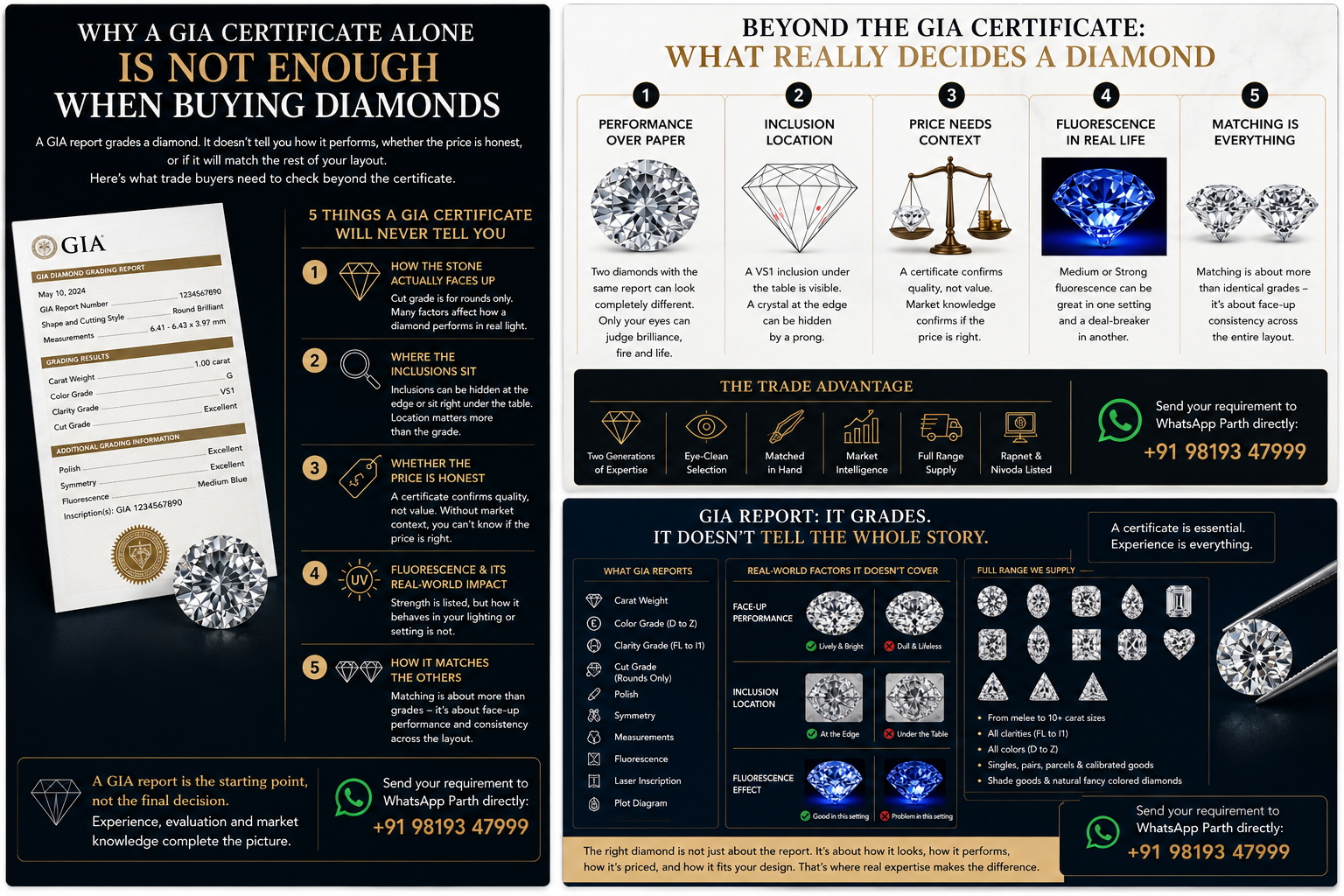
GIA created standardised diamond grading in the 1950s to solve a specific problem: there was no common language for describing diamond quality, and buyers were routinely misled. The 4Cs gave the industry a shared vocabulary. The grading report gave buyers a consistent, internationally recognised reference point that could be verified independently.
For that purpose, GIA reports are excellent. They are accurate, they are consistent, and they carry genuine weight — with clients, with customs documentation, with insurance valuers, and with resale. A GIA report is a legal and commercial document as much as a quality assessment.
But it was designed to describe a diamond, not to predict how it performs. That distinction matters enormously in trade buying, and it gets glossed over constantly.
5 Things a GIA Certificate Will Never Tell You
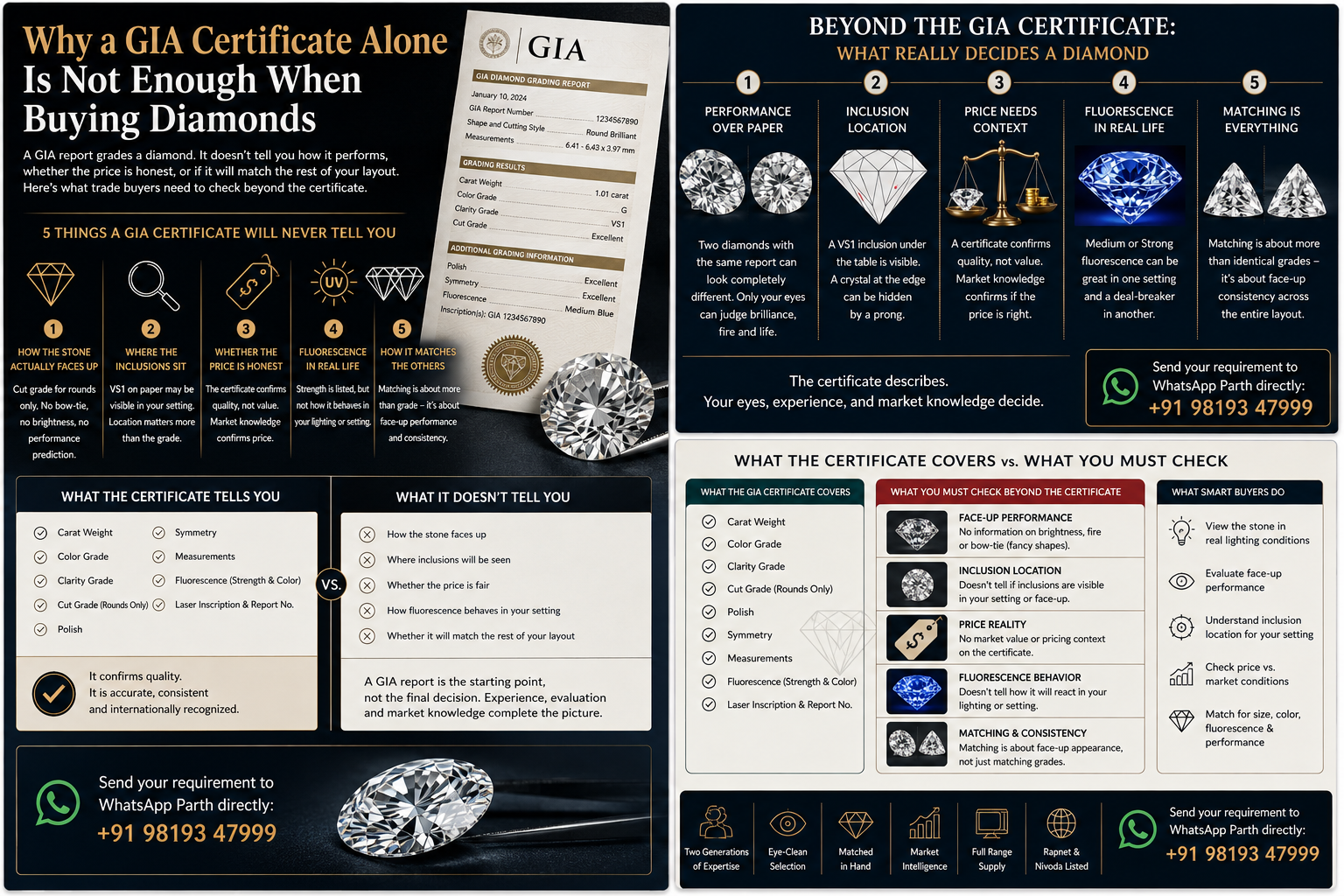
1. How the stone actually faces up
Cut grade on a GIA report covers the round brilliant only. For a round, the grade accounts for proportions, polish, symmetry, and light performance — and it is reasonably predictive of how the stone will look.
For every fancy shape — oval, pear, cushion, emerald, marquise, radiant — there is no overall cut grade. There is a symmetry grade and a polish grade, but no assessment of how the stone actually behaves under light. An oval with Very Good symmetry and Excellent polish can carry a bow-tie shadow that dominates the table. The report will not mention it.
Even within round brilliants, two Excellent cut stones can perform differently. Table percentage, crown angle, and pavilion angle interact in ways that produce meaningfully different light return — and two stones that sit within the same grading band can look different in real light, especially under the mixed diffused lighting of a jewellery store.
The certificate tells you the grade. Only looking at the stone tells you the performance.
2. Where the inclusions actually sit
A VS1 clarity grade means the inclusions are minor and difficult to detect under 10x magnification. It does not tell you whether the inclusion sits at the edge of the table — where a prong will cover it, making it effectively invisible in wear — or directly under the table, where it will catch a client’s eye the moment they look down at their hand.
An SI1 with an off-centre cloud under a bezel can outperform a VS2 with a crystal directly under the table, in any setting that will be used for that stone. The plot diagram in a GIA report gives you location, but interpreting it for a specific setting type requires experience, not just grading literacy.
For matched pairs or pave layouts, inclusion mapping becomes even more critical — a stone that grades identically to its partner on paper can still create a visual inconsistency in a finished piece if the inclusions fall differently.
3. Whether the price is honest
A certificate confirms quality. It says nothing about whether the price you are being quoted corresponds to current market conditions.
Diamond pricing — particularly at the polished level — moves with Rapaport, with rough prices at auction, with demand from specific markets, and with the availability of particular specifications at a given moment. A D VS1 3-carat oval priced at a certain Rap discount last quarter is not necessarily priced the same today. And two suppliers quoting you stones with identical certificates can be a significant percentage apart in price, for legitimate reasons that have nothing to do with quality.
Without market context, you cannot know whether a price represents good value, a tight margin, or someone capitalising on the fact that the certificate looks the same either way. This is precisely why the relationship with a supplier who is actually in the market every day matters — they know where pricing sits, and they can tell you when something is priced correctly and when it is not.
4. Fluorescence — and what it means for your specific use case
GIA reports fluorescence strength (None, Faint, Medium, Strong, Very Strong) and colour. What the report does not tell you is how that fluorescence will interact with the other stones in a matched set, or whether it will be visible in the setting environment your client actually uses.
Strong blue fluorescence in a lower-colour stone — G, H, I — can genuinely improve its face-up appearance in daylight, effectively pushing it a grade higher to the eye. In the same fluorescence band, a D or E stone can develop a slight haziness under UV-rich light that would be unacceptable in a high-jewellery piece.
Neither the grade nor the strength alone tells you which situation applies. It depends on the stone’s specific optical properties, and those have to be assessed in person.
For layouts and matched pairs, fluorescence matching is critical and often underestimated. A pave row with mixed fluorescence strengths will light up unevenly under certain conditions — something that only becomes apparent after the piece is set, which is not when you want to discover it.
5. Whether it works with the rest of your layout
A certificate grades one stone in isolation. Jewellery is not made in isolation.
For brands sourcing matched pairs, graduated suites, halo layouts, or multi-stone collections, the relevant question is never just “does this stone grade well?” — it’s “does this stone grade well and match the colour temperature, cut profile, and fluorescence behaviour of the stones it will sit beside?”
Two stones graded H colour on their respective reports can face up quite differently depending on their cut and crystal structure. A strong fluorescence in one and none in the other will read under certain lighting. A spread cushion cut beside a squarer cushion with the same grade creates visual dissonance in a suite.
Matching layouts is a skill that GIA does not grade and a certificate cannot substitute for. It requires either physically evaluating stones side by side — or working with a supplier who does that before the stones ever reach you.
What to Actually Verify When Buying on Certificate
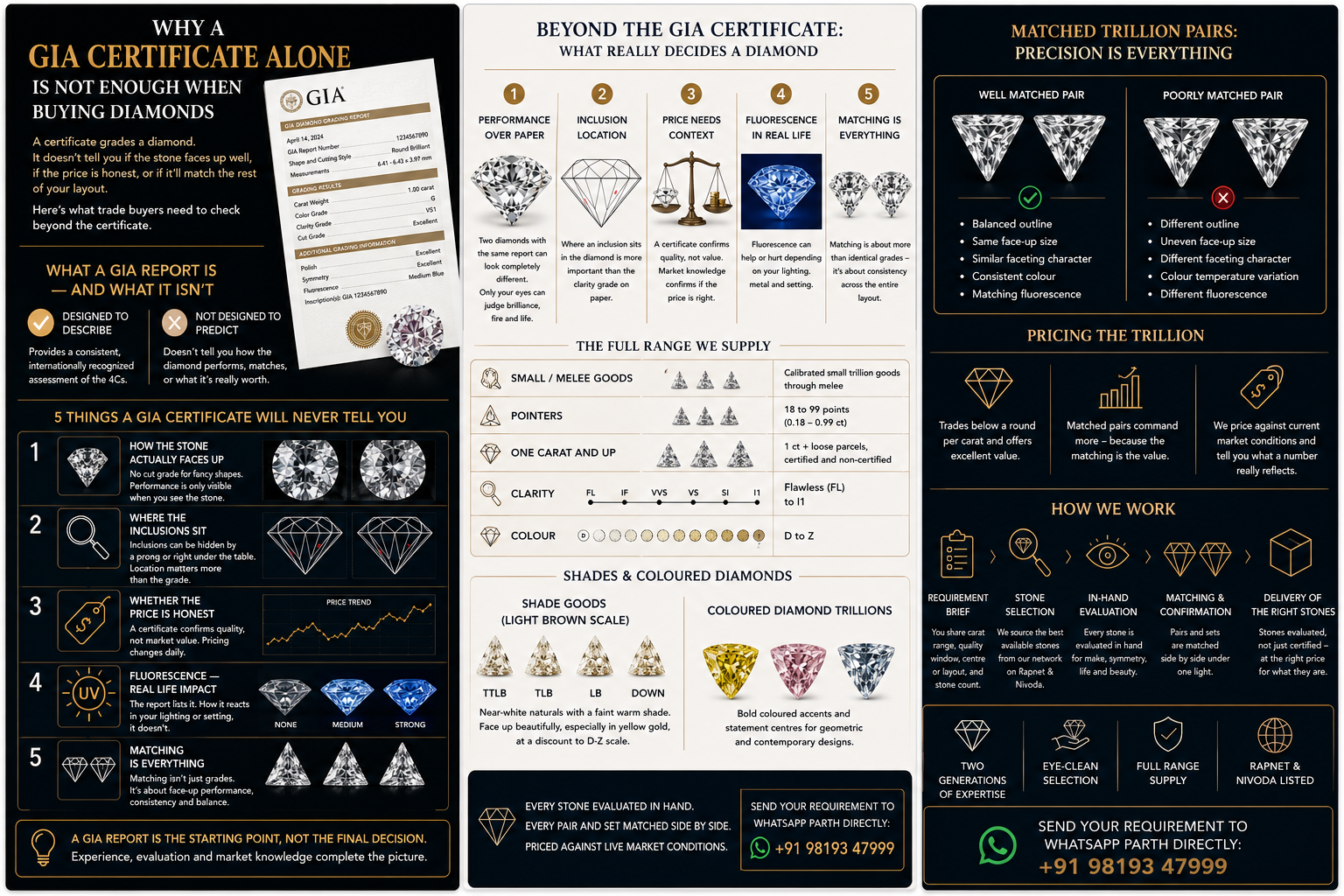
If you are buying remotely — which most trade buyers do — here is what to ask for beyond the certificate scan:
Video under multiple light sources.
A still image taken under directional studio light is styled to flatter the stone. A rotating video under diffused overhead light shows you what the stone actually does — how the bow-tie behaves in an oval, how the brilliance is distributed in a cushion, whether a step-cut emerald has the mirror-like clarity its grade suggests.
Inclusion mapping relative to your setting. Ask the supplier to tell you where the primary inclusion falls and whether it will be obscured by your intended setting. For prong, bezel, channel, or pave — the answer is different, and a supplier who knows their stones can tell you in thirty seconds.
Fluorescence context for your layout. If you are building matched pairs or a suite, fluorescence matching should be specified upfront, not discovered after purchase. Ask explicitly what the fluorescence is and whether it has been matched against the other stones in the layout.
Current market price context. Ask where the stone sits relative to Rapaport. A supplier who cannot or will not answer this question is not operating at trade level.
Origin documentation if you need it. GIA’s Country of Origin reports — a separate service from the standard grading report — provide mine-to-market traceability for clients who need to document ethical sourcing. Not every stone will have one; if provenance matters to your client or your brand, specify it upfront.
The Specific Case of Fancy Shapes
Everything above applies more acutely to fancy shapes than to rounds, because rounds at least have a cut grade that gives you some predictive power.
For ovals, pears, marquises, and cushions, the GIA report gives you proportions but no performance assessment. This means the evaluation burden sits entirely with whoever is physically looking at the stone. An experienced trade supplier will be able to tell you:
- Whether an oval’s bow-tie is faint and dynamic (acceptable) or static and heavy (a problem in most settings)
- Whether a pear’s wings are even and its culet is centred — asymmetry in a pear is obvious in a finished piece
- Whether a cushion’s chunky or crushed-ice faceting pattern suits the specific design it’s destined for
- Whether a marquise’s pointed ends have been cut with enough care to avoid chipping risk in wear
None of this is on the certificate. All of it affects whether your client is happy with the finished piece.
A Note on Lab Reports More Broadly
GIA is not the only report in circulation. IGI, HRD, EGL, and a range of other laboratories also issue grading reports, and trade buyers will encounter them regularly.
The practical reality is that grading standards vary between laboratories — sometimes significantly. An IGI VS1 and a GIA VS1 are not graded against identical criteria, and understanding where the differences lie is part of operating at trade level. Neither report is dishonest — they reflect the standards of the issuing laboratory — but a buyer who doesn’t account for inter-lab grading differences when comparing stones across reports will encounter pricing surprises.
At Raremonds, we trade across GIA, HRD, and IGI-certified stones and can advise specifically on how to interpret each report in context — including where equivalent quality sits across laboratory standards.
What This Means for How You Source
A GIA certificate is a necessary condition for buying confidently. It is not a sufficient one.
What sits alongside the certificate — market pricing knowledge, physical stone evaluation, inclusion mapping, fluorescence management, fancy-shape expertise, and layout matching — is what separates a sourcing process that produces excellent jewellery from one that produces technically correct stones that disappoint in person.
At Raremonds, we evaluate every stone before it reaches you. Not because we distrust certification — GIA’s grading is the foundation of everything we do — but because our clients are building collections and bespoke pieces where performance in the finished piece is the only metric that matters.
If you’re sourcing natural diamonds at trade level and want a supplier who can tell you what the certificate doesn’t, we’d like to hear your requirement.
Send us your specification: shape, size, quality, quantity, and setting type. We’ll respond within 24 hours with options that have been evaluated — not just certified.
Send your requirement to Raremonds → WhatsApp Parth directly: +91 98193 47999
Published by Raremonds · Natural Diamond Wholesale Supplier · BKC Mumbai Related: Bow-tie effect in oval and pear diamonds · Diamond fluorescence: what it means for value · How to verify a diamond supplier before your first order
FAQ
If two GIA reports are identical, why would I pay more with one supplier?
Because the certificate grades the stone at a point in time against standardised criteria. It doesn’t tell you how the stone is priced relative to current market conditions, whether it faces up as well as its grade suggests, or whether a supplier’s evaluation has identified anything that makes it particularly well-suited — or unsuitable — for your use case. Price differences between suppliers for identical certificates usually reflect market positioning, margin structure, or genuine quality differentiation that the certificate doesn’t capture.
For fancy shapes, is there any report that covers light performance?
GIA does not issue cut grades for fancy shapes. GCAL offers a light performance assessment as an additional report for some fancy shapes, but it is not universally available and not every supplier will have it. The most reliable evaluation remains physical inspection — your own or a trusted supplier’s.
How do I know if my supplier is actually evaluating stones or just forwarding certificates? Ask them: where is the stone physically located right now, and have you seen it in person? A supplier working from a platform listing will not be able to answer the second question. A supplier who has evaluated the stone will tell you specifically what they observed — the bow-tie behaviour, the inclusion placement, the fluorescence appearance. Vague answers are a signal.
Does Raremonds supply stones with origin documentation?
Yes, for clients where provenance matters — whether for brand positioning, client requirements, or export compliance. GIA’s Country of Origin service and additional provenance documentation are available for specific stones. Specify your requirement upfront and we will confirm availability.
What certifications does Raremonds work with?
Primarily GIA — it remains the most globally accepted laboratory for natural diamonds in the markets we serve (USA, UK, Australia, Europe). We also supply HRD and IGI-certified stones where appropriate, and we can advise on inter-lab grading differences so you’re comparing accurately across reports.

.png)