

A heavy bow-tie does not cost you a diamond. It costs you a remake, a returned piece, a client who quietly stops reordering, and the margin you priced on the assumption that a D VS1 oval would perform like a D VS1 oval. None of that is on the grading report — which is precisely why the bow-tie effect is one of the most expensive blind spots in fancy-shape sourcing.
Every oval has a bow-tie. Every pear has one too. At trade level the question is never whether it exists — it is whether it is acceptable for the piece, the client, and the price you committed to, and that is a question no certificate will answer for you. If you are sourcing fancy shapes for bespoke commissions, branded collections, or a manufacturing floor, the bow-tie is the single factor most likely to turn a correctly-graded stone into a commercial problem after it is set.
This is what it actually costs you, why it sits outside the report, and how to source against it.
What a Bow-Tie Actually Costs the Trade
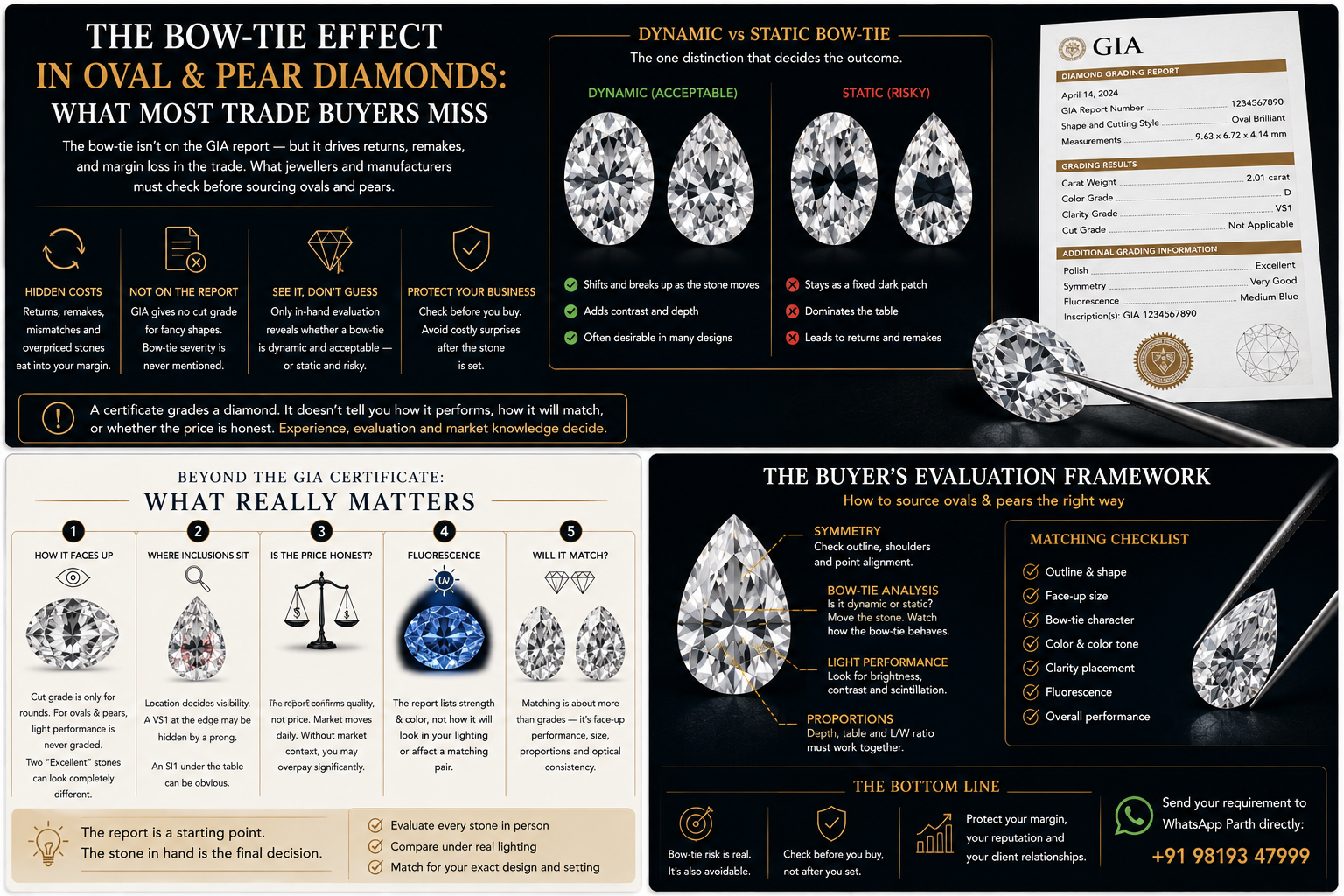
For a retail consumer, a bow-tie is an aesthetic preference. For a jeweller, manufacturer, or house, it is a business risk that shows up at the worst possible point in the cycle — after the stone is set, the piece is finished, and the client is looking at it.
A static, dominant bow-tie in a centrepiece oval is the kind of fault a client feels even when they cannot name it. The stone “looks dark” or “doesn’t sparkle like I expected,” and you are now absorbing a remake, a recut, or a return — none of which were in your margin. For a manufacturer running a collection, the problem compounds: a bow-tie inconsistency across a run of nominally identical ovals produces pieces that don’t match each other on the display tray, and the inconsistency is impossible to correct after setting.
There is also a pricing dimension that buying on certificate alone hides entirely. A D VS1 oval with a heavy static bow-tie and a D VS1 oval that faces up clean and bright are not the same asset, and they should not command the same price — yet on paper they are identical, and a buyer working from the report alone will pay the same for both. Over a sourcing programme, paying clean-stone prices for bow-tie-compromised goods is a quiet, recurring margin leak that never appears as a line item.
The cost, in other words, is not the stone. It is the remake, the return, the mismatch, the reputational hit with your own client, and the price you overpaid because the report told you the stones were equal.
Why the Bow-Tie Is Absent From the GIA Report
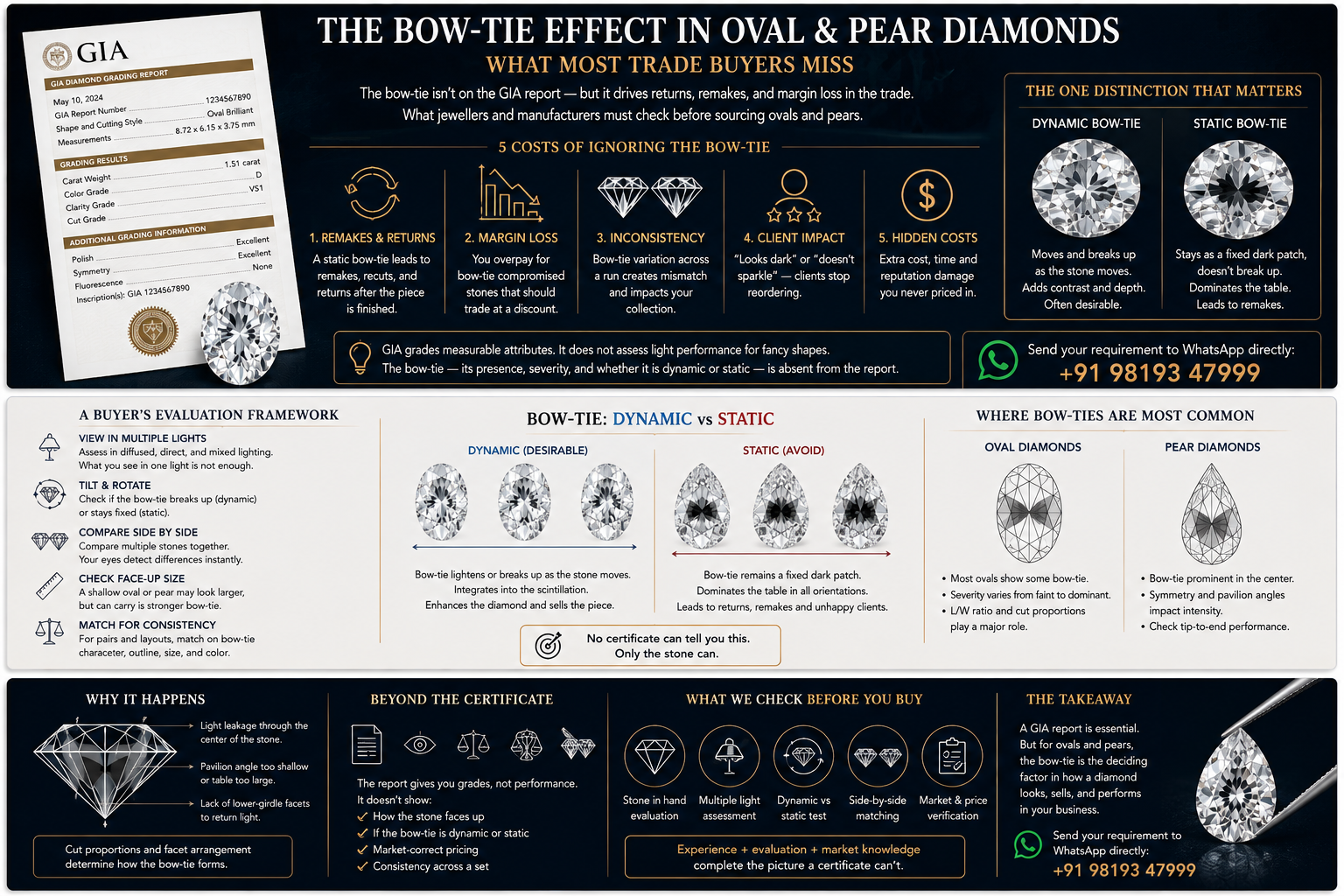
GIA assigns a full cut grade — proportions, polish, symmetry, and light performance — to round brilliants only. For every fancy shape, including ovals and pears, GIA issues a symmetry grade and a polish grade but no overall cut grade and no light-performance assessment.
The practical consequence for a trade buyer is significant: the bow-tie — its presence, its severity, and crucially whether it is dynamic or static — is entirely absent from the report. Two ovals with identical symmetry grades, identical polish, identical length-to-width ratios, and identical depth percentages can carry bow-ties of completely different commercial character. One faces up beautifully and sells. The other sits in the case. The report cannot distinguish them, which means the evaluation has to happen with the stone in hand — by you, or by a supplier you trust to do it on your behalf.
This is not a deficiency in GIA grading. The report was built to describe a stone’s measurable characteristics, not to predict how it performs in a finished piece under a client’s lighting. But it does mean that for fancy shapes, sourcing on certificate alone transfers all the visual risk onto you — and you only discover it after the piece is made.
The One Distinction That Determines Whether a Stone Is Sellable
Among everything that can be said about bow-ties, one distinction governs the commercial outcome: dynamic versus static.
A dynamic bow-tie shifts, lightens, and breaks up as the stone moves. It integrates into the stone’s overall scintillation and reads as contrast and depth — in many designs it is desirable. A static bow-tie sits as a fixed dark patch regardless of orientation or lighting. It dominates the table, it photographs as a shadow, and no setting will rescue it. One enhances the diamond and sells the piece; the other becomes your remake.
This is the assessment that matters at the point of purchase, and it is exactly the assessment a grading report cannot make for you. A supplier who has physically handled the stone can tell you in one sentence which one it is. A supplier forwarding a platform listing cannot — they are guessing from the same photograph you are.
A Buyer’s Evaluation Framework
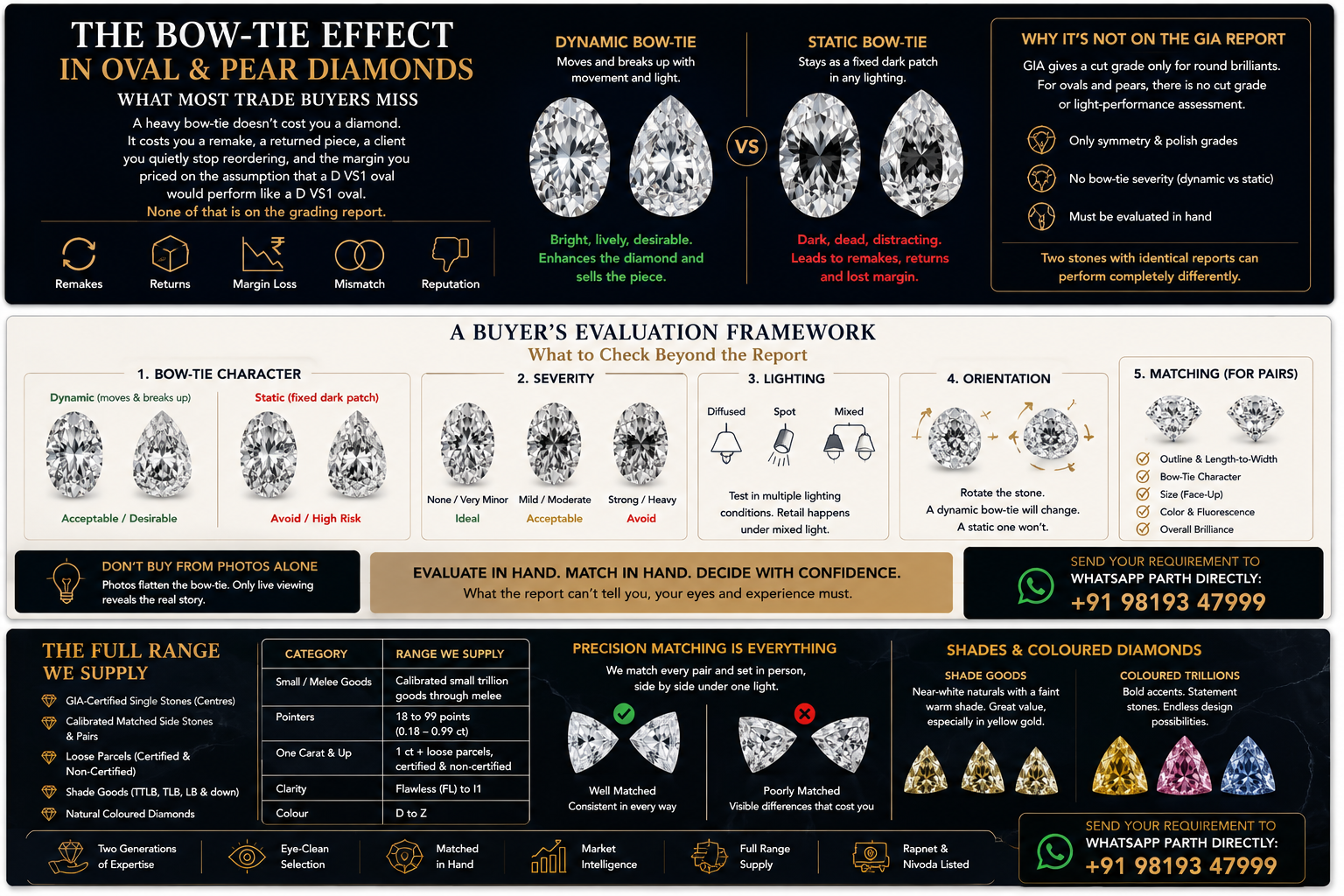
You do not need to re-cut diamonds to source them well — but you do need a framework for what drives bow-tie severity, so you can specify it, price it, and reject what doesn’t meet your standard. These are the factors that matter commercially.
Length-to-width ratio. More elongated stones carry a longer central zone where light leakage is structurally more likely. An oval at 1.50 or higher needs more scrutiny in that zone than one at 1.35. Elongated ovals are often exactly what a client wants, so the point is not to avoid them — it is to demand higher cutting quality in the centre as elongation increases, and to price accordingly.
Depth and pavilion angle. Shallow stones leak light and worsen the bow-tie; over-deep stones go dark throughout and mask it behind general underperformance. The commercially important fact is that cutters maximising weight retention from rough routinely sacrifice the pavilion angles that control the bow-tie — which means a stone whose proportions look acceptable on paper can still carry a pronounced bow-tie the report never hints at.
Wing symmetry in pears. In pears specifically, uneven shoulders direct light differently on each side and exaggerate the bow-tie. A pear with mismatched wings will almost always show a heavier, less balanced shadow than a well-cut stone with matched shoulders — and this is immediately visible to an experienced eye and completely invisible on the report. For pears, wing symmetry and culet centring should be part of every sourcing conversation.
Where Trade Buyers Lose Money
Buying on a single studio video. The bow-tie is extraordinarily lighting-sensitive. Directional studio lighting — the standard for platform listings — floods the central zone and masks the shadow. The same stone under diffused overhead light or a store’s ambient conditions can show a markedly heavier bow-tie. A single flattering video is not evaluation; it is marketing. For any centrepiece oval or pear, require video under diffused overhead light, not just directional studio light.
Treating symmetry grade as a proxy. An Excellent symmetry grade tells you the facets are well-aligned to each other. It does not tell you those facets return light acceptably at the centre. Symmetry grade and bow-tie severity are independent variables — an Excellent-symmetry oval can carry a heavy static bow-tie. Sourcing decisions made on symmetry grade alone are made on the wrong number.
Ignoring it in melee and side stones. The bow-tie is most discussed for stones a carat and up, but it is equally present in the 0.30–0.70ct ovals and pears used in pairs, drops, and side-stone layouts. A bow-tie mismatch between two 0.50ct ovals flanking a centre stone is glaring in the finished piece and impossible to fix after setting. For matched pairs and layouts, bow-tie character has to be matched — not just grade.
Not specifying tolerance in the brief. Most sourcing briefs never mention the bow-tie, which hands the entire judgment to whoever pulls the stone — and not every supplier physically evaluates what they ship. If you are sourcing a significant oval or pear, state your standard explicitly: dynamic only, faint and shifting under diffused light, or matched character across a pair. A supplier who cannot respond to that specification with confidence has not looked at the stone — and that tells you everything about the sourcing risk you are carrying.
How to Source Against It — A Practical Checklist
Color Diamonds Collections:
Natural Yellow Diamonds | Natural Pink Diamonds | Natural Blue Diamonds | Natural Green Diamonds | Natural Brown Diamonds | Natural Chameleon Diamonds | Natural Purple Diamonds | Natural Orange Diamonds | Natural Gray Diamonds
Diamond Shaped Collections:
Natural Round Brilliant Diamonds | Natural Pear Shaped Diamonds | Natural Oval Diamonds | Natural Marquise Diamonds | Natural Radiant Cut Diamonds | Natural Emerald Cut Diamonds | Natural Cushion Cut Diamonds
Whether you buy from Raremonds or anyone else, these are the questions that separate a supplier who evaluates from one who forwards listings:
- Is the bow-tie dynamic or static, and how prominent is it at the widest point of the stone?
- Can you provide video under diffused overhead light, not only studio directional lighting?
- For pears: are the wings symmetrical and the culet centred?
- For pairs and layouts: has the bow-tie character been matched across the stones, not just the grade?
- Can you supply on memo or returnable terms so I can evaluate the stone in my own light before committing?
- If I reorder this stone for a repeat run, can you match its bow-tie character, not just its specification?
A supplier operating at trade standard answers these immediately and specifically. A reseller working from a screen hedges. The difference is your remake rate and your margin.
The Raremonds Position on Fancy-Shape Sourcing
Raremonds does not source fancy shapes on certificate alone. Every oval and pear we supply is physically evaluated — for bow-tie character, wing symmetry in pears, cut profile relative to the intended setting, and fluorescence behaviour — because these are the factors that determine whether a finished piece exceeds your client’s expectations or comes back to your bench.
With two generations in the natural diamond trade, we have evaluated enough ovals and pears to price and select them on how they actually perform, not on how they read on paper. That means we will tell you when a cheaper certificate hides a bow-tie that will cost you a remake, and when a stone a grade down faces up cleaner and sells better — and we price fancy shapes on their real performance, so you are not paying clean-stone money for compromised goods.
For trade buyers, this is also a risk-management relationship. We supply matched pairs and layouts selected for consistent bow-tie character across every stone, we hold and reproduce fancy-shape specifications across repeat orders so a collection that sells can be reordered without mismatch, and we work to your stated bow-tie tolerance rather than leaving the judgment to chance. The goal is simple: the stone performs in the finished piece, the first time and every reorder after.
Send Us Your Requirement
Sourcing ovals or pears for bespoke commissions, branded collections, or matched pairs? Send us your specification — shape, size, quality window, bow-tie tolerance, setting type, and quantity. We’ll respond within 24 hours with options evaluated for bow-tie character and face-up performance — not just certified — and we can supply for evaluation before you commit to volume.
Send your requirement to Raremonds → WhatsApp Parth directly: +91 98193 47999
Frequently Asked Questions
How does the bow-tie effect affect the trade price of an oval or pear?
It should affect it significantly, even though the certificate doesn’t reflect it. Two stones with identical grades but different bow-tie character are not equivalent assets, and a heavy static bow-tie should carry a meaningful discount against a clean-facing stone of the same grade. Buyers sourcing on certificate alone routinely pay clean-stone prices for compromised goods — a recurring margin leak that only a supplier who evaluates and prices on performance will protect you from.
Can I evaluate fancy shapes on memo before committing to a volume order?
You should insist on it for any significant fancy-shape purchase. Because the bow-tie is lighting-sensitive and absent from the report, evaluating the stone under your own lighting — or in a finished sample piece — is the only reliable way to confirm it performs before you commit a production run to it. A supplier confident in their goods will support evaluation or returnable terms; one who resists is a signal worth heeding.
How do you ensure bow-tie consistency across a production run or a reorder?
Consistency across a run depends on the supplier selecting against the bow-tie character of the whole set, not pulling individual stones that each meet a grade in isolation. For reorders, it depends on the supplier’s sourcing depth to reproduce not just the specification but the visual behaviour of the original stones. Before building a SKU around a fancy shape, confirm your supplier can match bow-tie character across both the initial run and future reorders — most cannot.
What’s the right way to specify bow-tie tolerance in a sourcing brief?
Be explicit and commercial about it: state that you require a dynamic bow-tie only, that the bow-tie should be faint and shifting under diffused light, or that you need matched bow-tie character across a pair or layout. A supplier who physically evaluates their stones will confirm compliance against that standard directly. One who cannot answer the question has not looked at the stone — and you are carrying that risk into your finished piece.
Who carries the risk if a stone’s bow-tie isn’t as represented?
That depends entirely on your supplier terms, which is why they matter as much as the stone. Sourcing on certificate from a platform listing leaves the visual risk with you, discovered only after setting. Working with a supplier who physically evaluates the stone, represents its bow-tie character specifically, and stands behind that representation shifts the risk to where it belongs — with the party who actually inspected the goods. Clarify this before you buy, not after.

.png)