

Most people find the Dutch marquise by accident. They are researching marquise engagement rings, an unfamiliar silhouette appears in the results, and they spend the next half hour trying to work out why it looks so different from every marquise they have seen. The answer is in the sides.
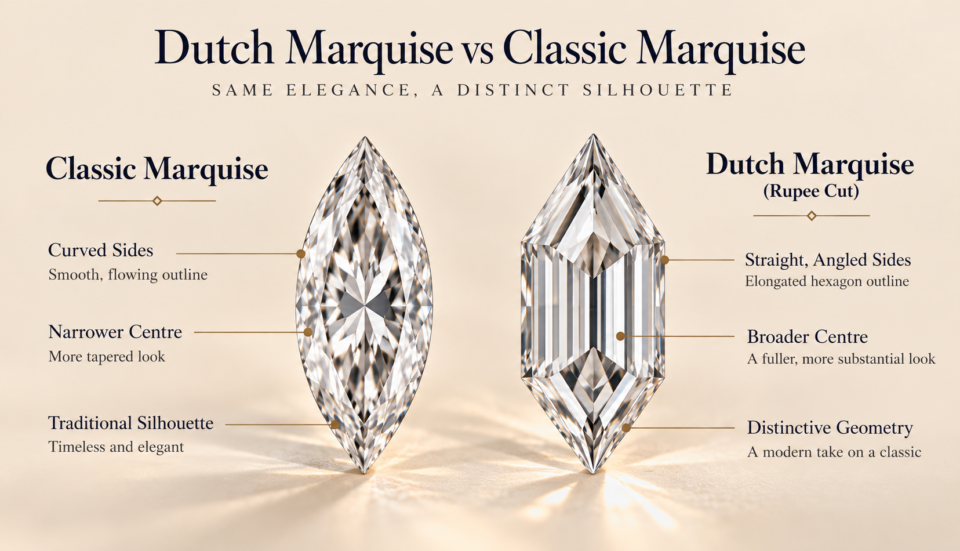
A classic marquise sweeps from point to point in two smooth curves. The Dutch marquise replaces those curves with straight, angled edges, so the outline becomes an elongated hexagon with a pointed tip at each end and a noticeably fuller centre. Same family, different architecture, and in 2026 one of the fastest-rising specialty cuts in bridal.
We have cut, sourced and matched marquise goods across two generations at Raremonds, and the Dutch marquise is a shape we now get asked about weekly, by retailers building a point of difference and by private clients who want the elongation of a marquise without the sharpness. This guide covers what the cut is (and is not), why it is trending, the supply reality nobody explains, and exactly what to look for whether you are buying one stone or stocking a case.
What a Dutch marquise diamond is
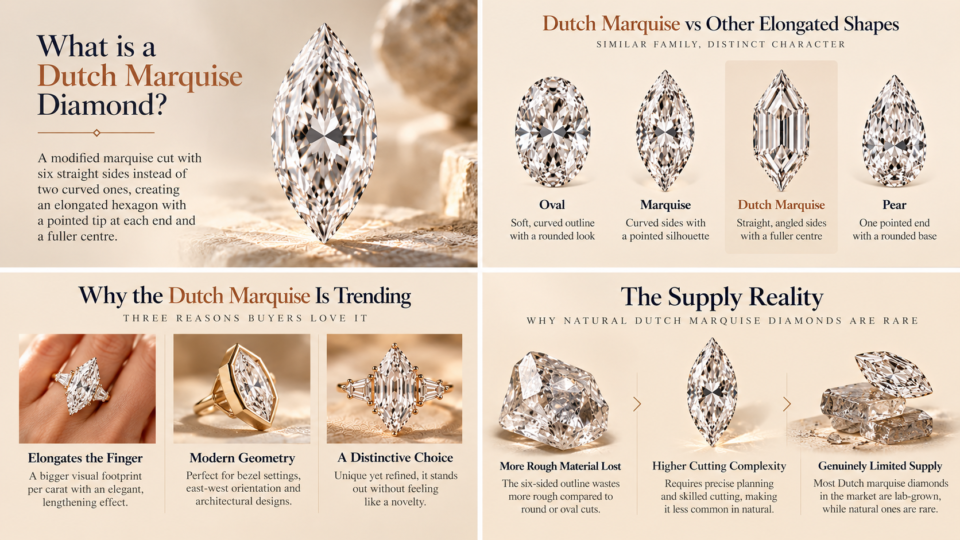
A Dutch marquise diamond is a modified marquise cut with six straight sides instead of two curved ones. Picture a classic marquise, then flatten each long curve into two angled planes meeting at the stone’s widest point. The result reads as an elongated hexagon: two sharp ends, four clean angled edges, and a broader belly than a standard marquise carries. Faceting is typically brilliant, so the stone sparkles like a marquise rather than glowing like a step cut, although step-cut versions exist and are gaining ground for buyers who want the hall-of-mirrors look inside this outline.
Three facts a buyer should know from the start:
It Is Not a GIA-Standardised Shape
It is not a GIA-standardised shape. A laboratory report will describe it by measurements and typically as a modified marquise or hexagonal modified brilliant; you will not see “Dutch marquise” printed as a shape category. That is normal for specialty cuts and not a red flag.
It Has a Second Name: The Rupee Cut
It has a second name: the rupee cut. The elongated lozenge motif on historic Indian rupee coinage shares the same outline, and some jewellers use the terms interchangeably. It also gets confused with the elongated hexagon cut, which shares the silhouette but is usually cut with different faceting and less brilliance.
Proportions Vary by Cutter
Because it is not standardised, proportions vary by cutter. Two Dutch marquises of the same weight can differ in ratio, belly width and tip angle. That variation is part of the appeal (no two are identical) and part of the buying discipline (you must see the outline, not just the numbers).
Why the Dutch marquise is trending in 2026
The cut is riding three currents at once.
The Elongated-Shape Wave
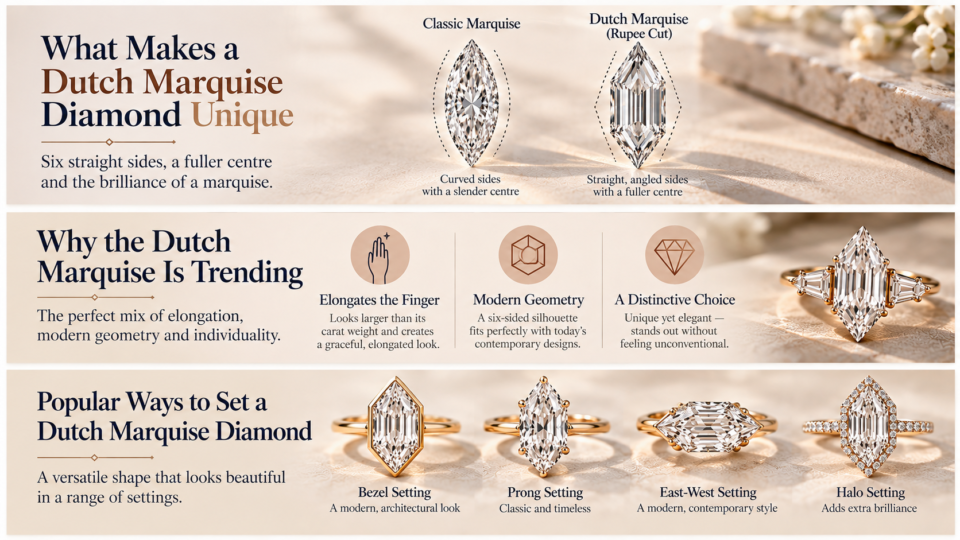
The first is the elongated-shape wave. Ovals, pears, marquises and their hybrids are the most requested engagement ring shapes of 2026, because they lengthen the finger and read larger than their carat weight. The Dutch marquise delivers all of that with a bigger visual footprint per carat than almost anything else, because its straight sides push the outline wider at the centre.
The Appetite for Geometry
The second is the appetite for geometry. Bezel settings, east-west orientation, architectural bands and Art Deco references are the design language of the moment, and a six-sided stone sits inside that language far more naturally than a curved one. Set east-west in a yellow-gold bezel, a Dutch marquise looks like it was designed for 2026.
Individuality
The third is individuality. Buyers who find the round too common and the oval too widely worn want something with a story that is still elegant rather than eccentric. The Dutch marquise is exactly that: distinctive enough to prompt the question “what is that?”, refined enough never to look like a novelty.
The supply reality nobody explains
Here is the part most guides skip, and it matters for anyone buying natural. The Dutch marquise revival has been supplied overwhelmingly by lab-grown producers. The reason is economic: natural cutters plan every stone to maximise weight from the rough crystal, and a six-sided elongated outline wastes more material than a round or a standard oval. Lab-grown rough is cheap and plentiful, so growers can chase a specialty trend within months. Natural cutters cannot justify it unless a client is paying for the shape.
The consequence is that natural Dutch marquise diamonds are genuinely scarce, and most “Dutch marquise” listings online are lab-grown. For a buyer who wants the shape in a natural diamond, there are two honest routes: find one of the few natural stones already cut (usually through a specialist rather than a marketplace), or have one cut to order from suitable rough or recut from an existing elongated stone.
We do both, and we will always tell you which route makes sense for your budget and timeline. A natural Dutch marquise carries a premium for rarity of supply, not for the cutting style itself, and that distinction should be explained to you plainly before you pay it.
How to buy a Dutch marquise: the consumer checklist
Decide Your Ratio Before You Shop
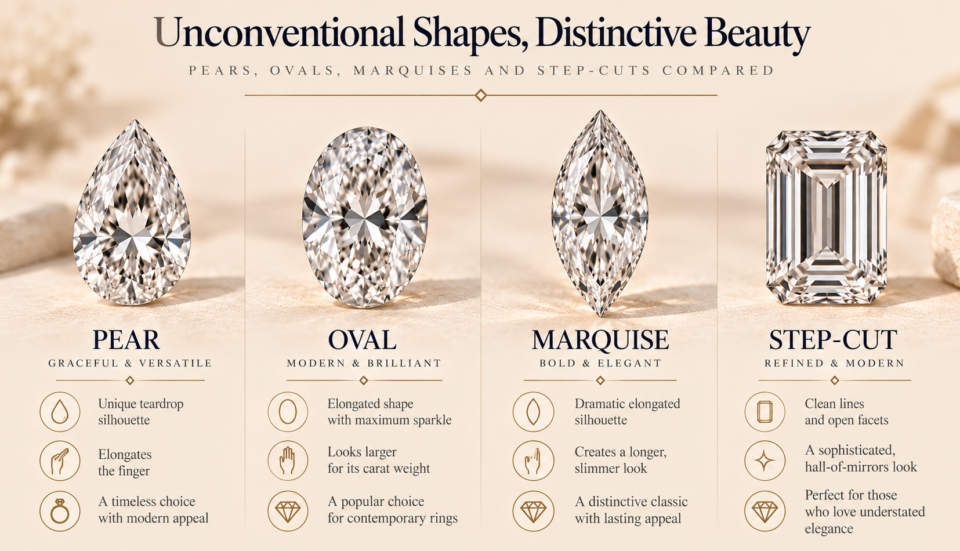
Decide your ratio before you shop. Dutch marquises run shorter and fuller than classic marquises (which sit around 1.85 to 2.1 length-to-width). Many Dutch cuts sit lower, with a wider centre. Longer reads more dramatic; shorter reads more like a hexagon. Ask for the ratio and look at the outline on video against a ruler.
Insist on Symmetry
Insist on symmetry. Six straight sides mean six chances to be uneven. Both tips must sit on the centre line, the two halves must mirror, and the angled edges must match pair by pair. A slightly lopsided hexagon is far more visible than a slightly lopsided oval.
Check the Bow-Tie
Check the bow-tie. It is an elongated brilliant, so a dark bow-tie across the centre is possible. You want a dynamic one that shifts as the stone moves, not a fixed shadow. Video under normal light, not a sparkle reel, will show you which you have.
Protect the Points
Protect the points. Two sharp tips chip if left exposed. V-prongs, a bezel or a half-bezel are the correct settings; a plain four-prong on a Dutch marquise is a repair waiting to happen.
Colour and Clarity
Colour and clarity behave like other elongated cuts. Colour shows a little at the tips, so G to H is comfortable in white metal and H to J looks beautiful in yellow gold. Clarity needs to be eye-clean; the fuller centre shows a feature under the table more readily than a narrow marquise would.
Confirm Natural or Lab-Grown Origin
Ask whether the stone is natural or lab-grown, and ask for the report. Given how much of this category is lab-grown, this is the single most important question, and a certificate that states origin is the answer.
How to stock it: the retailer view
Position the Dutch Marquise as a Point-of-Difference Stone
The Dutch marquise is a point-of-difference stone, not a volume stone. It sells to the client who has already rejected the round and the oval, so one or two well-chosen pieces in the case earn more than a tray of them. Pair it with settings that show off the geometry: bezels, east-west solitaires, Deco-style shanks.
Educate Staff on Ratio and Symmetry
Educate staff on the ratio and symmetry points above, because the sale is made on explaining why this outline differs from a standard marquise. And decide your natural-versus-lab position honestly and state it on the tag; buyers in this category ask, and they trust the store that answers before being asked.
Plan Lead Time for Natural Dutch Marquise Stock
For natural Dutch marquise stock, plan lead time. The realistic model is cut-to-order or recut-to-match rather than off-the-shelf, which is where a supplier with custom-cut and made-to-spec capability replaces a search bar.
Pricing
Natural Dutch Marquise Pricing
Natural Dutch marquise pricing has two components: the underlying stone (priced like any elongated fancy shape, below a round of the same weight) and a scarcity premium for the outline, which reflects limited supply and the rough cost of cutting it.
How Raremonds Prices Dutch Marquise Diamonds
There is no list. We price against comparable elongated goods, show the premium explicitly, and tell you when a classic marquise or a moval would give you the same presence for less.
How Raremonds helps
Natural Dutch Marquise Diamonds
We supply the Dutch marquise the honest way: the few natural stones we can source through our network, cut-to-order through our custom-cut service for clients who want the exact ratio and belly width, and recut-to-match when a Dutch marquise needs a partner for earrings or a suite. Every stone is checked for symmetry across all six sides, bow-tie behaviour and tip integrity, documented on video under standard light, natural and untreated, and screened for laboratory growth regardless of its paper. If the right answer for your budget is a different elongated cut, we will say so.
Send your requirement to Raremonds → WhatsApp Parth directly: +91 98193 47999
Looking for Bespoke Diamond Services Contact us here
The short version
The Dutch marquise is a marquise with straight, angled sides, an elongated hexagon with pointed ends and a fuller centre, also called the rupee cut. It is trending because it delivers the elongation buyers want with the geometry designers want, and it reads larger than its weight. It is not GIA-standardised, so proportions vary and symmetry must be checked by eye. Supply is dominated by lab-grown; natural stones are scarce and usually cut to order. Buy on ratio, six-sided symmetry, bow-tie behaviour and a protective setting, and always confirm origin on the report.
FAQ
What is a Dutch marquise diamond?
A modified marquise with six straight, angled sides instead of two curves, giving an elongated hexagonal outline with pointed ends and a fuller centre. It is also known as the rupee cut and is not a GIA-standardised shape.
Dutch marquise vs regular marquise: what is the difference?
The sides. A regular marquise curves smoothly from tip to tip; a Dutch marquise uses straight angled edges. The Dutch version usually sits at a lower length-to-width ratio with a wider belly, reads more geometric, and spreads more across the finger.
Is a Dutch marquise rare?
In natural diamond, yes. Most Dutch marquise stones on the market are lab-grown, because the outline wastes rough and natural cutters rarely produce it unless it is ordered. Natural stones are usually cut to order or sourced through specialists.
Does a Dutch marquise have a bow-tie?
It can, like any elongated brilliant. A well-cut stone shows a dynamic bow-tie that moves with the stone; a poorly cut one shows a fixed dark band. Check on video under normal light.
What setting suits a Dutch marquise?
Anything that protects the two points: V-prongs, a full bezel or a half-bezel. East-west orientation and yellow-gold bezels suit the geometry particularly well.
Can Raremonds cut a natural Dutch marquise to order?
Yes, through our custom-cut service, to your ratio and outline, and we can recut an existing elongated stone into a Dutch marquise or match one for a pair.

.png)