

Where Marquise Sits in 2026 — and Why Well-Cut Goods Command a Premium
The marquise revival is real and dramatic, driven by elongated shapes, vintage aesthetics, celebrity stones, and social media bringing the navette to a generation that never considered it. Here’s what buyers need to understand: marquise is right now the most expensive fancy shape — not because fancies have overtaken round, but because cutting one well is genuinely hard. It wastes significant rough, and clean symmetry across two points with a controlled bow-tie demands real craftsmanship. Demand surged while well-cut supply stayed tight. A well-cut marquise faces up 15-20% larger than a round of the same weight. Average commercial-cut goods still trade below round per carat — it’s the well-cut, two-carat-plus stones the trend wants that command real premiums.
What GIA’s Report Covers — and the 2027 Cut Grade
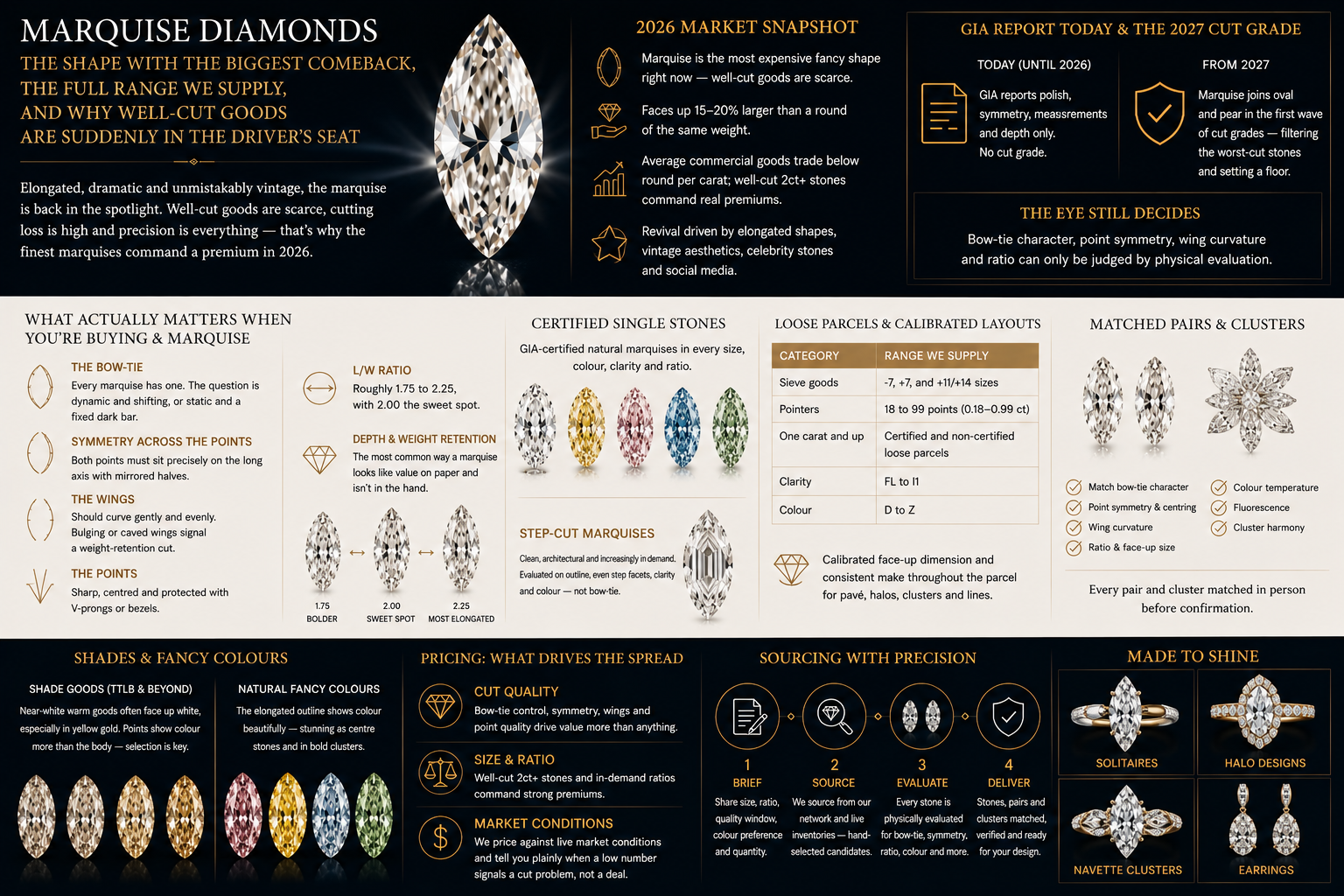
GIA issues no cut grade for marquise today — polish, symmetry, measurements, and depth only. Marquise is in the first wave of incoming cut grades, alongside oval and pear, from 2027 — meaningful progress for the hardest elongated brilliant to cut. It won’t replace the eye reading bow-tie character, point symmetry, wing curvature, and ratio. Physical evaluation remains the only reliable assessment through 2026 and beyond.
What Actually Matters When You’re Buying a Marquise
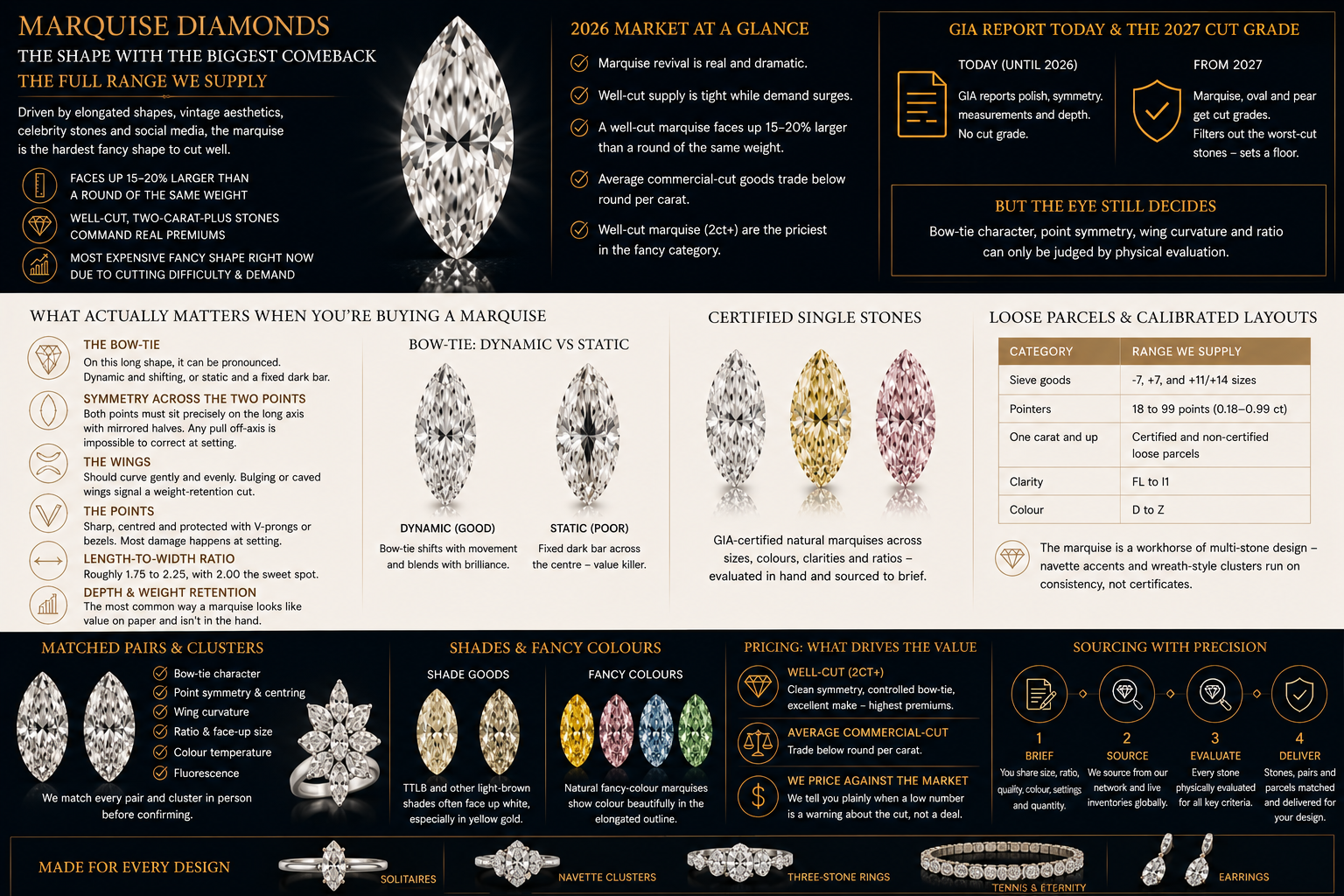
The bow-tie — on this long a shape, it can be pronounced; dynamic and shifting, or static and a fixed dark bar. Symmetry across the two points — both must sit precisely on the long axis with mirrored halves; any pull off-axis is impossible to correct at setting. The wings — should curve gently and evenly; bulging or caved wings signal a weight-retention cut. The points — sharp, centred, and protected with V-prongs or bezels, since most damage happens at setting. Length-to-width ratio — roughly 1.75 to 2.25, with 2.00 the sweet spot. Depth and weight retention — the most common way a marquise looks like value on paper and isn’t in the hand.
Color Diamonds Collections:
Natural Yellow Diamonds | Natural Pink Diamonds | Natural Blue Diamonds | Natural Green Diamonds | Natural Brown Diamonds | Natural Chameleon Diamonds | Natural Purple Diamonds | Natural Orange Diamonds | Natural Gray Diamonds
Diamond Shaped Collections:
Natural Round Brilliant Diamonds | Natural Pear Shaped Diamonds | Natural Oval Diamonds | Natural Marquise Diamonds | Natural Radiant Cut Diamonds | Natural Emerald Cut Diamonds | Natural Cushion Cut Diamonds
Certified Single Stones
For solitaires and centrepieces, we supply GIA-certified natural marquises across sizes, colours, clarities, and ratios — evaluated in hand and sourced to the ratio the brief calls for.
Loose Parcels and Calibrated Layouts
| Category | Range We Supply |
| Sieve goods | -7, +7, and +11/+14 sizes |
| Pointers | 18 to 99 points (0.18–0.99 ct) |
| One carat and up | Certified and non-certified loose parcels |
| Clarity | FL to I1 |
| Colour | D to Z |
The marquise is a workhorse of multi-stone design — navette accents and the classic wreath-style clusters built on marquise and pear goods run on consistency, not certificates.
Matched Pairs and Clusters
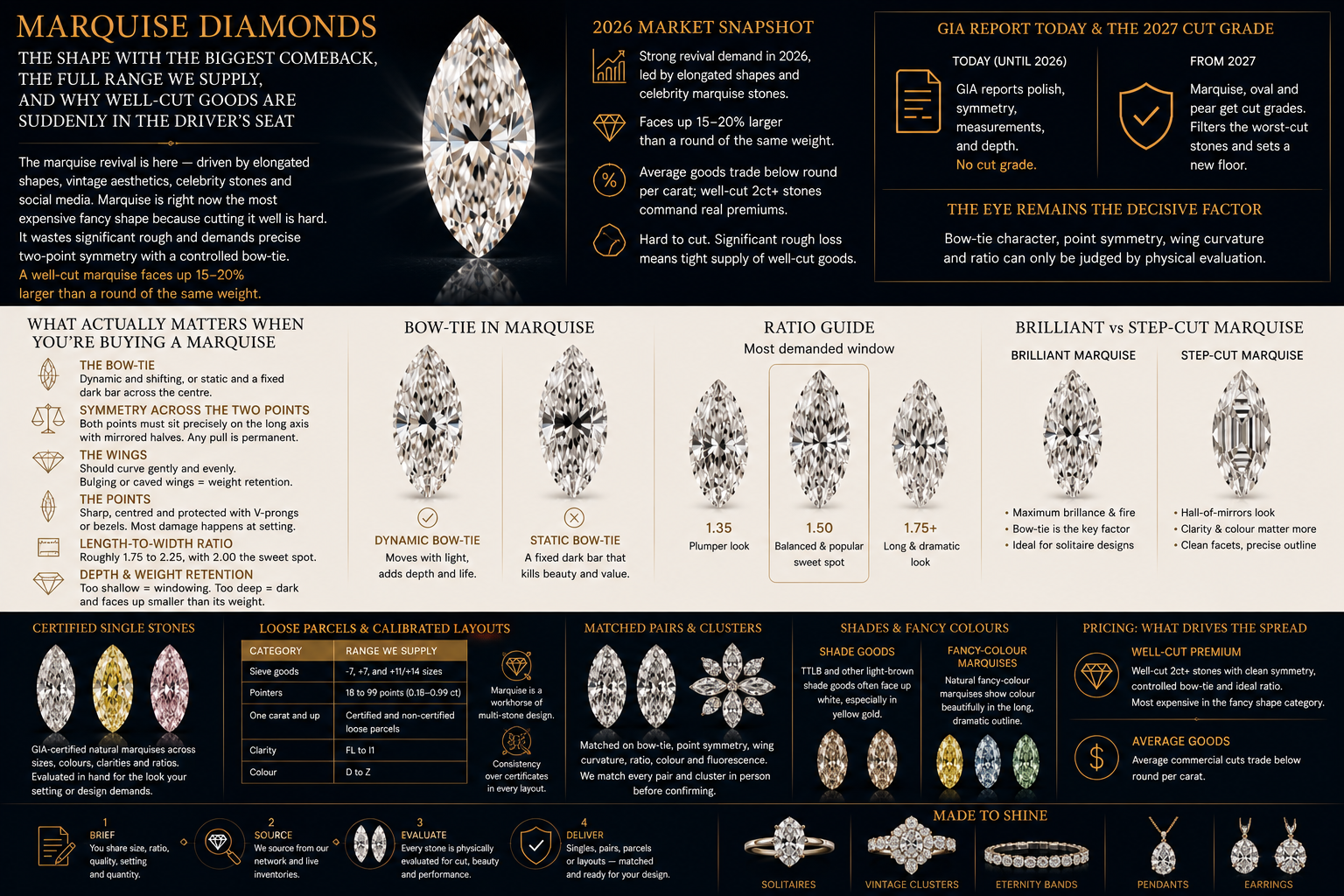
Among the most demanding matching jobs in the trade — bow-tie character, point symmetry and centring, wing curvature, ratio, colour temperature, and fluorescence all compounding across two stones at once. The same applies to marquise-and-pear clusters, where every stone in the layout has to agree, not just on paper. We match every pair and cluster in person before confirming.
Shades and Fancy Colours
TTLB and other light-brown shade goods often face up white, especially in yellow gold — though the points show colour more than the body, so reading which shade goods face up clean is a judgement call. We also supply natural fancy-colour marquises, where the long, dramatic outline shows colour beautifully as a centre or bold cluster accent.
Pricing
Pricing is unusually two-sided: average commercial-cut goods trade below round per carat, while well-cut larger stones — two-carat-plus, clean symmetry, controlled bow-tie — are the priciest in the fancy category. We price against current market conditions and tell you plainly when a low number is a warning about the cut, not a deal.
FAQ
Why is marquise the most expensive fancy shape right now?
Strong revival demand meeting tight supply of well-cut goods. Cutting one well wastes significant rough and demands precise two-point symmetry, so well-cut stones at two carats and up are scarce and priced from strength.
Does GIA grade marquise cut?
Not yet — confirmed coming alongside oval and pear from 2027. Bow-tie, point symmetry, and wing curvature still need reading in hand.
What ratio is best for a marquise?
Roughly 1.75 to 2.25, with 2.00 the sweet spot. Lower reads stubbier; higher reads dramatic but raises the cutting bar.
What sizes do you supply?
The full range — sieve goods through melee, pointers 0.18 to 0.99ct, and certified or non-certified parcels at a carat and up across FL-I1 and D-Z.
Do you supply shade goods and fancy-colour marquises?
Yes — light-brown shade goods that often face up white, and natural fancy-colour marquises that show colour particularly well in the elongated outline.
Do you supply matched pairs and clusters?
Yes — single stones, matched pairs, navette goods for marquise-and-pear clusters, and graduated suites, all matched in hand on bow-tie, symmetry, wings, colour, and fluorescence before confirmation.

.png)