

One engagement ring did more for antique cushions than a decade of trade shows. When the most famous ring of 2025 turned out to be a roughly ten-carat antique elongated cushion, searches for old mine cut diamonds spiked by nearly a thousand percent within hours, and the head of jewellery at a major auction house called 2026 the year of the antique cushion-cut engagement ring. Vogue’s 2026 coverage now lists elongated antique cushions alongside ovals and marquises as the shapes defining the season.
That attention has created a market with real money moving through it and very little clear information. “Elongated cushion” and “old mine cut” are being used interchangeably online, and they are not the same thing. A buyer who does not know the difference will pay antique money for a modern stone, or modern money for a stone that should never have been recut. We have handled antique and elongated cushions across two generations at Raremonds, and this guide sets out what each term actually means, why the demand is real rather than a fad, and how to buy well as a consumer or a retailer.
Three Stones That Get Called the Same Thing
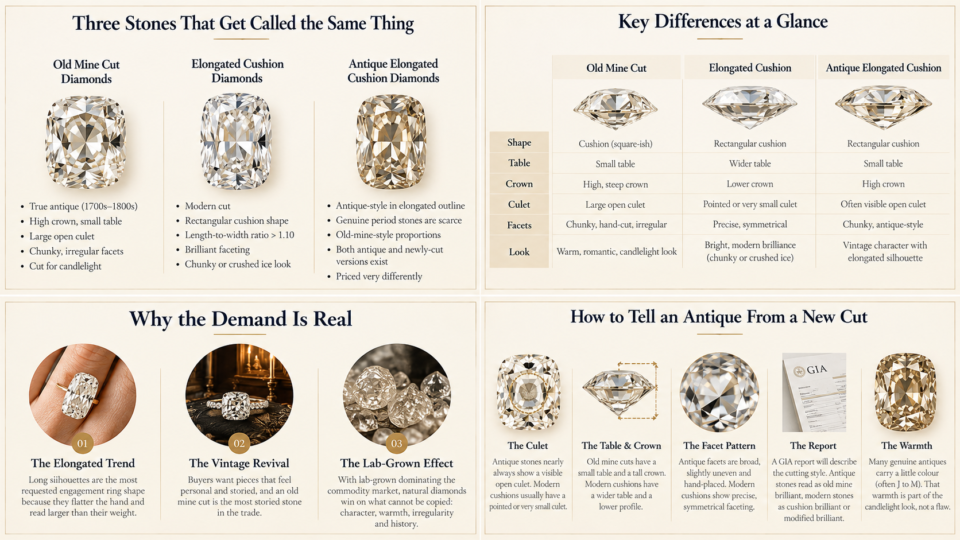
Old Mine Cut Diamonds
The old mine cut is the true antique: a cushion-shaped diamond cut by hand between roughly the 1700s and the late 1800s, before electric light or modern proportion theory. Its signature is a high crown, a small table, a large open culet that shows as a small circle at the centre, and chunky, irregular facets that throw broad flashes rather than fine sparkle. Every one is slightly different because every one was shaped by eye to its rough. It was cut for candlelight, and that is still the light it performs best in.
Elongated Cushion Diamonds
The elongated cushion is a modern cut: a rectangular cushion, usually with a length-to-width ratio above about 1.10, brilliant-faceted for maximum light return, and either “chunky” (broad flashes) or “crushed ice” (fine shimmer) in character. It is a contemporary shape that happens to share a soft-cornered outline with the antique.
Antique Elongated Cushion Diamonds
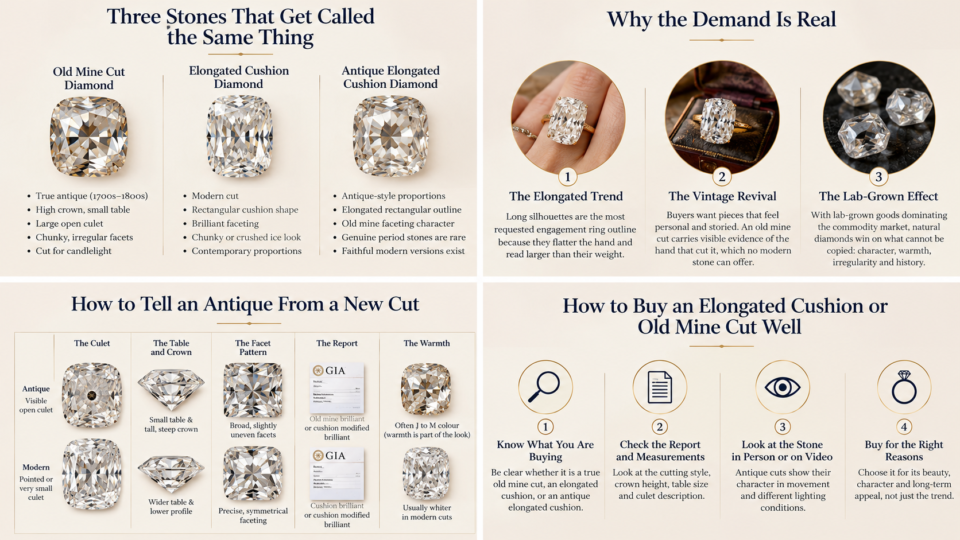
The antique elongated cushion is where the two meet, and it is the stone the celebrity ring made famous: old-mine-style proportions and faceting in an elongated rectangular outline. Genuine period stones of this type exist and are scarce; faithful newly-cut versions are made today for the vintage market. Both are legitimate, they are priced very differently, and telling them apart is the whole game.
Why the Demand Is Real
Strip away the celebrity moment and three structural reasons remain.
The Elongated Trend
The first is the elongated trend itself. Long silhouettes are the most requested engagement ring outline of 2026 because they flatter the hand and read larger than their weight, and the elongated cushion delivers that with a softness ovals and marquises lack.
The Vintage Revival
The second is the vintage revival. Buyers are moving toward pieces that feel personal and storied rather than mass-produced, and an old mine cut is the most storied stone in the trade. It carries visible evidence of the hand that cut it, which no modern stone can offer.
The Lab-Grown Effect
The third is the lab-grown effect. With lab-grown goods dominating the commodity engagement stone, natural diamonds win on what cannot be copied: character, warmth, irregularity, history. An antique cut is character made physical. Supply of genuine period stones is fixed and shrinking, and every year more of them are recut into modern shapes, which destroys their antique value. Rising demand against a fixed, eroding supply is exactly the setup that rewards buying correctly and early.
How to Tell an Antique From a New Cut
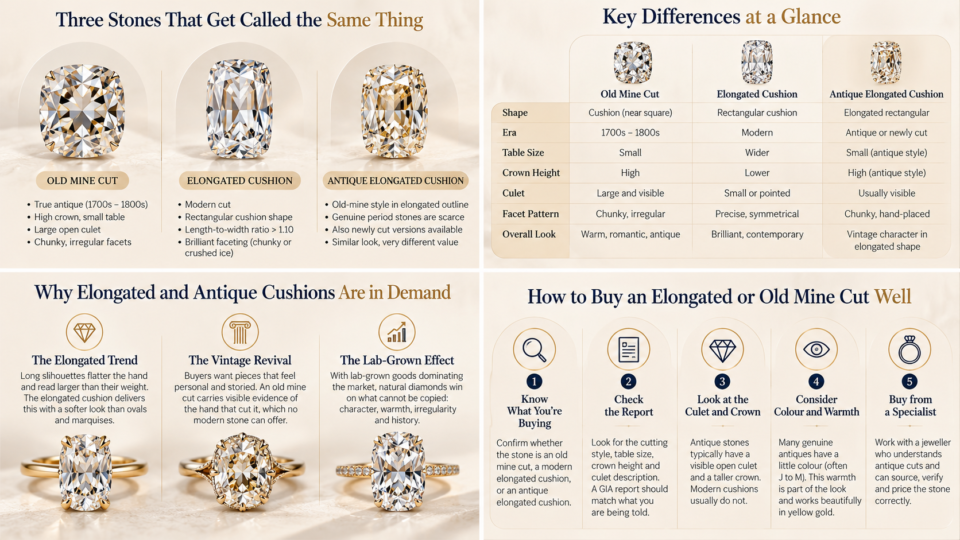
You will not always be able to from a photograph, and sellers do not always say. These are the tells we use:
The Culet
Antique stones nearly always show a visible open culet from the face-up view. Modern elongated cushions usually have a pointed or very small culet.
The Table and Crown
Old mine cuts have a small table and a tall, steep crown. Modern cushions have a wider table and a lower profile.
The Facet Pattern
Antique facets are broad, slightly uneven and hand-placed. Modern cushions show precise, symmetrical faceting, particularly in crushed-ice styles.
The Report
A GIA report will describe the cutting style. Antique stones typically read as an old mine brilliant or a cushion modified brilliant with the antique proportions evident in the crown height and table size. A modern stone will read as a cushion brilliant or cushion modified brilliant with contemporary proportions. If a seller cannot tell you which the report says, ask why.
The Warmth
Many genuine antiques carry a little colour, often J to M, because the rough of the period was not sorted the way it is today. That warmth is not a flaw in this category; it is part of the candlelight look and yellow-gold settings were built around it.
The Buying Guide for Consumers
Decide Which of the Three Stones You Actually Want
Decide which of the three stones you actually want before you look at prices. A genuine period antique elongated cushion is the scarcest and carries the strongest provenance. A newly-cut antique-style stone gives you the look with more choice in size and colour, at a lower price. A modern elongated cushion gives you brilliance and a clean outline at the most accessible price. None is wrong; paying for one while receiving another is.
Judge Antiques Under Warm Light
Judge antiques under warm light. An old mine cut viewed under a jeweller’s cold spotlight will look dull next to a modern stone, because it is answering a different question. Ask to see it in daylight or warm indoor light, which is where it lives.
Look at the Culet Size Face-Up
Look at the culet size face-up. A modest open culet adds character. A very large one reads as a hole in the centre of the stone. Which side of that line a stone falls on is a matter of taste, and you should see it, not guess.
Check the Outline
Check the outline. Elongated cushions vary from nearly square to long rectangles. Ratios around 1.15 to 1.35 read as clearly elongated while staying soft. Antique outlines are often slightly irregular, which is charming up to a point and clumsy beyond it. Look at the stone from directly above.
Embrace the Warmth, Within Reason
Embrace the warmth, within reason. A K or L antique in yellow gold is the look. A brown-tinged or grey stone is not warmth, it is a mask, and should be priced as one.
Never Let Anyone Recut a Genuine Antique
Never let anyone recut a genuine antique to “improve” it. A recut old mine cut becomes a small modern cushion with no antique value. If a period stone has a chip, a sympathetic repair that keeps the antique character is the answer, and a specialist should plan it.
Protect the Corners
Protect the corners. Cushions are forgiving, but antique girdles can be thin or uneven. A well-made setting with four or eight claws, or a bezel, is the right choice.
The Buying Guide for Retailers
Stock and Label All Three Stones
Stock all three stones and label them honestly on the tag; the client who has watched three videos about the celebrity ring will ask, and the store that answers first wins the sale.
Buying Period Antique Stones
For period antiques, buy on culet, crown and outline character rather than on the 4Cs, and price them on rarity and provenance.
Buying Newly-Cut Antique-Style Stones
For newly-cut antique-style stones, buy on how faithfully the cutter has reproduced the proportions; some “antique style” cushions are modern chunky cushions with a slightly larger culet and should not carry the antique premium.
Specifying Modern Elongated Cushions
For modern elongated cushions, specify chunky or crushed ice in the order, because a client who wanted one and receives the other will not be persuaded.
Planning for Lead Times and Matching
Long elongated cushions in fine make are in short supply, so plan lead times, and for pairs (earrings, three-stone rings) expect matching to take longer than for ovals: antique stones are individuals, and two that grade alike can read very differently side by side.
Pricing
There is no single price for this category because it is three categories.
Genuine Period Antique Elongated Cushions
Genuine period antique elongated cushions in size price on scarcity and provenance, and the celebrity moment has pushed asking prices for anything labelled “antique cushion” upward, including stones that do not deserve it.
Newly-Cut Antique-Style Stones
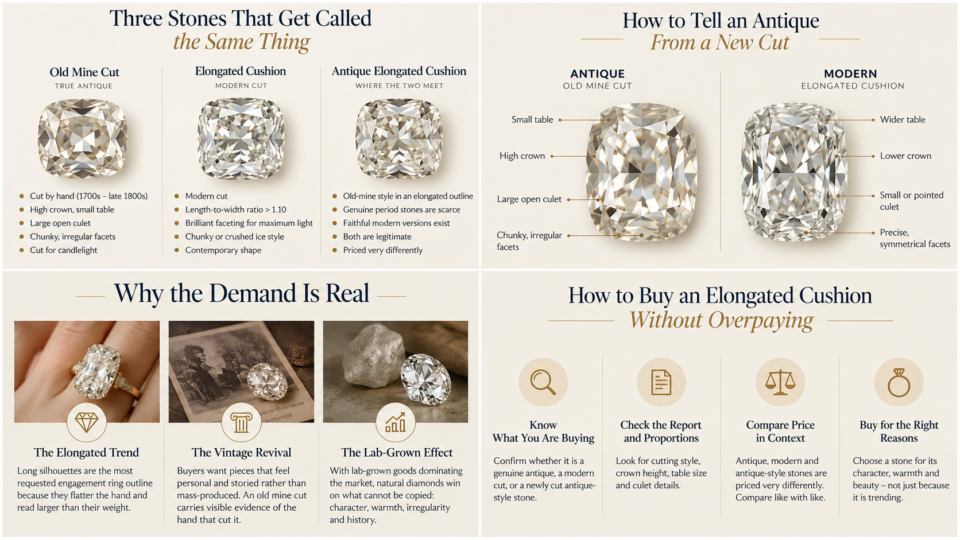
Newly-cut antique-style stones price on the labour of the traditional cut and the quality of the reproduction.
Modern Elongated Cushions
Modern elongated cushions price like any fancy shape, below a round of the same weight, with a premium for long, well-made stones because they are scarce.
Comparing Real Market Prices
We price all three against real comparables and, most importantly, tell you which one you are looking at before we tell you the number.
How Raremonds Helps
We supply genuine period old mine and antique elongated cushions sourced through our estate and specialist network, faithfully newly-cut antique-style stones made to traditional proportions, and modern elongated cushions in both chunky and crushed-ice character. Every stone is identified honestly as what it is, evaluated under the light it was cut for, documented on video, natural and untreated, and screened for laboratory growth regardless of its paper. Where a client’s dream stone does not exist in the market, our recut-to-match and custom-cut services complete a pair or create the outline to order, and our advice includes when not to touch an antique at all.
Send your requirement to Raremonds → WhatsApp Parth directly: +91 98193 47999
The Short Version
“Elongated cushion” and “old mine cut” are three different stones wearing two names: the hand-cut antique with its open culet and high crown, the modern rectangular brilliant, and the antique-style elongated cushion where the two meet. Demand is real and structural, driven by the elongated trend, the vintage revival and the natural-versus-lab divide, and supply of true period stones is fixed and shrinking. Buy by first deciding which stone you want, then judging antiques under warm light, reading the culet and crown, embracing honest warmth and refusing to recut a period piece. Retailers should stock and label all three, and expect matching to take time. We supply every version and name it before we price it.
FAQ
Is an Elongated Cushion the Same as an Old Mine Cut?
No. An old mine cut is a hand-cut antique cushion (roughly 1700s to late 1800s) with a high crown, small table and open culet. An elongated cushion is a modern rectangular cushion with brilliant faceting. The antique elongated cushion, made famous by the celebrity ring, combines old mine proportions with an elongated outline.
Why Did Old Mine Cut Diamonds Become So Popular in 2026?
A high-profile 2025 engagement ring featuring an antique elongated cushion sent searches for old mine cuts up nearly a thousand percent, and the wider vintage revival, the elongated-shape trend and the appetite for natural stones with character have kept demand high since.
How Do I Know if a Cushion Is a Genuine Antique?
Look for a visible open culet, a small table with a tall crown, broad slightly irregular hand-placed facets, and a laboratory report describing an old mine or antique cutting style. Newly-cut antique-style stones reproduce these features; a specialist can tell you which you are looking at.
Should I Recut an Old Mine Cut Diamond?
Almost never. Recutting removes the antique character and value, leaving a smaller modern stone. If a period stone is chipped, a sympathetic repair planned by a specialist preserves it.
What Length-to-Width Ratio Is Best for an Elongated Cushion?
Around 1.15 to 1.35 reads as clearly elongated while staying soft. Longer stones are dramatic but scarce and need careful evaluation for windowing and bow-tie.
Is Warmth a Problem in an Old Mine Cut?
Usually the opposite. Antique stones often carry J to M colour, which suits the candlelight look and yellow-gold settings. Grey or brown tints are different and should be priced as a mask.

.png)