

Ask a couple who cannot decide between an oval and a marquise what they actually want, and the answer is usually a moval. The name is a portmanteau of marquise and oval, and so is the stone: the long, tapering body of a marquise with the soft, rounded ends of an oval, so you get the finger-lengthening drama without the needle points.
It has moved from a collector’s curiosity to one of the most requested engagement ring silhouettes of the year, appearing in trend reports alongside the shapes it borrows from, and in the trade it has become the compromise shape for buyers torn between two loves.
We cut and source movals at Raremonds, and the questions arrive constantly: what exactly is it, why does every listing look different, is a natural one possible, and what should I check. This guide answers all of them, for the buyer choosing one stone and for the retailer deciding whether to stock the shape.
What a moval is, and why no two look the same
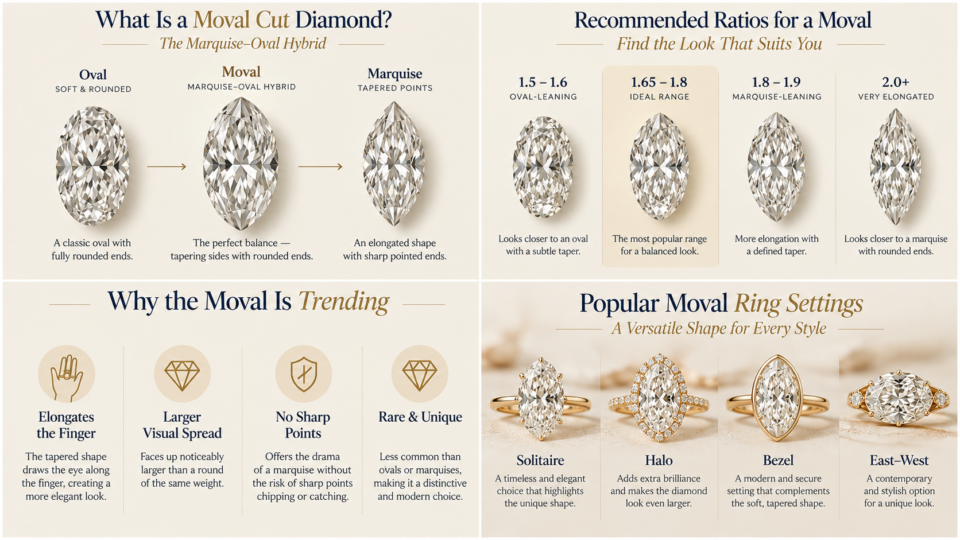
A moval is an elongated brilliant-cut diamond with a marquise’s tapering sides and an oval’s rounded ends. Picture a marquise whose two sharp points have been softened into gentle curves, or an oval that has been stretched and pinched toward each end. Faceting is usually a modified brilliant of around 60 to 70 facets, drawing on both parent shapes, so it sparkles like an oval with a more sculpted outline.
The thing every buyer must understand at the start: the moval is not a standardised cut. There is no single mandatory outline, no GIA shape category called “moval”, and no agreed ratio. One cutter’s moval leans toward oval; another’s leans toward marquise.
A laboratory report will describe the stone by its measurements and cutting style (typically a modified brilliant with an oval or marquise reference) rather than by the word moval. That freedom is why the shape feels handmade and individual, and it is why you buy a moval by looking at its outline, never by its name alone.
Ratio recommendations
Ratio recommendations in the market disagree for exactly this reason. Some houses cut movals around 1.5 to 1.7, closer to a long oval with a hint of taper; others go 1.75 to 2.0 and beyond, closer to a rounded marquise.
Our view: the shape earns its name from roughly 1.6 upward, where the taper is unmistakable, and the sweet spot for most hands and settings sits between about 1.65 and 1.9. Below that it reads as an oval; above 2.0 it reads as a marquise with the points removed. Decide which end of the spectrum you want, then look at candidates on video against a ruler.
Why the moval is trending
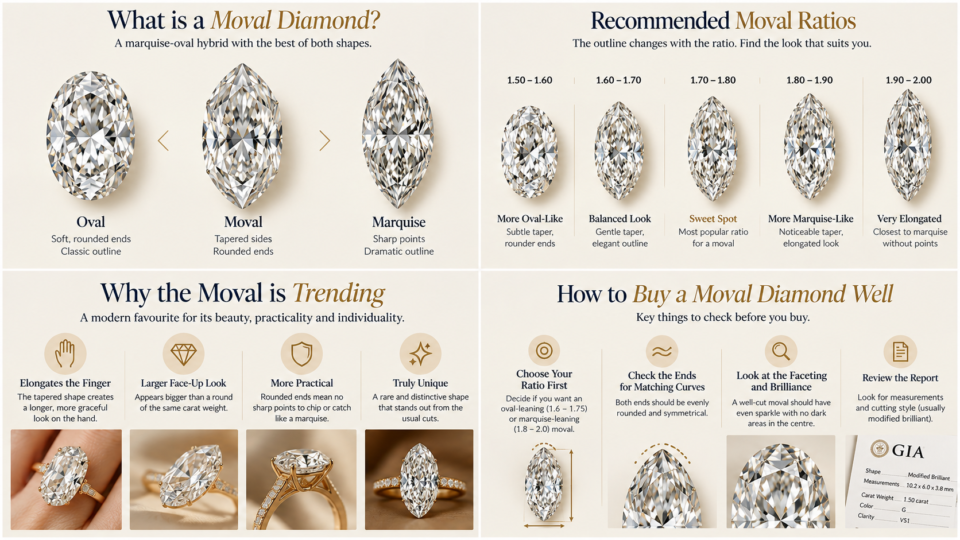
Elongated shapes are the most requested engagement ring outlines of 2026, and the moval is arguably the purest expression of the trend: its taper draws the eye along the finger more effectively than an oval, while its rounded ends keep more visual weight than a marquise. It also faces up noticeably larger than a round of the same weight, which is the practical reason it leads order books rather than the romantic one.
Why Buyers Are Choosing the Moval
Two more things drive it. It avoids the marquise’s known weaknesses: no sharp points to chip or catch, no severe geometry for buyers who find the marquise too dramatic. And it is genuinely rare on other hands, which in a market where individuality is the brief is a feature that sells itself.
Designers have noticed: movals appear in bezels, east-west settings, hidden halos and vintage-style mounts, and an antique-style “old mine moval” (old-cut faceting in the moval outline) has emerged for buyers who want the shape with a candlelight glow.
The supply reality
Most movals on the market are lab-grown. The reason is rough yield: natural cutters plan every stone to maximise weight from the crystal, and a tapered elongated outline wastes more material than a round or a standard oval, so natural cutters rarely produce movals unless a client orders one. Lab-grown rough is cheap and abundant, so growers can supply the shape in any ratio within weeks.
Natural Moval Buying Options
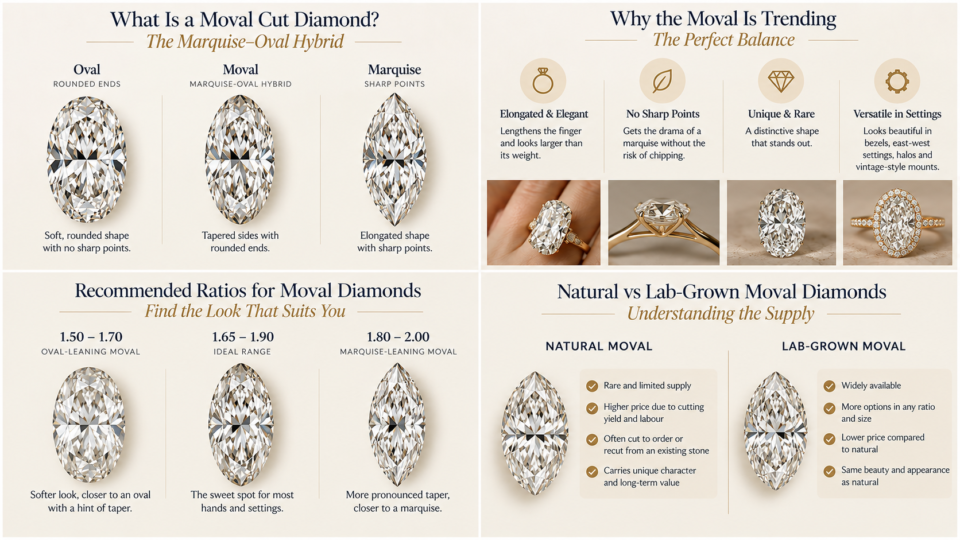
For a buyer who wants a natural moval, that means two honest routes: a small pool of natural stones already cut, usually found through a specialist rather than a marketplace, or a stone cut to order from suitable rough or recut from an existing long oval or marquise. Recutting is often the elegant answer: a marquise with a chipped point, or a long oval a client finds too plain, becomes a moval with modest weight loss and a more distinctive outline.
A natural moval carries a premium for the labour and yield of cutting it, not for the name, and that should be shown to you against a comparable oval before you pay it.
The buying guide for consumers
Choose Your Ratio First
Choose your ratio first, then look. Decide whether you want an oval-leaning moval (around 1.6 to 1.75) or a marquise-leaning one (1.8 to 2.0), and look only at stones in that band. Ask for the ratio and view the outline face-up against a straight edge.
Check the Ends for Matching Curves
Check the ends for matching curves. Both rounded ends must be the same shape and sit on the centre line. A moval with one fuller end reads as a badly cut pear. Symmetry across both axes is the first thing to inspect from directly above.
Watch the Bow-Tie
Watch the bow-tie. Like every elongated brilliant, a moval can show a dark band across its centre. You want a dynamic bow-tie that shifts as the stone moves, not a fixed shadow. Insist on video under normal room light, not a sparkle reel.
Check Depth and Windowing
Depth and windowing. A moval cut too shallow for spread goes glassy in the middle; too deep, it darkens and faces up small. Ask for depth percentage and, more usefully, look at the stone tilting on video.
Evaluate Colour
Colour. Elongated shapes hold a little colour toward the ends. G to H reads white in platinum or white gold; H to J looks warm and beautiful in yellow gold. See it in the intended metal.
Evaluate Clarity
Clarity. Brilliant faceting hides more than a step cut would, so eye-clean SI1 is often excellent value; avoid a feature that sits dead under the table, where the long axis magnifies it.
Choose the Right Setting
Setting. The rounded ends are safer than marquise points but still narrower than an oval’s. Prongs at the ends, a half-bezel or a full bezel protect the stone; east-west orientation suits the taper beautifully.
Confirm Origin on the Report
Confirm origin on the report. Given how much of the category is lab-grown, ask whether the stone is natural and ask for a laboratory report that states it. The report will not say “moval”; that is normal.
The buying guide for retailers
Stock Contrasting Moval Ratios
The moval is a conversation stone: it sells to the client who came in for an oval and a marquise and left with neither. Stock one or two well-cut examples at contrasting ratios (one oval-leaning, one marquise-leaning) so the client can see the spectrum, and film both in motion. Train staff on the ratio question, because it is the whole sale.
Plan for Natural Moval Supply
For natural movals, plan on cut-to-order and recut routes rather than off-the-shelf supply; a supplier with custom-cut, made-to-spec and recut-to-match capability is the realistic source. Recut-to-moval is also a genuine service to offer clients with a damaged marquise or an unloved long oval. Matched moval pairs for drop earrings are striking and take time to assemble; quote lead times honestly.
Pricing
Moval Pricing Compared With Other Elongated Shapes
A moval prices off the elongated fancy-shape market, in the same territory as a fine oval or marquise of equivalent weight and quality, with a cutting premium in natural diamond for the labour and rough cost of producing it to order.
Lab-grown movals are inexpensive and plentiful, which is worth knowing when a “natural moval” is offered at a lab-grown price. We price every moval against a comparable oval and show the difference, and we say plainly when a superb oval would serve a client better than an ordinary moval.
How Raremonds helps
We supply movals the honest way: the few natural stones we can source ready-cut, stones cut to order through our custom-cut service to your exact ratio, and recuts that turn an existing marquise or long oval into a moval with minimal weight loss.
Every stone is checked for end symmetry, bow-tie behaviour and windowing, documented on video in motion, natural and untreated, and screened for laboratory growth regardless of its paper. Pairs are matched by eye, side by side, before either stone is confirmed.
Send your requirement to Raremonds → WhatsApp Parth directly: +91 98193 47999
The short version
A moval is a marquise-oval hybrid: a tapering elongated body with rounded ends, sparkling like an oval and stretching the finger like a marquise, without the chip-prone points. It is trending because elongation is the look of 2026 and the moval is its purest, rarest form. It is not standardised, so ratios and outlines vary by cutter; decide oval-leaning or marquise-leaning first and buy on the outline you see.
Most supply is lab-grown; natural movals are scarce and usually cut to order or recut from a marquise or long oval. Check end symmetry, bow-tie, windowing, colour in the intended metal, and confirm origin on the report. Retailers should stock two contrasting ratios and treat the shape as bespoke.
FAQ
What is a moval cut diamond?
A hybrid of the marquise and the oval: an elongated brilliant with a marquise’s tapering sides and an oval’s rounded ends. It reads as an oval with a more sculpted outline, or a marquise without the sharp points.
Is a moval the same as an elongated oval?
Not quite. An elongated oval keeps evenly curved sides; a moval narrows noticeably toward the ends. The taper is the defining feature, and most cutters regard the shape as a true moval from around a 1.6 ratio upward.
What ratio should a moval be?
Recommendations vary because the cut is not standardised. Roughly 1.6 to 1.75 reads oval-leaning; 1.8 to 2.0 reads marquise-leaning. Choose the end of the spectrum you prefer and look at the outline on video.
Does a moval have a bow-tie?
It can, like any elongated brilliant. A well-cut moval shows a dynamic bow-tie that moves with the stone; a poorly cut one shows a fixed dark band. Check under normal room light.
Are natural moval diamonds available?
Yes, but they are scarce because the outline wastes rough. Most movals on the market are lab-grown. Natural stones are usually cut to order or recut from an existing marquise or long oval.
Can a marquise be recut into a moval?
Yes, and it is often the best answer for a marquise with a chipped point. The points are softened into curves with modest weight loss, producing a more wearable and distinctive stone. We plan and quote every recut before the wheel turns.

.png)