

For most of the modern era, an engagement diamond meant a round brilliant, and a “fancy shape” meant one of a handful of alternatives that still sparkled the same way.
That is no longer the market. Ovals, pears and marquises are outselling what they did even two or three years ago, hybrids like the moval and the Dutch marquise are being asked for by name, and a quieter shift is happening inside those outlines: buyers are asking for the pear, the oval and the marquise cut as step cuts, with the long, calm, hall-of-mirrors facets of an emerald cut inside a silhouette that has always been brilliant-faceted.
This is not a novelty. It is the meeting point of the three strongest currents in fine jewellery right now, and it is producing stones the trade had barely seen five years ago.
We cut and source these goods at Raremonds, and this guide explains why the demand exists, what a step-cut elongated stone actually is, where the supply comes from, and how consumers and retailers should buy them without the mistakes that a new category always invites.
Why Buyers Want Something Different Now
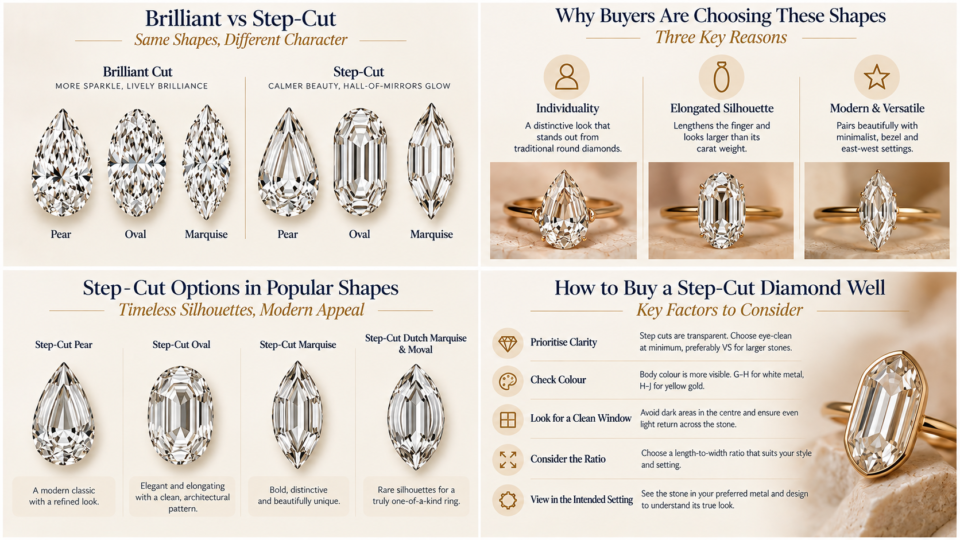
Individuality has become the brief. The couples buying now are not interested in doing what everyone else did. Bridal coverage for 2026 is explicit about it: the through-line of the season is personality, not tradition.
A round brilliant is the most standardised object in the diamond world; an elongated stone varies in ratio, outline and faceting from cutter to cutter, so no two are alike. That variation, once a drawback, is now the point.
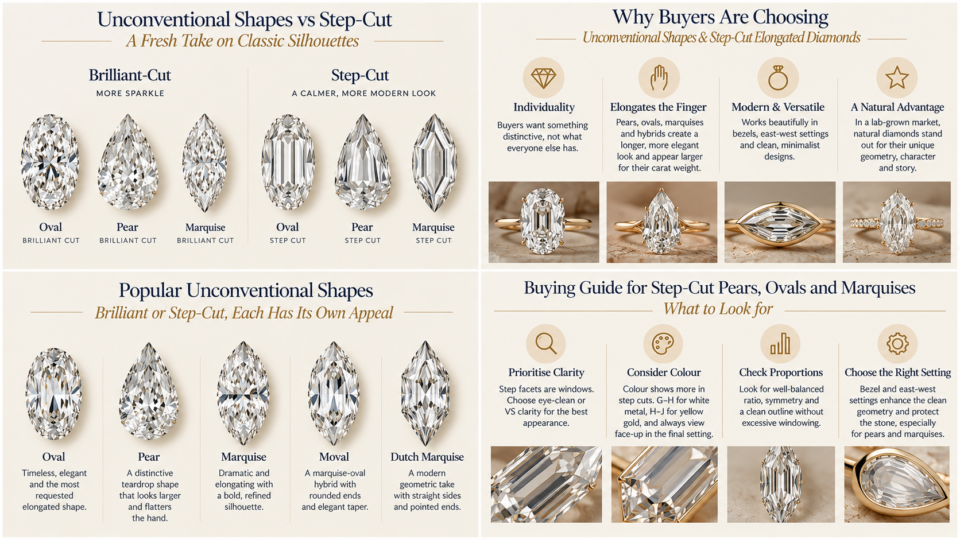
Elongation is the look. Oval has climbed to near parity with round for engagement rings. Pear and marquise have followed, because long shapes lengthen the finger and read larger than their carat weight. Every unconventional outline that is trending shares that quality: it draws the eye along the hand.
The Lab-Grown Divide Has Changed What Natural Is For
The lab-grown divide has changed what natural is for. With lab-grown goods dominating the commodity centre stone, the natural diamond that wins is the one that cannot be copied off a shelf: distinctive geometry, character, a story, a cut nobody else’s ring has. Unconventional shapes are the most visible expression of that. They are also, for retailers, the least list-shoppable inventory on the counter.
What a Step-Cut Pear, Oval or Marquise Actually Is
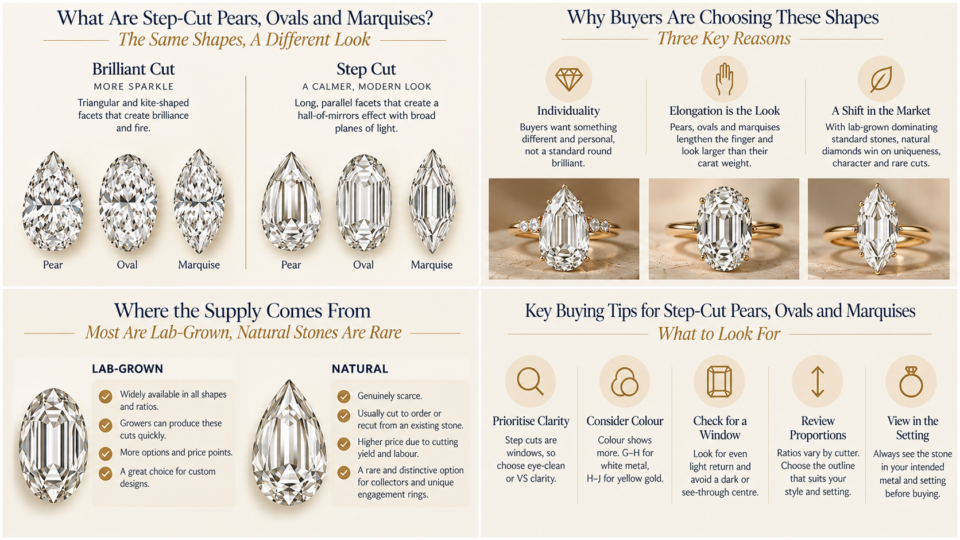
Take the outline of a pear, an oval or a marquise, and instead of the triangular and kite-shaped brilliant facets that fragment light into sparkle, cut it with long, parallel step facets running with the outline, the way an emerald or Asscher is cut.
The stone stops flashing and starts glowing: broad planes of light, a clean architectural interior, a hall-of-mirrors depth that changes as the hand moves. It is the emerald cut’s temperament in a shape the emerald cut never had.
Why Buyers Choose Step-Cut Elongated Shapes
Buyers reach for it for three reasons. It is calmer and more modern than sparkle, which suits the minimalist and bezel-set designs of the moment. It reads as unmistakably custom, because almost nobody else has one.
And it pairs with east-west settings and clean gold bands better than a brilliant does. The step-cut pear in particular has become a genuine category of its own; step-cut ovals and step-cut marquises (including step-cut Dutch marquises) follow close behind, along with step-cut movals and hexagons.
Where the Supply Comes From, Honestly
Most step-cut pears, ovals and marquises on the market are lab-grown, for the same reason the Dutch marquise and the moval are: growers can chase a specialty trend in months, while natural cutters plan every stone to maximise weight from the rough, and a step cut in an unusual outline wastes material.
Natural step-cut elongated stones are scarce and are usually cut to order or recut from an existing stone. That scarcity is the opportunity for a buyer who wants natural, and it is why this category belongs with a house that can cut to spec rather than with a search bar. A natural step-cut pear is bespoke almost by definition.
The Buying Guide for Consumers
Step cuts change the rules, so the checklist is different from a brilliant’s.
Clarity Moves to the Top
Clarity moves to the top. Step facets are windows. An inclusion that a brilliant would hide sits in plain view under those long planes. Buy eye-clean at minimum, and prefer VS clarity for anything above a carat; SI works only when the feature is at the edge and you have seen it on video.
Colour Shows More
Colour shows more. With less sparkle to mask it, body colour reads plainly, especially at the point of a pear or the tips of a marquise. G to H in white metal, H to J in yellow gold, and see the stone face-up in the intended metal before deciding.
There Is No Bow-Tie, but There Is a Window
There is no bow-tie, but there is a window. Brilliant elongated stones have the bow-tie problem; step-cut ones have the opposite risk, a “dead” or see-through centre when the pavilion is cut too shallow. Rock the stone on video: the steps should light up in sequence, not go glassy in the middle.
Outline Symmetry Is Everything
Outline symmetry is everything. A lobe that is uneven, a point that wanders off centre, wings that do not match: step faceting makes each of these more visible, not less, because the parallel lines give the eye a ruler. Look from directly above.
Ratio to Taste, but See It First
Ratio to taste, but see it first. A step-cut pear reads well around 1.45 to 1.65, an oval around 1.35 to 1.55, a marquise closer to 1.8 to 2.0. Longer stones look more dramatic and need more careful cutting to avoid windowing.
Protect the Points and Corners
Protect the points and corners. A pear point or marquise tip is as vulnerable in a step cut as in a brilliant. V-prongs, bezels and half-bezels are the correct settings, and the settings that suit the look anyway.
Confirm Origin on the Report
Confirm origin on the report. Because so much of the category is lab-grown, ask whether the stone is natural and ask for a laboratory report stating it. The report will describe the outline and the step-cut faceting style; it will not carry a cut grade, because no fancy shape does.
Know What You Are Paying For
Know what you are paying for. A natural step-cut elongated stone carries a premium for cutting labour and rough yield, not for the outline being fashionable. A supplier should be able to show you the premium against a comparable brilliant-cut stone of the same outline.
The Buying Guide for Retailers
Stock a Small Number of Exceptional Pieces
This category sells on explanation, so it rewards a trained counter more than a full one. Stock a small number of exceptional pieces rather than a tray; the client who wants a step-cut pear has already decided against the ordinary and will pay for the right stone, not the nearest one.
Photograph and film these stones in motion, because a step cut’s beauty is sequential and a still image undersells it.
Label Origin and Set Clear Clarity Standards
Label origin on every tag and be ready for the question. Specify clarity windows tighter than you would for brilliants, because a step-cut return is nearly always an inclusion the client can see.
And treat these as bespoke inventory: cut-to-order, recut-to-match and made-to-spec are the realistic supply routes for natural goods, so a supplier with those services replaces the marketplace for this category. Matched pairs (step-cut pear drops are extraordinary) take longer than brilliant pairs; plan the lead time.
Pricing
Brilliant-Cut vs Step-Cut Pricing
Brilliant-cut pears, ovals and marquises price against the elongated fancy-shape market, below rounds of the same weight. Step-cut versions in natural diamond price above their brilliant equivalents, because they are cut to order and cost rough to make, and because well-cut examples are scarce.
Hybrids like the moval and the Dutch marquise carry a similar scarcity premium. None of these premiums should be paid blind: we price against the comparable brilliant stone and show the difference, and if a client would be better served by a superbly cut brilliant oval than a step-cut one, we say so.
How Raremonds Helps
We supply the unconventional-shape market from both directions: the few natural step-cut pears, ovals and marquises that exist ready-cut, sourced through our network, and stones cut to order through our custom-cut and made-to-spec services, or recut from an existing elongated stone into a step cut.
Every stone is checked for outline symmetry, windowing and clarity visibility through the facets, documented on video in motion, natural and untreated, and screened for laboratory growth regardless of its paper. Pairs are matched by eye, side by side, and quoted with honest timelines.
Send your requirement to Raremonds → WhatsApp Parth directly: +91 98193 47999
Conclusion:
Buyers want unconventional shapes because individuality is the brief, elongation is the look, and a distinctive natural stone is the thing lab-grown cannot copy. Inside that trend, the step-cut pear, oval and marquise put emerald-cut calm into elongated outlines, and they have become a category of their own.
Most supply is lab-grown; natural step-cut elongated stones are scarce and usually cut to order. Buy them on clarity first, colour second, outline symmetry always, watch for windowing rather than bow-tie, protect the points, confirm origin on the report and understand the cutting premium. Retailers should stock few, film them in motion, and treat them as bespoke.
FAQ
What is a step-cut pear diamond?
Why are step-cut pears, ovals and marquises trending?
Do step-cut elongated diamonds have a bow-tie?
Are natural step-cut pears and ovals available?
What clarity do I need for a step-cut shape?
Can Raremonds cut a step-cut pear or oval to order?

.png)